
Praxis Physics 5266 Practice Test 2026 | Exam Prep Questions
$69.00
- Buy to unlock unlimited access to all Quiz questions and Answers in this Quiz.
- After purchase you can print a PDF of the whole quiz at any point. The PDF will contain the questions and the correct answers.
About this Exam
The Praxis Physics (5266) test is a rigorous subject assessment designed specifically for individuals aiming to become secondary school physics educators. This exam serves as a standard requirement for teacher licensure in many states, ensuring that prospective teachers possess the deep content knowledge necessary to lead a high school classroom effectively. The exam is designed for those who have typically completed a bachelor’s degree program in physics or physics education. Passing this exam demonstrates that you are ready to instruct students in the fundamental principles that govern the physical universe.
Ready to test your knowledge?
Buy Now to Access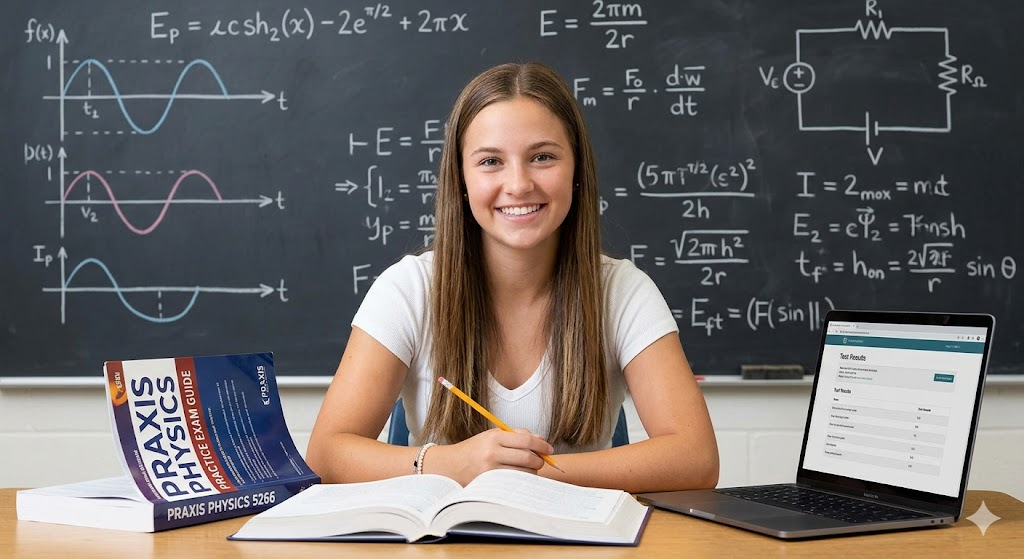
Additional Information
What the Course Entails and Exam Details
To succeed on the Praxis Physics 5266 exam, you must have a comprehensive command of university-level physics concepts and the nature of science itself. The assessment covers a wide range of core topics outlined by ETS.
Candidates must demonstrate proficiency in Classical Mechanics, including kinematics, dynamics, vector analysis, and fluid mechanics. A significant portion of the exam is dedicated to Electricity and Magnetism, covering topics such as electrostatic fields, circuits, and electromagnetic induction. You must also understand the principles of Optics and Waves, including light behavior and wave properties.
Furthermore, the syllabus includes Thermodynamics and Statistical Mechanics, assessing knowledge of heat transfer and kinetic theory. Finally, the test covers Modern Physics, focusing on atomic structure and radioactivity, as well as the overarching Science, Technology, and Society (STS) category, which tests understanding of the scientific method and safe laboratory practices.
What to Expect in the Final Exam
The Praxis Physics 5266 is a computer-delivered test. You should prepare for an intense assessment designed to measure both your conceptual understanding and your ability to apply mathematics to solve physical problems.
The format consists entirely of multiple-choice questions. There are approximately 125 questions in total. You will have a time limit of 2.5 hours to complete the entire exam.
The questions are divided between discrete questions (stand-alone items) and sets of questions based on common stimuli (like data sets, graphs, or scenarios). The scoring ranges from 100 to 200, but the passing score varies by state or licensing agency. It is crucial to check the specific requirement for the state where you are seeking licensure. Note that an on-screen scientific calculator is provided for use during the exam, as standard scientific calculators are not permitted in the testing room.
How to Study and Exam Centers
Effective preparation for this exam requires a strategic blend of content review and practical application. Utilizing high-quality Praxis Physics 5266 practice test resources is perhaps the most crucial component of a study plan.
Start by downloading the official ETS Study Companion to review the detailed breakdown of categories and the types of questions used. Practice with full-length exams to build your test-taking stamina and to identify specific content weaknesses. Many candidates find that timing themselves during practice sessions helps significantly with managing the 2.5-hour constraint. Review standard college physics textbooks and focus heavily on solving numerical problems, not just memorizing concepts.
The exam is administered by Educational Testing Service (ETS). To take the test, you must register through your ETS account online. Testing is available by appointment at hundreds of authorized Prometric testing centers globally. In addition to these physical centers, some states offer the option for at-home testing via an online-proctored environment, provided your computer and testing space meet strict technical and security requirements.
Job Opportunities from the Course
Achieving a passing score on the Praxis Physics 5266 exam and securing licensure opens immediate and highly demanded career opportunities. Physics educators are currently among the most sought-after professionals in the education sector.
Public High School Physics Teacher (Grades 9-12)
Private School Physics Instructor
Science Department Chair (with experience)
Physics Tutor (Online or In-person)
Curriculum Developer specializing in Physical Sciences
Advanced Placement (AP) or International Baccalaureate (IB) Physics Teacher
STEM Coordinator for school districts
Educational Content Writer for Science Publishers
Frequently Asked Questions
Reviews
5.0
Based on 0 reviews
Leave a Review
No reviews yet. Be the first to review!