
Praxis Teaching Reading: Elementary (5205) Practice Test
$69.00
- Buy to unlock unlimited access to all Quiz questions and Answers in this Quiz.
- After purchase you can print a PDF of the whole quiz at any point. The PDF will contain the questions and the correct answers.
About this Exam
The Praxis Teaching Reading: Elementary (5205) exam is a crucial step for aspiring elementary school educators, designed to measure whether state licensure candidates have the knowledge and skills necessary to teach reading effectively. This comprehensive assessment is typically taken by individuals seeking certification as elementary school teachers, reading specialists, or literacy coaches. Developed by educational experts in collaboration with the Educational Testing Service (ETS), this exam ensures that teachers possess a deep understanding of evidence-based reading instruction, empowering them to support diverse learners in mastering fundamental literacy skills. Passing this test signifies a candidate's readiness to cultivate strong, proficient readers in grades K-5.
Ready to test your knowledge?
Buy Now to Access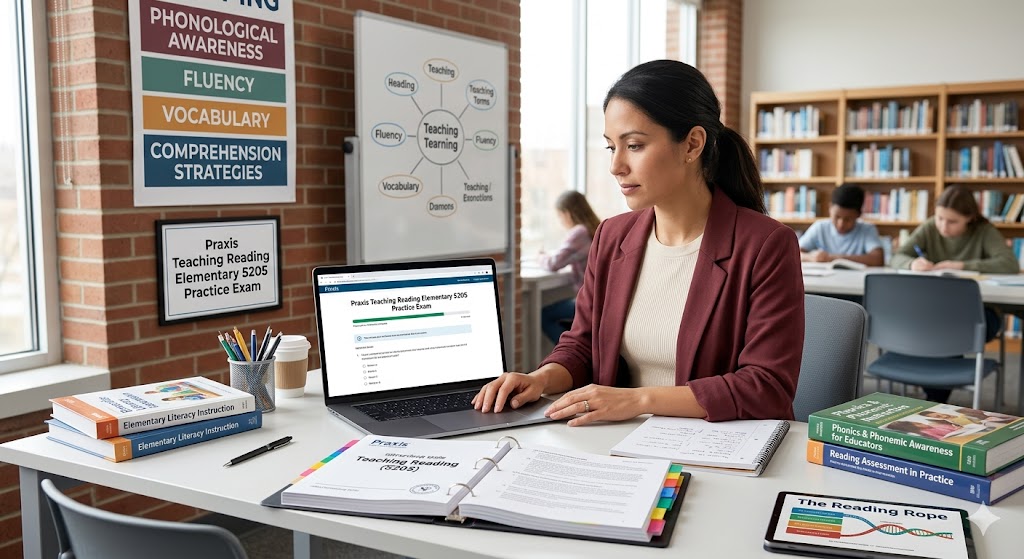
Additional Information
What the Course Entails and Exam Details
This examination is not just a test of a candidate’s reading ability, but of their pedagogical content knowledge for teaching reading. The Praxis 5205 exam is rigorously structured to cover the spectrum of essential literacy components. Candidates must demonstrate proficiency in understanding the five pillars of reading (Phonemic Awareness, Phonics, Fluency, Vocabulary, and Comprehension) as well as the overarching assessment and instructional strategies needed for diverse classrooms. The exam will require candidates to analyze student reading behaviors, select appropriate instructional interventions, interpret assessment data to guide instruction, and demonstrate an understanding of the writing process and its relationship to reading. Mastering this content validates a candidate's ability to plan and implement effective, research-based reading programs for all elementary students.
What to Expect in the Final Exam
The Praxis Teaching Reading: Elementary (5205) exam consists of 90 selected-response (multiple-choice) questions and 3 constructed-response (essay) questions, administered over a total testing time of 2 hours and 30 minutes. The selected-response section contributes approximately 75% of the total score, while the constructed-response section accounts for the remaining 25%. Candidates must be prepared to synthesize their knowledge of multiple domains to analyze complex student scenarios. The passing score threshold is not uniform; it is set by individual states or licensing agencies, typically ranging from 150 to 160 on a scale of 100-200. It is imperative that candidates check the specific requirements for their state licensing board before scheduling their exam to understand the score needed for certification.
How to Study and Exam Centers
Effective preparation for the Praxis 5205 exam requires a multi-faceted approach. Candidates should begin by downloading the official ETS Study Companion, which provides a detailed syllabus and sample questions. Utilizing official full-length Praxis practice tests is vital for acclimating to the exam format and time constraints. A strong study plan must include deep dives into key concepts, such as the differentiation between phonological awareness and phonemic awareness, and the specific constructed-response rubric criteria. Many successful test-takers use flashcards for defining pedagogical terms and practice analyzing diverse children’s literature through an instructional lens. The examination is administered year-round by ETS at hundreds of certified testing centers globally, often located at universities, community colleges, and professional testing facilities like Prometric. Additionally, Praxis now offers an "At Home" testing option, allowing candidates to take the exam from a secure, private location via online proctoring.
Job Opportunities from the Course
Successfully passing the Praxis Teaching Reading: Elementary (5205) exam is often a foundational requirement for obtaining state licensure, which opens the door to numerous impactful career paths focused on early literacy. While passing the exam is just one component of overall teaching certification, this specialization enables educators to assume roles such as:
Certified Elementary School Teacher (Grades K-5/K-6)
Elementary Reading Specialist
Title I Reading Teacher
Reading Interventionist
Literacy Coach (K-5)
Curriculum Developer for Elementary Language Arts
Private Reading Tutor (Specializing in Elementary Education)
Adult Literacy Educator (Utilizing foundational reading knowledge)
Instructional Coordinator focusing on Elementary Literacy Programs
Frequently Asked Questions
Reviews
5.0
Based on 0 reviews
Leave a Review
No reviews yet. Be the first to review!