
Praxis Technology and Engineering Education 5053 Practice Test 2026 | Exam Prep Questions
$69.00
- Buy to unlock unlimited access to all Quiz questions and Answers in this Quiz.
- After purchase you can print a PDF of the whole quiz at any point. The PDF will contain the questions and the correct answers.
About this Exam
The Praxis Technology and Engineering Education (5053) exam is a crucial component of the teacher certification process in numerous states across the US, specifically designed for candidates seeking to teach technology education or engineering courses in middle school or high school grades (typically 7-12). This exam validates that an individual possesses the subject-specific knowledge, conceptual understanding, and pedagogical skills necessary to effectively implement technology and engineering curricula. The test incorporates essential concepts from key educational standards, including the Technological Literacy Standards and concepts from the International Society for Technology Standards for Teachers. This guide is your ultimate resource to effectively prepare for the Practice Test 2026 and the final examination.
Ready to test your knowledge?
Buy Now to Access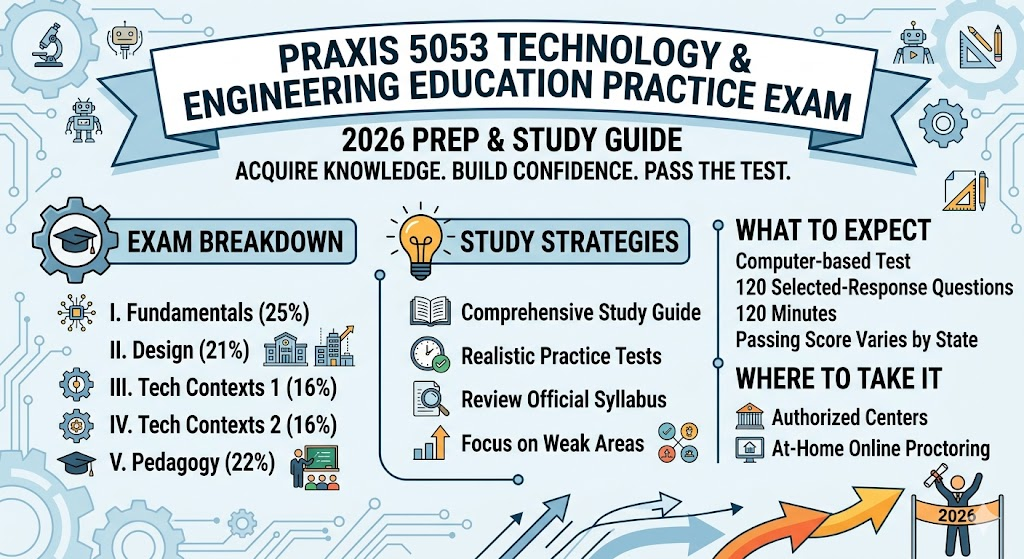
Additional Information
What the Course Entails and Exam Details
This examination does not follow a specific single course but rather assesses a broad base of knowledge across the entire technology and engineering education landscape, as well as necessary pedagogical understanding. Mastery in these core domains is essential not just for the exam, but for a successful career as an educator in this dynamic field. When reviewing study materials and engaging with exam prep questions for 2026, ensure your preparation covers the following content categories, derived directly from the official exam outline:
Fundamentals of Technology and Engineering: Core concepts, influences, and the historical context of technology and engineering, including technological systems, criteria, constraints, and innovation.
Design and Application of Products and Systems: The principles and processes of engineering design, problem-solving, and managing entire technical systems, including critical thinking, troubleshooting, and optimization.
Technology Contexts 1: Energy, Materials, and the Built Environment: Concepts related to energy, power, transportation, manufacturing, and construction technologies, including how they interact with each other and their impact.
Technology Contexts 2: Information, Computation, and Technological Applications: Knowledge of communication and information systems, digital technologies, computation, and automation.
Pedagogy and Professional Responsibilities: Assessment methods, classroom safety, instructional strategies, curricular planning, and understanding professional roles in the context of technology and engineering education.
What to Expect in the Final Exam
Here is a clear breakdown of the format, standard procedures, and scoring specifics for the final Praxis Technology and Engineering Education 5053 exam, to ensure no surprises on test day in 2026:
Format: The exam consists of 120 selected-response questions (also known as multiple-choice). Some questions may require you to select more than one correct answer or require specific interactive elements.
Time Limit: You will have 120 minutes (2 hours) to complete the entire test. This allows for approximately one minute per question, highlighting the importance of efficient time management during practice.
Delivery: The exam is administered exclusively via computer. You can take the test either at an authorized physical testing center or in a remote, at-home setting with online proctoring.
Scoring: Your score is based on the number of correct answers you provide (no penalty for guessing). This raw score is then converted to a scaled score.
Passing Score: The required passing score for licensure varies by state. It is crucial to verify the specific passing score requirements for the state(s) where you plan to be certified. ETS (Educational Testing Service) facilitates the exam, but individual states or agencies determine their passing thresholds.
Rules: Standard testing protocols apply, including providing official identification, securing personal belongings before the exam, and being subject to constant monitoring (either in person or remotely).
How to Study and Exam Centers
Effective preparation is the differentiator between simply attempting the exam and achieving your target score in 2026. Here are actionable study strategies and information on where you can take the test:
Powerful Study Strategies:
Engage with a Comprehensive Study Guide: Utilize a reputable study guide specifically tailored for the Praxis 5053 exam. These guides typically provide structured review, key term definitions, and in-depth explanations across all content categories. Ensure your resources are aligned with the 2026 curriculum.
Take Realistic Practice Tests: Actively incorporate a practice test series into your preparation routine. Regularly taking full-length, timed practice exams, including those focused on Practice Test 2026 questions, will help you:
Accustom yourself to the pacing and pressure of the actual exam.
Identify specific content areas where your knowledge is weakest, allowing for focused review.
Familiarize yourself with the types and phrasing of selected-response questions.
Review the Official Exam Outline: Start your preparation by downloading and thoroughly reviewing the official Praxis Technology and Engineering Education (5053) Study Companion from the ETS website. This document provides the most accurate and up-to-date breakdown of the content categories, subtopics, and the percentage weighting of each domain. Use this as your master checklist.
Practice Detailed Explanations: When working with exam prep questions for 2026, don't just find the correct answer; understand why it's correct and why the other options are not. Analyzing detailed answer explanations, often included in premium study resources and practice tests, is an incredibly effective way to deepen your understanding and correct misconceptions.
Utilize Flashcards: Create or use pre-made flashcards for quick and frequent recall of important technology and engineering terminology, concepts, historical figures, and pedagogical principles.
Form a Study Group: Consider connecting with colleagues, classmates, or fellow test-takers to discuss complex concepts, share resources, and quiz each other. Teaching a concept to someone else is a powerful reinforcement technique.
Testing Centers and Registration:
The Praxis exams are administered by ETS (Educational Testing Service). To take the test:
Online Registration: You must register for the exam through your official ETS Praxis account online.
Authorized Testing Centers: You can choose to take your computer-delivered test at a network of authorized testing centers, which are available across the US and include dedicated Pearson VUE and other certified facilities.
Remote/At-Home Testing: For increased flexibility, ETS offers the option to take the exam remotely from your home or another private location. This requires specific equipment (a dynamic webcam, reliable internet, a private room) and uses online proctoring via specialized software to ensure the integrity of the exam process.
Important: Locations, available dates, and specific rules (e.g., ID requirements, what you can bring, prohibited items) are detailed on the official ETS website. Always verify current policies and procedures, especially for any potential changes relevant to 2026. Do not arrive at a testing center until you have registered for the exam and scheduled your appointment.
Job Opportunities from the Course
Earning certification through the Praxis Technology and Engineering Education 5053 exam, paired with the requisite state-specific licenses and educational background, unlocks a variety of impactful and engaging career paths. Your knowledge from this comprehensive subject matter prepares you for roles such as:
Middle School Technology Education Teacher (Grades 7-8)
High School Engineering/Technology Teacher (Grades 9-12)
STEM (Science, Technology, Engineering, and Math) Coordinator/Educator
Career and Technical Education (CTE) Instructor (in technology-related fields)
Robotics and Automation Instructor
Curriculum Developer (specifically for technology/engineering education programs)
Instructional Coach (focused on technology integration)
Technical Trainer (within educational settings)
Preparing for the Praxis Technology and Engineering Education 5053 is a significant undertaking, but with dedication, strategic preparation, and the right resources, success is absolutely achievable in 2026. This comprehensive study guide provides the fundamental knowledge you need to begin your journey. Start with a self-assessment using the official syllabus, engage deeply with structured study materials and targeted practice questions, and approach your preparation methodically. With hard work, you'll be well on your way to earning your certification and shaping the tech and engineering leaders of tomorrow! Best of luck with your study!
Frequently Asked Questions
Reviews
5.0
Based on 0 reviews
Leave a Review
No reviews yet. Be the first to review!