
Prehospital Trauma Life Support (PHTLS) Post Test Practice
$69.00
- Buy to unlock unlimited access to all Quiz questions and Answers in this Quiz.
- After purchase you can print a PDF of the whole quiz at any point. The PDF will contain the questions and the correct answers.
About this Exam
Prehospital Trauma Life Support (PHTLS) is an internationally recognized continuing education program designed for prehospital emergency medical care providers. This course, developed by the National Association of Emergency Medical Technicians (NAEMT) in cooperation with the American College of Surgeons Committee on Trauma, focuses on the care of trauma patients in the field. Its primary goal is to improve the quality of trauma care and decrease mortality by teaching providers a systemic, evidence-based approach to assessing and treating patients.
PHTLS training is essential for a wide range of professionals, including Emergency Medical Technicians (EMTs), Paramedics, nurses, physician assistants, and other healthcare providers who operate in prehospital or initial emergency environments. Successfully passing the PHTLS post-test is a critical requirement to earn this vital certification.
Ready to test your knowledge?
Buy Now to Access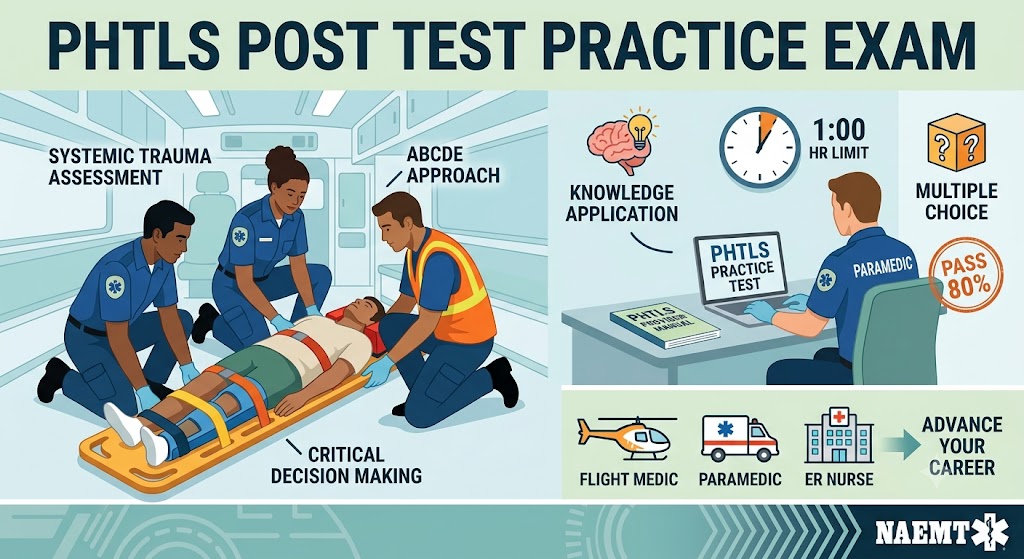
Additional Information
What the Course Entails and Exam Details
The PHTLS course provides comprehensive training on managing multi-system trauma. It goes beyond basic emergency care to focus on the definitive treatment strategies needed to stabilize patients before they reach a hospital. The course covers the standard PHTLS provider course and the newer, more intense PHTLS hybrid or modular options. Key topics and modules include:
Scene Management and Primary Survey (the ABCDE approach)
Airway Management and Ventilation Strategies
Shock Evaluation and Management, including fluid resuscitation
Assessment and Management of Thoracic Trauma
Assessment and Management of Abdominal Trauma
Head and Spinal Trauma management, including spinal motion restriction
Musculoskeletal and Burn Trauma Care
Special Populations (Pediatric, Geriatric, and Obstetric trauma)
Environmental Emergencies related to trauma
The Science of Trauma (understanding kinematics and mechanisms of injury)
The course and exam details are as follows:
Administering Body: National Association of Emergency Medical Technicians (NAEMT)
Course Format: Available as a classroom-based, instructor-led course or a hybrid course combining online learning with in-person skills practice.
PHTLS Post-Test: This is a multiple-choice examination designed to evaluate knowledge and decision-making skills.
What to Expect in the Final Exam
The PHTLS post-test is a crucial final step to certification. While specific details can vary by course provider and the edition of PHTLS being used, students can generally expect the following for the multiple-choice exam:
Number of Questions: Typically consists of 50 to 75 multiple-choice questions.
Format: The questions are designed to test not just factual recall, but also the ability to apply PHTLS principles to clinical scenarios.
Passing Score: A passing grade is typically 75% or 80%, depending on the specific program or institutional requirements.
Time Limit: Students are usually allowed between 1 and 1.5 hours to complete the written exam.
Proctoring and Rules: The written exam is typically proctored by an authorized PHTLS instructor. It is a closed-book examination.
In addition to the written test, students must also successfully pass a practical skills evaluation. This involves demonstrating proficiency in various trauma assessment and treatment scenarios, such as spinal motion restriction, advanced airway management, and rapid trauma survey.
How to Study and Exam Centers
Preparation for the PHTLS exam requires a dedicated effort, combining theoretical knowledge with practical skills. Here are actionable study strategies:
1. Study the Manual: The PHTLS provider manual is the definitive resource. Focus on algorithms and evidence-based recommendations.2. Utilize NAEMT Resources: NAEMT offers official study guides, practice questions, and online modules for course participants.3. Use PHTLS Post-Test Practice Exams: Take multiple practice tests. This will help you understand the question format and identify knowledge gaps.4. Practice Clinical Scenarios: Review and mentally practice the assessment and treatment algorithms for different types of trauma. Group study can be highly effective.5. Review the 'Dirty Dozen': Pay close attention to the most common life-threatening injuries and their immediate treatments.6. Hands-on Practice: For the practical component, spend ample time practicing skills like tourniquet application, needle decompression, and immobilization with colleagues or mentors.
Exam Centers and Testing Locations:
You cannot take the PHTLS post-test on demand at a standard testing center like Pearson VUE. It must be completed as part of an authorized PHTLS course. Here is how and where you can take the exam:
Authorized Training Centers: PHTLS courses are offered by numerous authorized training centers globally, including hospitals, EMS agencies, fire departments, and community colleges.
EMS Agencies and Fire Departments: Many departments host PHTLS training internally for their staff.
Educational Institutions: Colleges and universities with EMS education programs frequently offer PHTLS.
Course Finders: Use the course finder on the official NAEMT website to locate authorized training centers and scheduled courses near you. Upon successful completion of the course, including the written and practical evaluations, you will receive your PHTLS provider card.
Job Opportunities from the Course
A PHTLS certification is highly valued in the emergency medical services and healthcare fields. It demonstrates advanced knowledge and commitment to optimal trauma care, unlocking various career opportunities and potentially leading to career advancement or increased responsibilities.
Specific job titles and career paths this certification unlocks include:
Paramedic (both ground and flight)
Emergency Medical Technician (EMT)
Emergency Room Nurse (RN)
Trauma Nurse
Flight Nurse
Physician Assistant (PA) specializing in Emergency Medicine
Search and Rescue (SAR) Technician
Tactical Medic (Special Operations)
Industrial Medic / Occupational Health Provider
EMS Instructor
Military Combat Medic
Frequently Asked Questions
Reviews
5.0
Based on 0 reviews
Leave a Review
No reviews yet. Be the first to review!