
Prehospital Trauma Life Support (PHTLS) Practice Test
$69.00
- Buy to unlock unlimited access to all Quiz questions and Answers in this Quiz.
- After purchase you can print a PDF of the whole quiz at any point. The PDF will contain the questions and the correct answers.
About this Exam
Welcome to the definitive guide for your Prehospital Trauma Life Support (PHTLS) journey!
The PHTLS course is internationally recognized as the premier continuing education program for prehospital emergency medical care.
It is specifically designed for frontline healthcare providers—including EMTs, paramedics, nurses, physician assistants, and first responders—who are responsible for the initial assessment and management of trauma patients in the field.
By focusing on evidence-based care and the "why" behind every intervention, PHTLS empowers you with the critical thinking skills needed to make rapid, life-saving decisions under pressure.
Our practice materials are crafted to mirror this intensity and help you master the material.
Ready to test your knowledge?
Buy Now to Access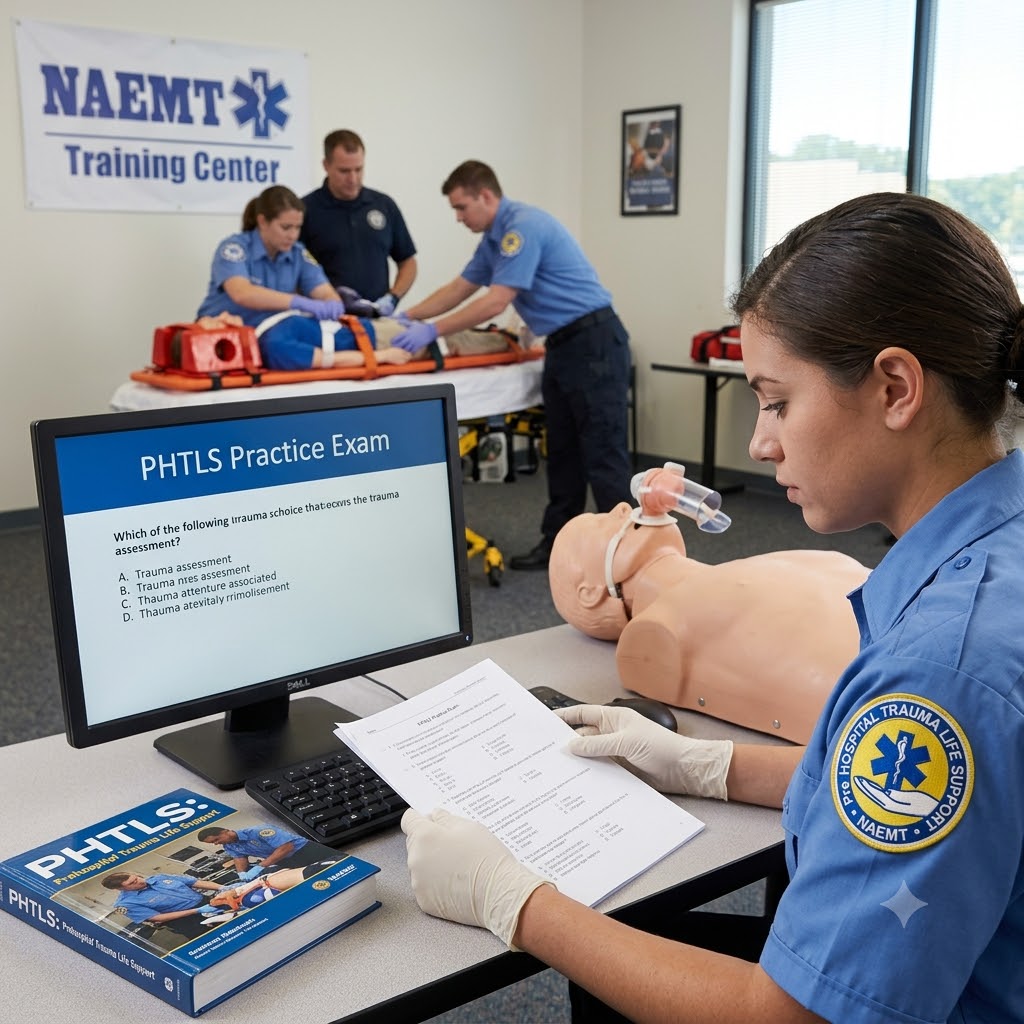
Additional Information
What the Course Entails and Exam Details
A standard PHTLS provider course is a comprehensive, multi-day educational experience.
The curriculum is rigorous, blending intensive classroom lectures with dynamic hands-on skills stations and scenario-based team practice.
You will delve deeply into the official NAEMT PHTLS textbook, which serves as the core curriculum for prehospital trauma care globally.
The key domains covered in the course and reflected in the final exam include:
The Science of Trauma: Understanding the kinematics and pathophysiology of injury.
Scene and Patient Assessment: Mastering the systematic PHTLS primary and secondary surveys (using the XABCDE priority approach).
Airway and Ventilation: Advanced techniques for airway management and adequate oxygenation in trauma.
Hemorrhage Control: Rapid identification and definitive management of life-threatening external and internal bleeding.
Shock: Recognition and physiology-based management of various shock states.
Specific Injuries: Comprehensive care for burns, thoracic trauma, abdominal trauma, musculoskeletal injuries, and head/spinal cord injuries.
Special Populations: Adjusting care for pediatric and geriatric trauma patients.
What to Expect in the Final Exam
The culmination of the PHTLS provider course involves a challenging written final exam.
This exam is designed to test your critical thinking and ability to apply the PHTLS principles in complex, real-world scenarios, rather than just rote memorization.
Here is what you should expect regarding the test format:
Question Format: The test consists of multiple-choice questions. A significant portion of these questions are case scenarios that present a patient's condition and ask you to determine the next best step, the priority intervention, or the underlying pathophysiology.
Passing Score: A passing grade is typically set around 76% (or a minimum score defined by the current NAEMT standards), demonstrating competency in core concepts.
Time Limit: You will have a defined time limit to complete the written exam, which is usually around 60 to 75 minutes.
Integration with Practical Skills: It’s important to note that the written exam is just one component of earning your certification. You must also successfully pass the practical scenario-based skills stations conducted during the course.
Retest Policy: Policies regarding retesting for the written component vary by training center but generally allow for one rewrite if the initial attempt is unsuccessful.
How to Study and Exam Centers
Preparation is paramount for success on the PHTLS exam. Here are the most effective strategies to prepare:
Start with the Source: The PHTLS: Prehospital Trauma Life Support textbook is the foundation of the exam. Read it thoroughly, prioritizing chapters on assessment, hemorrhage control, and shock management.
Utilize Official Pre-tests: NAEMT often provides official pre-tests and study guides to course participants. Complete these early to identify your weak points.
Practice, Practice, Practice: Engage in numerous high-quality practice tests (like the ones offered here). Our questions are specifically modeled after the style and difficulty of the official PHTLS written exam, helping you become familiar with scenario-based testing.
Master the XABCDE Assessment: You must be able to perform a rapid and thorough trauma assessment flawlessly. Practice this systematic approach repeatedly, speaking the steps out loud.
Form a Study Group: Reviewing scenarios and discussing pathophysiology with peers can deepen your understanding of complex topics.
Where and How to Take the Exam: Authorized Centers
It is essential to understand that the PHTLS written exam is not administered as a standalone test at general testing centers like Pearson VUE.
Because PHTLS is a continuing education course, the written and practical exams are always integrated into a formal, authorized PHTLS provider class.
To earn your certification, you must:
Locate a Course: Find an authorized NAEMT training center. These are typically EMS academies, fire departments, hospitals, and community colleges that hold official NAEMT accreditation.
Register and Attend: Enroll in and attend the full classroom-based or hybrid PHTLS course.
Complete the Assessment: The written final exam will be administered by the instructors in a proctored environment at that training location immediately following the completion of the course curriculum.
Job Opportunities from the Course
A PHTLS certification is highly sought after by employers across the spectrum of emergency services.
For many high-performance EMS agencies, critical care transport services, and fire departments, it is either a mandatory prerequisite or a heavily preferred credential that demonstrates an advanced level of commitment and capability.
Achieving this certification unlocks and advances careers in multiple roles, including:
Paramedic (911 and Critical Care Transport)
Emergency Medical Technician (EMT-Basic and Advanced)
Flight Paramedic
Firefighter/Paramedic
Flight Nurse
Emergency Room Technician
Tactical Medic (SWAT/Law Enforcement Support)
Contract Medic (Industrial, Remote, and International)
Search and Rescue Technician
Combat Medic/Corpsman (for military personnel)
Frequently Asked Questions
Reviews
5.0
Based on 0 reviews
Leave a Review
No reviews yet. Be the first to review!