
Prepare for the CITI Assessing Risk - SBE Test.
$69.00
- Buy to unlock unlimited access to all Quiz questions and Answers in this Quiz.
- After purchase you can print a PDF of the whole quiz at any point. The PDF will contain the questions and the correct answers.
About this Exam
The CITI Assessing Risk SBE module is a critical
foundational step for anyone involved in social, behavioral, or educational
human subjects research.
It provides a comprehensive framework for evaluating and
mitigating potential harms in settings where physical risk is not the primary
concern, focusing instead on psychological, social, legal, and economic
well-being.
This essential training is specifically designed for
principal investigators, graduate students, research coordinators, policy
analysts, and Institutional Review Board (IRB) members who must determine if a
research protocol is ethically sound and regulatory compliant.
By mastering this material, you demonstrate a strong
commitment to ethical research practices, protecting participant autonomy, and
upholding the integrity of your study and institution.
Ready to test your knowledge?
Buy Now to Access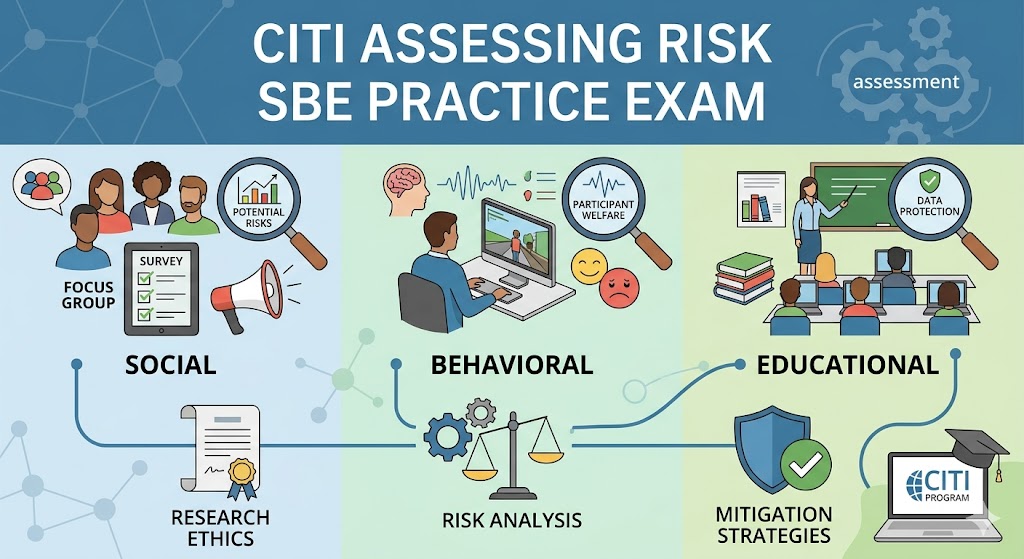
Additional Information
What the Course Entails and Exam Details
The core syllabus of the CITI Assessing Risk module dives
deep into the intricate definition of risk as it applies to non-clinical SBE
research.
You will move beyond obvious physical harms and learn how
to identify, categorize, and quantify probability and magnitude across multiple
domains, including psychological stress, invasion of privacy, and potential
economic disadvantages.
The course entails practical skills for applying
regulatory frameworks, such as the Common Rule, to assess when a study
qualifies as "minimal risk," enabling expedited review or exemption,
or "greater than minimal risk," requiring full board review.
Additionally, it covers specific strategies for
mitigating unique SBE risks through enhanced informed consent procedures,
anonymity, confidentiality protections, and post-study debriefing protocols.
What to Expect in
the Final Exam
The final exam for this module consists entirely of
multiple-choice questions designed to test your applied understanding of the
concepts rather than simple rote memorization.
There are no practical, short-answer, or essay-based
components, making the test straightforward if you have actively studied the
core principles and scenario-based examples provided within the training.
Most institutions require a passing score of 80% or
higher, which is often a cumulative score across all required CITI modules, to
successfully complete the certification and receive your official completion
report.
The quiz is typically untimed and open-book, allowing you
to carefully review the complex scenarios and reference your module notes
without the stress of strict time limits, ensuring you can reason through
ethical dilemmas effectively.
How to Study and
Exam Centers
Effective study strategies for this exam involve actively
reading the provided CITI course modules and taking detailed notes on key
definitions, such as "minimal risk" and the different categories of
harm.
Utilizing a reliable practice exam is one of the best
ways to test your retention and familiarize yourself with the nuanced,
scenario-based question format you will encounter.
Since this is an online-only certification, you do not
need to visit a physical testing center like Pearson VUE or a local authorized
school, eliminating additional travel and administrative hurdles.
You will take the final exam directly through the secure
CITI Program online portal, offering you the flexibility to study and test from
your home or office at your own pace, ensuring a conducive learning
environment.
Job Opportunities
from the Course
Completing the CITI Assessing Risk SBE module is a
mandatory qualification that unlocks numerous career paths in academic,
clinical, and corporate research environments.
Professionals with this certification frequently pursue
roles as Clinical Research Coordinators or Research Managers, ensuring ethical
compliance and participant safety in ongoing studies.
It also qualifies you for vital administrative positions
such as IRB Analyst or IRB Administrator, where you will actively review new
research protocols for safety and adherence to federal regulations.
Other common job titles and career paths include Social
Scientist, Educational Researcher, Policy Analyst, Grants Manager, and
compliance officers within university or private research organizations.
Frequently Asked Questions
Reviews
5.0
Based on 0 reviews
Leave a Review
No reviews yet. Be the first to review!