
President's Cabinet and Succession Practice Test
$69.00
- Buy to unlock unlimited access to all Quiz questions and Answers in this Quiz.
- After purchase you can print a PDF of the whole quiz at any point. The PDF will contain the questions and the correct answers.
About this Exam
The President's Cabinet and Presidential Succession knowledge area focuses on the structure, function, and roles of the executive departments and the formal line of individuals who would assume the presidency. This domain is crucial for students of American government, political science, and civic education, as it explains how the federal government operates day-to-day and how it maintains leadership stability in times of crisis. It is also relevant for individuals pursuing careers in government service, public policy, and related fields.
This practice test is designed for students at the high school, AP US Government, and introductory college levels who are seeking to mastery their understanding of these core constitutional and statutory concepts.
Ready to test your knowledge?
Buy Now to Access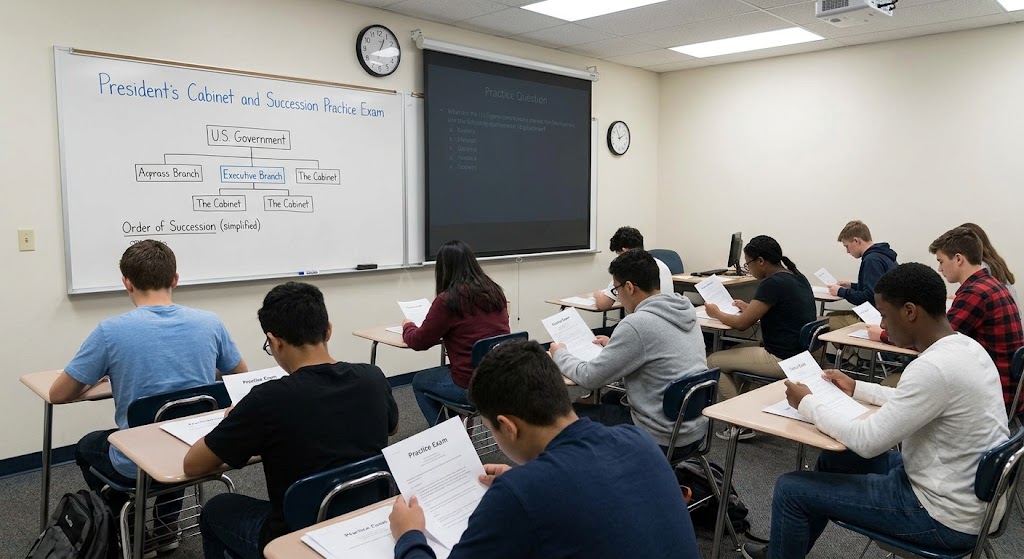
Additional Information
What the Course Entails and Exam Details
This specific practice test, and the associated study domain, is not a standardized external course with a prescriptive syllabus; rather, it assesses knowledge covered in standard American government curriculum. The test covers several key areas: The roles and responsibilities of each of the 15 executive departments (State, Treasury, Defense, Justice, Interior, Agriculture, Commerce, Labor, Health and Human Services, Housing and Urban Development, Transportation, Energy, Education, Veterans Affairs, and Homeland Security); the structure and purpose of the President's Cabinet, including how heads of departments (Secretaries) and other cabinet-level officials (like the Vice President, Chief of Staff, and heads of agencies like the EPA and OMB) are appointed, confirmed, and what they advise the President on.
The other major component is Presidential Succession, focusing on the Presidential Succession Act of 1947, which established the specific order: the Vice President, Speaker of the House of Representatives, President pro tempore of the Senate, and then the eligible Cabinet Secretaries in the order their departments were established, starting with the Secretary of State.
What to Expect in the Final Exam
While not a unified "certification," this practice test mimics the types of questions a student would face in relevant academic exams. You can expect multiple-choice questions, which may include matching department names to their primary functions (e.g., matching the Department of Justice with law enforcement and legal advice, or the Department of Treasury with economic policy and tax collection). Questions might also ask you to identify the formal line of succession or explain the role of specific cabinet members.
There isn't a standardized "passing score" or time limit set by a singular body for this topic. However, a typical 30-50 question test would be aimed at completion within a 45-60 minute period. The objective is to demonstrate strong, recall-based knowledge and an understanding of how the various components function together within the Executive branch.
How to Study and Exam Centers
Effective study strategies for this area combine rote memorization with contextual understanding. Begin by creating detailed flashcards for each of the 15 executive departments. On one side, list the department name, and on the other, include its primary mission, key responsibilities, and a current or well-known Secretary. For Presidential Succession, memorize the order of the top five roles and then memorize the order in which the remaining cabinet departments were established. Creating acronyms or mnemonics can be highly effective for this.
This specific practice test is not administered at specialized testing centers like Pearson VUE or authorized schools for a certificate. Rather, it is typically taken within an educational institution as part of a formal course, or used as a self-study tool from online resources like this practice test, study websites, and government textbooks.
Job Opportunities from the Course
A strong, foundational knowledge of the President's Cabinet and succession process is relevant for several educational and early-career paths. While not directly leading to a single job title, mastery of this domain is a prerequisite for advanced study and various careers in the public sector.
Relevant career paths and potential job opportunities include:
Political Science Researcher/Analyst
Government Relations Specialist
Congressional Staffer
Public Policy Analyst
Teacher/Educator (High School Government/History)
Local or State Government Administrator
Federal Government Employee (within various departments or agencies)
Lawyer (specializing in administrative or constitutional law)
Non-Profit Program Manager (focused on civic engagement or public service)
Journalist/Reporter (covering politics and government)
Political Consultant
Lobbyist
Frequently Asked Questions
Reviews
5.0
Based on 0 reviews
Leave a Review
No reviews yet. Be the first to review!