
Primary Clinical Skills- Intro to Mental Status Practice Exam
$69.00
- Buy to unlock unlimited access to all Quiz questions and Answers in this Quiz.
- After purchase you can print a PDF of the whole quiz at any point. The PDF will contain the questions and the correct answers.
About this Exam
The Primary Clinical Skills Introduction to Mental Status exam evaluates a foundational competency required in healthcare and mental health professions.
It is designed to test a student's ability to systematically observe, describe, and assess a patient's psychological and cognitive functioning at a specific point in time.
This certification or coursework milestone is primarily intended for nursing students, medical students, clinical psychology trainees, and aspiring physician assistants.
By passing this practice exam, students demonstrate they are ready to safely and effectively evaluate patients in real-world clinical psychiatric and general medical settings.
Ready to test your knowledge?
Buy Now to Access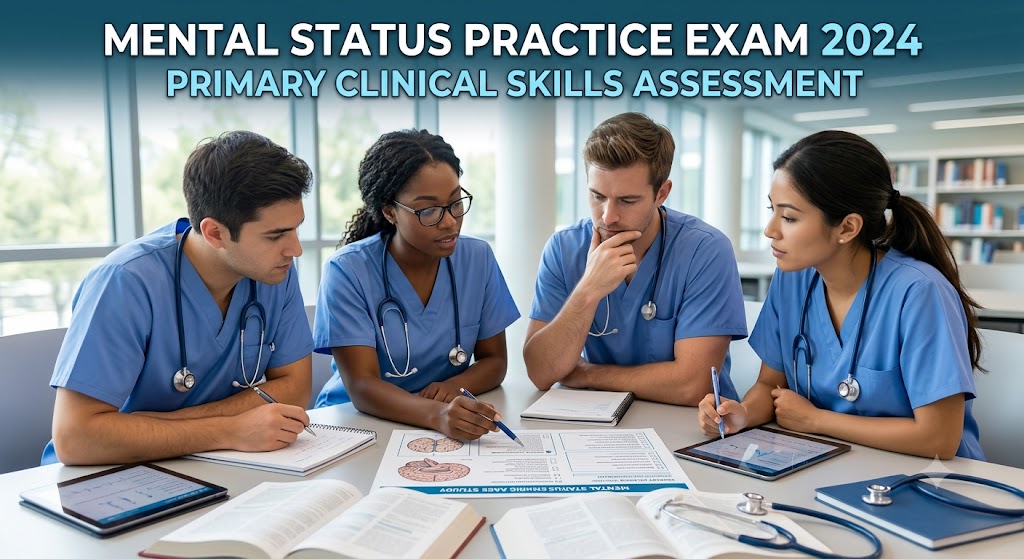
Additional Information
What the Course Entails and Exam Details
The course curriculum provides a comprehensive deep dive into the standard components of the Mental Status Examination (MSE).
Students learn how to systematically evaluate a patient's appearance, behavior, and motor activity during clinical encounters.
The syllabus heavily covers the assessment of speech and language, including the rate, rhythm, and volume of how a patient communicates.
You will also learn to differentiate between mood (the patient's internal emotional state) and affect (the outward expression of that emotion).
Further core topics include evaluating thought processes and thought content, recognizing perceptual disturbances like hallucinations, and testing cognition, insight, and judgment.
What to Expect in the Final Exam
The final exam typically employs a blended format to thoroughly test both theoretical knowledge and practical application.
You can expect multiple-choice questions that focus on defining clinical terminology and identifying correct assessment techniques.
Additionally, the exam frequently features clinical vignettes where you must read a patient's presentation and correctly chart their mental status.
Many institutions also include a practical Objective Structured Clinical Examination (OSCE) component, requiring you to perform a mock assessment on a standardized patient.
Passing scores generally range between 75% and 80%, depending on the institution, with strict time limits usually set around 60 to 90 minutes for the written portion.
How to Study and Exam Centers
Mastering the Mental Status Exam requires both memorization and active clinical practice.
A highly effective study strategy is to use the ASEPTIC mnemonic (Appearance, Speech, Emotion, Perception, Thought, Insight, Cognition) to memorize the assessment order.
You should utilize flashcards for mastering complex psychiatric terminology such as "tangentiality," "flight of ideas," and "flat affect."
Practice mock interviews with your peers to build your confidence in asking difficult or sensitive questions smoothly.
Since this is typically a foundational clinical skills assessment, exams are mostly administered directly through university portals, nursing school testing centers, or clinical simulation labs.
For certification purposes, standardized computer-based versions may be hosted online via secure proctoring software or at authorized physical testing centers like Pearson VUE.
Job Opportunities from the Course
Mastering these primary clinical skills unlocks numerous specialized career paths within the healthcare sector.
Below are the primary roles where this knowledge is highly utilized:
Registered Psychiatric Nurse
Clinical Psychologist
Licensed Clinical Social Worker (LCSW)
Physician Assistant (PA)
Medical Assistant
Psychiatric Technician
Mental Health Counselor
Occupational Therapist
Behavioral Health Specialist
Frequently Asked Questions
Reviews
5.0
Based on 0 reviews
Leave a Review
No reviews yet. Be the first to review!