
Principles and Practice of Engineering (PE) Civil: Structural Practice Exam
$69.00
- Buy to unlock unlimited access to all Quiz questions and Answers in this Quiz.
- After purchase you can print a PDF of the whole quiz at any point. The PDF will contain the questions and the correct answers.
About this Exam
The Principles and Practice of Engineering (PE) Civil: Structural exam is a crucial milestone for civil engineers specializing in the design, analysis, and safety of structures. Administered by the National Council of Examiners for Engineering and Surveying (NCEES), this comprehensive, 8-hour computer-based test ensures that engineering professionals possess the minimum level of competency necessary to protect public health, safety, and welfare. Achieving licensure as a Professional Engineer (PE) in this discipline signifies a significant achievement, validating advanced expertise and opening doors to unparalleled career opportunities. This practice exam is specifically designed to simulate the final testing experience, allowing candidates to assess their readiness, identify weaknesses, and gain the confidence needed to succeed. Whether you're a recent graduate or an experienced engineer seeking professional recognition, thorough preparation, particularly through realistic practice, is the absolute key to unlocking your full potential.
Ready to test your knowledge?
Buy Now to Access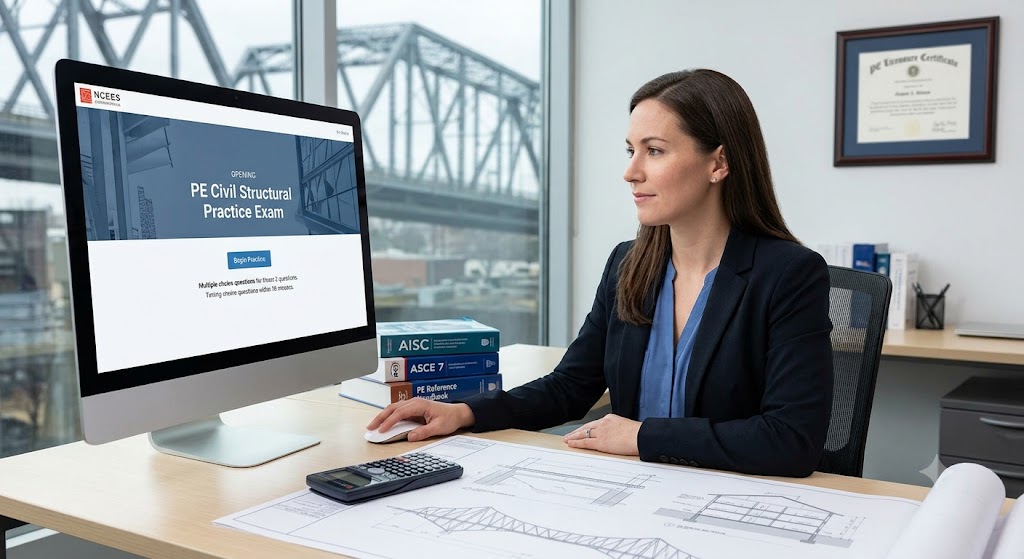
Additional Information
What the Course Entails and Exam Details
Preparing for the PE Civil Structural exam requires a deep understanding of core engineering principles across various topics, split between a general Civil Engineering breadth section and a discipline-specific Structural engineering depth section. The breadth portion, typically covered in the morning session, evaluates knowledge shared by all civil disciplines. The Structural depth section, in the afternoon, focuses intensely on advanced topics like:
Analysis of Structures: Understanding loads (dead, live, snow, wind, seismic), load applications, structural forces, load effects, and temporary structures.
Design and Details of Structures: Proficiency in designing components using materials like reinforced concrete, structural steel, timber, and masonry, guided by current design standards.
Codes and Standards: Comprehensive knowledge of essential industry codes, including ASCE 7 (Minimum Design Loads), ACI 318 (Building Code Requirements for Structural Concrete), AISC Steel Construction Manual, AWC NDS (Wood Design Package), TMS 402/602 (Masonry Structures), and relevant safety regulations (CFR Title 29).
Candidates must demonstrate not just theoretical understanding, but also the practical ability to apply these concepts through analysis, design, and calculation-intensive problems. Mastering the electronic Reference Handbook provided by NCEES during the exam, and understanding its interaction with specific design standards, is critical for success in this demanding computer-based environment.
What to Expect in the Final Exam
The final PE Civil Structural exam is a rigorous, 8-hour, computer-based test. The exam appointment time is approximately 9 hours, inclusive of tutorials, a nondisclosure agreement, and a scheduled break. The actual exam consists of 80 multiple-choice questions, with 40 questions in the morning breadth session and 40 questions in the afternoon depth session. Candidates choose their depth module at the time of registration. Please note, NCEES has recently transitioned some depth sections to alternate item types (AITs), and exam specifications can evolve, so always consult the most current NCEES information.
There is no fixed passing score for the PE Civil exam. NCEES utilizes a psychometric equating process to determine the passing standard, ensuring consistent difficulty levels across different exam administrations. Your result will be reported as pass or fail, and if you are unsuccessful, you will receive a diagnostic report detailing your performance in each content area to aid future study. During the exam, only approved reference materials are permitted, which include the NCEES PE Civil Reference Handbook and specify design standards, provided electronically. Strict rules regarding acceptable calculators and testing center conduct apply to maintain exam integrity.
How to Study and Exam Centers
Preparation for the PE Civil Structural exam should be comprehensive, disciplined, and focused. Start by thoroughly reviewing the NCEES exam specifications and Reference Handbook early in your study process. The single most valuable study technique is working through as many practice problems and full-length, timed practice exams as possible.
Simulate Exam Conditions: Take practice exams under realistic, timed conditions to build stamina, manage your time per question, and get accustomed to the computer-based interface.
Master Reference Materials: Become exceptionally familiar with the provided electronic Reference Handbook and standard design codes. Know where to quickly find relevant formulas, tables, and specifications.
Focus on Weaker Areas: Use diagnostic feedback from practice tests to dedicate more study time to topics where your performance is lower.
Utilize Study Guides and Courses: Consider professional review courses, study guides, and online forums to supplement your self-study and gain diverse perspectives.
The PE Civil Structural exam is administered exclusively at NCEES-approved Pearson VUE computer-based testing centers. These centers are located worldwide, ensuring accessibility for all candidates. To take the exam, you must first create a MyNCEES account, register for the exam, and obtain authorization from your state licensing board (if required). Once authorized, you can log back into your MyNCEES account to select a specific test center, date, and time that works best for you. Testing appointments are available during four testing windows throughout the year, but popular times and locations fill quickly, so registering early is strongly advised.
Job Opportunities from the Course
Achieving your PE license in Civil: Structural Engineering represents a significant professional advancement and dramatically expands your career horizons. Licensing opens doors to positions of greater responsibility, significantly higher earning potential, and the authority to stamp engineering drawings and designs. The specific job opportunities this certification unlocks include:
Structural Engineer
Senior Structural Engineer
Bridge Engineer
Structural Design Lead
Forensic Structural Engineer
Project Manager (with a Structural Focus)
Engineering Consultant
Construction Manager (with structural expertise)
Public Works Engineer (specializing in structures)
Research and Development Engineer (Structural Systems)
Frequently Asked Questions
Reviews
5.0
Based on 0 reviews
Leave a Review
No reviews yet. Be the first to review!