
Principles and Practice of Engineering (PE) Civil: Water Resources and Environmental (WRE) Practice Exam
$69.00
- Buy to unlock unlimited access to all Quiz questions and Answers in this Quiz.
- After purchase you can print a PDF of the whole quiz at any point. The PDF will contain the questions and the correct answers.
About this Exam
The Principles and Practice of Engineering (PE) Civil: Water Resources and Environmental exam is the final hurdle for engineers aspiring to become licensed Professional Engineers in the specialized fields of water resources and environmental engineering. It is designed for engineers who have gained a minimum of four years of post-college work experience and have already passed the Fundamentals of Engineering (FE) exam. This rigorous test assesses an individual's competence to practice professional engineering independently and protect public health, safety, and welfare. Attaining the PE designation signifies a high level of expertise and commitment to the profession, unlocking advanced career opportunities and leadership roles.
Ready to test your knowledge?
Buy Now to Access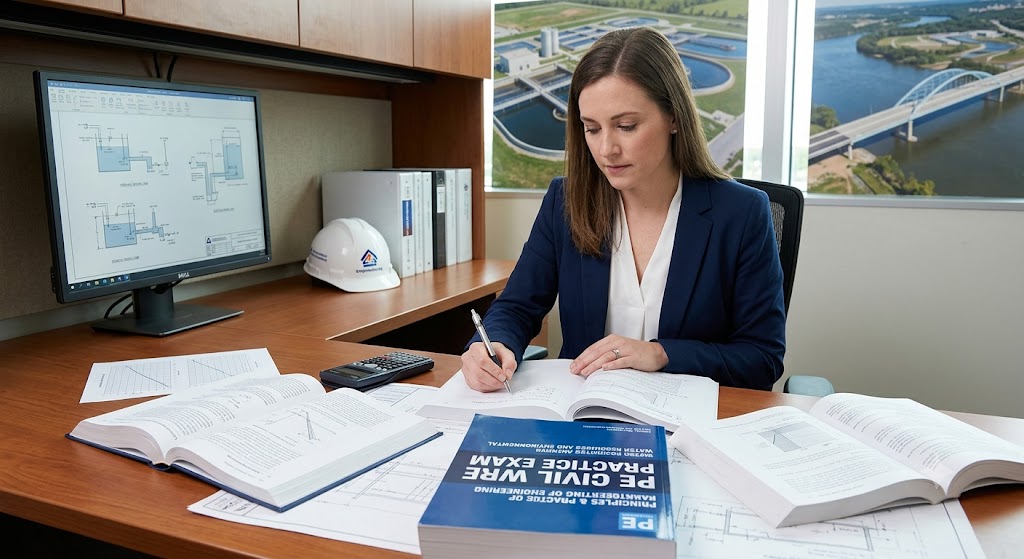
Additional Information
What the Course Entails and Exam Details
The PE Civil: Water Resources and Environmental exam focuses on advanced engineering principles applicable to two major, interwoven areas: Water Resources (hydrology, hydraulics, and water supply) and Environmental Engineering (wastewater treatment, water quality, and waste management).
The detailed syllabus covers critical skills and knowledge areas including:
Hydrology and Hydraulics: Analyzing runoff, streamflow, and floodplains; designing pipe systems, open channels, and hydraulic structures.
Water Quality and Treatment: Evaluating water chemistry and biology; designing systems for treating drinking water and managing water quality in natural systems.
Wastewater and Stormwater Management: Designing collection systems and treatment processes for wastewater; developing strategies for managing urban runoff.
Solid and Hazardous Waste: Planning waste disposal systems and understanding environmental remediation technologies.
Environmental Remediation and Health & Safety: Analyzing contaminated sites and understanding associated environmental regulations and safety protocols.
Engineers must demonstrate proficiency in complex problem-solving, applying engineering principles to design systems, interpreting relevant codes and standards, and ensuring environmental compliance.
What to Expect in the Final Exam
The PE Civil: Water Resources and Environmental exam is a computer-based test (CBT) administered exclusively at NCEES-approved Pearson VUE test centers. It consists of 80 multiple-choice questions total and takes approximately nine hours to complete. This includes a tutorial, a scheduled break, and an optional end-of-exam survey. The testing time is roughly eight hours.
The exam is structured into two main sections:
Breadth Section (Approx. 40 questions): Administered in the morning session, this part covers a wide range of topics across all five primary civil engineering disciplines: Construction, Geotechnical, Structural, Transportation, and Water Resources and Environmental. It tests fundamental knowledge required of all civil engineers.
Depth Section (Approx. 40 questions): Administered in the afternoon session, this section focuses strictly on advanced and specific Water Resources and Environmental topics.
You are provided with a searchable electronic version of the NCEES PE Civil Reference Handbook during the exam. This is the only reference material allowed. Specific types of calculators approved by NCEES are permitted, and strict behavioral rules are enforced at the testing centers.
How to Study and Exam Centers
Preparation is paramount for success on this challenging exam. A multi-pronged approach is highly effective. Here are key study strategies:
Master the Reference Handbook: The NCEES PE Civil Reference Handbook is your primary resource. You must know its organization inside and out. Practice locating relevant formulas, tables, and charts quickly, as this is a time-critical exam.
Engage with Practice Exams: Taking practice exams is the best way to simulate the real testing experience. Use official NCEES practice exams and reliable third-party practice resources. These help you manage time and identify weak areas.
Consider a Review Course: Many structured review courses are available (online or in-person) specifically designed for the WRE depth section. These offer expert guidance, study schedules, and targeted problem-solving techniques.
Solve Problems Daily: Consistency is key. Practice solving quantitative problems every day, focusing on accuracy and speed. Ensure you have a deep understanding of the fundamental concepts behind the formulas.
Review Breadth Topics: Don't neglect the breadth section. Allocate time to review the basics of the other civil engineering disciplines (Construction, Geotechnical, Structural, and Transportation) as they account for half of your total score.
The PE Civil WRE exam is administered by the National Council of Examiners for Engineering and Surveying (NCEES). Registration and scheduling are managed through your NCEES account. The exam is offered exclusively at authorized Pearson VUE professional test centers worldwide. You can locate a center near you during the registration process.
Job Opportunities from the Course
Earning your PE license, specifically in the Water Resources and Environmental discipline, drastically expands your career horizons and increases your earning potential. The designation is a recognized mark of authority.
Specific job titles and career paths unlocked by this certification include:
Water Resources Engineer
Environmental Engineer
Civil Engineer (Specializing in Water/Environmental)
Hydrologic Modeler
Water Quality Specialist
Project Manager (Engineering)
Wastewater Process Engineer
Stormwater Management Engineer
Regulatory Compliance Specialist
Consulting Engineer (Water/Environmental)
Municipal Engineer
Environmental Health and Safety (EHS) Manager
Principal Engineer/Engineering Director
Frequently Asked Questions
Reviews
5.0
Based on 0 reviews
Leave a Review
No reviews yet. Be the first to review!