
Principles and Practice of Engineering (PE) Environmental Practice Exam
$69.00
- Buy to unlock unlimited access to all Quiz questions and Answers in this Quiz.
- After purchase you can print a PDF of the whole quiz at any point. The PDF will contain the questions and the correct answers.
About this Exam
The Principles and Practice of Engineering (PE) Environmental Exam is a critical benchmark for early-career environmental engineers seeking professional licensure in the United States. Achieving PE certification validates an engineer's technical competency and commitment to protecting public health, safety, and the environment. This exam is designed for individuals with an ABET-accredited engineering degree and several years of relevant, verifiable work experience. Passing this exam is the prerequisite for obtaining the PE designation, marking a significant milestone in professional engineering development.
Ready to test your knowledge?
Buy Now to Access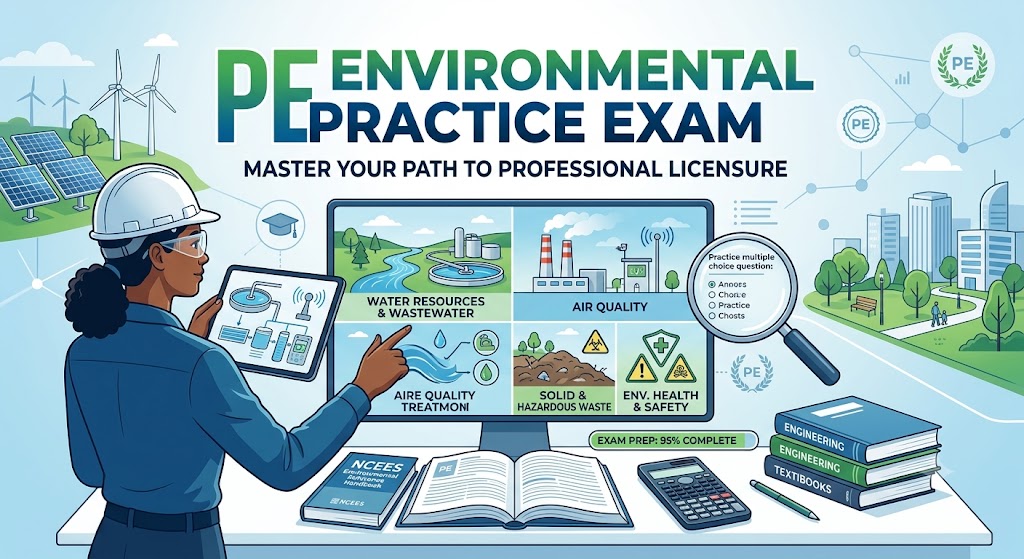
Additional Information
What the Course Entails and Exam Details
The PE Environmental Exam, while administered as a single event rather than a traditional 'course,' tests a candidate’s practical application of engineering principles learned through academic study and professional practice. The knowledge areas tested are broad and detailed. They include Water Resources and Wastewater (distribution systems, treatment processes, hydrology, hydraulics); Air Quality (emission sources, control technologies, atmospheric modeling); Solid and Hazardous Waste (landfill design, remediation, waste minimization); and Environmental Health and Safety (risk assessment, regulatory compliance). Prepare to demonstrate proficiency in calculations, design concepts, and regulatory application across these domains.
What to Expect in the Final Exam
The final exam is a Computer-Based Test (CBT) administered by NCEES. It consists of 80 multiple-choice questions administered in two four-hour sessions, totaling an 8-hour exam day (excluding break). Candidates must bring only NCEES-approved calculators and are provided a secure digital reference handbook during the exam; no other outside reference materials are allowed. The exam utilizes dynamic passing scores determined by a standard-setting committee; raw scores are converted to a scaled score, with typically a scaled score of 70 required to pass. Understanding the CBT interface and utilizing the search function within the provided reference manual effectively are essential skills.
How to Study and Exam Centers
Preparation requires a dedicated, structured study plan over several months. Focus on solving a large volume of practice problems, simulating exam conditions. Utilize official NCEES practice exams to familiarize yourself with the question style and level of difficulty. Review fundamental principles, formulas, and regulations covered in the exam specifications. Create a customized reference notebook (if allowed for preparation, though only the provided digital handbook is for the exam) and practice indexing information.
The exam is taken at dedicated Pearson VUE test centers located across the United States. These secure, standardized environments ensure a consistent testing experience for all candidates. Registration and scheduling are managed exclusively through the NCEES web portal. Early registration is recommended to secure your preferred date and location.
Job Opportunities from the Course
Achieving PE licensure dramatically expands your professional opportunities and earning potential. It unlocks career paths leading to senior engineering and management positions. Specific job titles include:
Project Engineer
Senior Environmental Engineer
Environmental Department Manager
Regulatory Compliance Specialist
Water/Wastewater Utility Manager
Principal Engineer in Consulting Firms
Governmental Agency Director (e.g., EPA, state environmental departments)
Expert Witness for Environmental Cases
Frequently Asked Questions
Reviews
5.0
Based on 0 reviews
Leave a Review
No reviews yet. Be the first to review!