
Principles of Investment Practice Exam
$69.00
- Buy to unlock unlimited access to all Quiz questions and Answers in this Quiz.
- After purchase you can print a PDF of the whole quiz at any point. The PDF will contain the questions and the correct answers.
About this Exam
Embark on your journey towards financial expertise with the comprehensive Principles of Investment Practice Exam. Designed for aspiring financial advisors, portfolio managers, investment analysts, and any professional seeking to validate a fundamental understanding of market mechanics, this practice exam is your ultimate final check. It simulates the rigors of a true certification, ensuring you possess the core knowledge required to navigate diverse asset classes, assess risk, and construct sound investment strategies for clients. This practice test is a vital tool for anyone preparing to earn a recognized designation, providing the confidence and clarity needed to succeed on exam day.
Ready to test your knowledge?
Buy Now to Access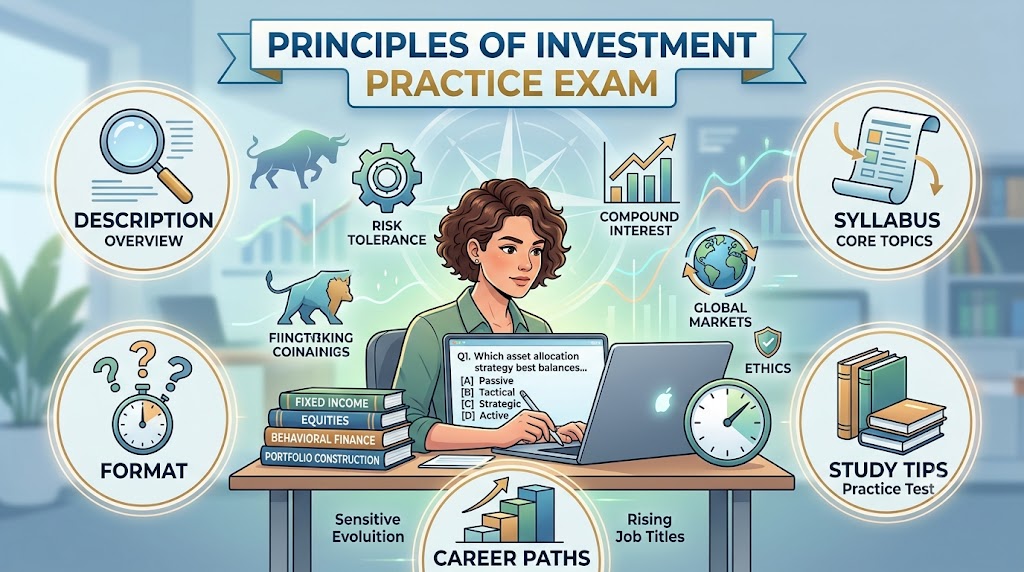
Additional Information
What the Course Entails and Exam Details
This examination covers the essential curriculum of modern investment practice, mirroring the content of leading industry certifications. The syllabus is meticulously structured around four key pillars: fundamentals, asset classes, portfolio management, and ethics. You will be tested on your comprehension of quantitative methods, including time value of money and basic statistics. Dive deep into the characteristics, valuation, and risks associated with equity securities, fixed-income instruments, derivatives, and alternative investments like real estate and commodities. The exam further evaluates your ability to apply investment theory, from asset allocation and diversification to behavioral finance and performance measurement. Finally, a robust section on ethics and professional standards ensures you can navigate the legal and regulatory landscape of the investment industry.
What to Expect in the Final Exam
Prepare yourself for a dynamic and time-sensitive assessment. The final exam typically takes the form of a rigorous multiple-choice test, composed of 100 to 120 scored questions, designed to evaluate both conceptual understanding and practical application skills. Candidates generally have a time limit of 2 to 3 hours to complete the examination. The required passing score usually falls between 70% and 75%. You must be adept at interpreting financial data, applying formulas, and making sound, ethical decisions under pressure. No personal calculators are permitted; a standard, non-programmable financial calculator is often provided within the testing interface or allowed as a specific model, along with on-screen scratchpad tools.
How to Study and Exam Centers
Achieving a high score demands a structured, multi-faceted study plan. Begin by thoroughly reviewing all course materials, leveraging official textbooks, online lectures, and supplementary guides. However, the cornerstone of effective preparation is active practice. Dedicate significant time to taking multiple full-length, timed practice exams. Analyze every incorrect answer to pinpoint weak areas and focus your revision. Form study groups to discuss complex concepts and share different analytical perspectives. When you are ready, you can take the official exam at a network of authorized centers, such as Pearson VUE, which offers a global footprint of secure testing facilities. Additionally, many certifications now provide the option of a proctored online exam, allowing you to test from the comfort and safety of your home or office.
Job Opportunities from the Course
A strong performance on an exam validating principles of investment practice can unlock numerous rewarding career paths in the financial services sector. Specific job titles include:
Investment Analyst
Financial Advisor
Portfolio Manager Assistant
Risk Analyst
Relationship Manager (Private Banking)
Equities Analyst
Fixed-Income Analyst
Wealth Management Associate
Fund Administrator
Compliance Officer (Investment)
Operations Associate
Client Service Representative (Investment Management)
Frequently Asked Questions
Reviews
5.0
Based on 0 reviews
Leave a Review
No reviews yet. Be the first to review!