
Printreading Trade Compentency Practice Test
$69.00
- Buy to unlock unlimited access to all Quiz questions and Answers in this Quiz.
- After purchase you can print a PDF of the whole quiz at any point. The PDF will contain the questions and the correct answers.
About this Exam
The Printreading Trade Competency exam is a pivotal assessment designed to validate your foundational ability to interpret, analyze, and apply information from technical drawings commonly used across a wide spectrum of skilled trades.
This competency is the lifeblood of construction, manufacturing, and engineering projects, ensuring that the visual designs created by architects and engineers are translated into physical reality accurately and safely.
This exam is designed for individuals entering or advancing in trades such as carpentry, electrical work, plumbing, HVAC, and welding.
A passing score serves as verifiable proof to employers that you possess the critical "blueprint literacy" necessary to function effectively on a job site or shop floor, reducing errors and enhancing project efficiency.
Ready to test your knowledge?
Buy Now to Access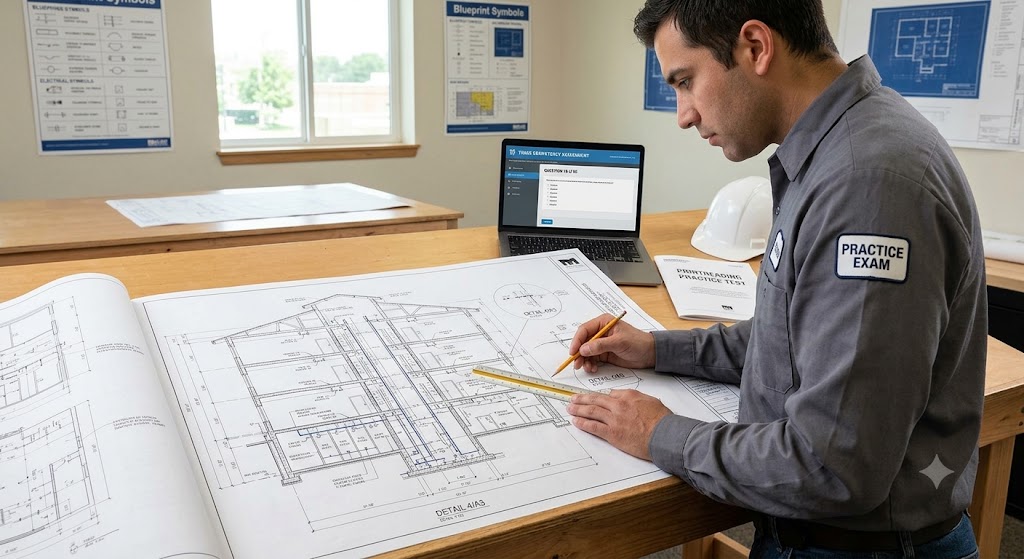
Additional Information
What the Course Entails and Exam Details
This competency assessment focuses on core skills rather than a specific standardized curriculum, though many candidates prepare through introductory printreading or blueprint reading courses.
The examination evaluates your understanding of the universal language of technical drawings, including:
Drawing Types: Recognizing and interpreting different views, including floor plans, elevations, sections, detail drawings, and schedules (such as window or door schedules).
Symbols and Abbreviations: Understanding the standardized icons used to represent materials, electrical components, plumbing fixtures, structural elements, and HVAC systems.
Scale and Dimensions: Confidently utilizing architectural and engineering scales to derive measurements and interpreting dimension lines to understand precise object sizes and placements.
Line Types and Conventions: Distinguishing between object lines, hidden lines, center lines, section lines, and dimension lines to understand drawing intent.
Title Blocks and Revisions: Navigating key administrative information, such as project names, dates, scales, drawing numbers, and critical revision histories.
What to Expect in the Final Exam
While specific exam formats may vary slightly depending on the issuing body or employer, the most common Printreading Trade Competency test is an objective, standardized examination.
The test primarily consists of multiple-choice questions, with some forms possibly including matching or true/false formats to evaluate visual recognition of symbols and terms.
You will typically be presented with scenarios and questions that require you to actively interpret and solve problems using sample prints provided as part of the exam materials.
The final exam usually takes between 90 and 120 minutes to complete, and a standard passing score is often set at 70% or 75%, though this can be higher for more specialized trade roles.
No calculators, dictionaries, or unauthorized study aids are permitted in the exam room during the final test.
How to Study and Exam Centers
Effective preparation requires a combination of theory and hands-on application.
Review Sample Prints: Acquire a diverse set of real or practice blueprints (residential, light commercial, mechanical). Actively study them, identifying every line, symbol, and note. Compare the plans with elevations and sections to understand how they represent the same object.
Study Key Codes: While not a code test, having a working knowledge of the basic layout of codes like the NEC (Electrical) or IPC (Plumbing) will help you understand why certain symbols and practices are used on a print.
The Printreading Trade Competency exam is usually administered as a computer-based or paper-and-pencil test through standardized testing providers like Pearson VUE, local trade schools, or authorized joint apprenticeship and training committee (JATC) centers.
Contact your prospective employer or trade union to confirm the recognized testing provider in your region.
Job Opportunities from the Course
Successfully demonstrating proficiency on the Printreading Trade Competency exam is a baseline requirement for multiple high-demand, skilled roles. This certification unlocks career paths in both residential and commercial construction, manufacturing, and maintenance.
Specific job opportunities enabled by this competency include:
Carpenter (Framing and Finish)
Electrician (Residential and Commercial)
Plumber
HVAC Technician
Welder and Fabrication Specialist
Ironworker
Sheet Metal Worker
Construction Project Coordinator
Estimator
Maintenance Mechanic
Building Inspector
Frequently Asked Questions
Reviews
5.0
Based on 0 reviews
Leave a Review
No reviews yet. Be the first to review!