
Privacy, Business Impact, and Risk Management in IT Security Practice Test
$69.00
- Buy to unlock unlimited access to all Quiz questions and Answers in this Quiz.
- After purchase you can print a PDF of the whole quiz at any point. The PDF will contain the questions and the correct answers.
About this Exam
This [Privacy, Business Impact, and Risk Management in IT Security Practice Test] is a specialized, high-level assessment designed for cybersecurity and information technology professionals. It focuses on the critical intersection of security controls, data privacy regulations, and business operations. This exam is ideal for candidates preparing for advanced certifications like CISSP (Certified Information Systems Security Professional), CISM (Certified Information Security Manager), or dedicated privacy roles such as CIPM (Certified Information Privacy Manager) and CDPSE (Certified Data Privacy Solutions Engineer).
It is designed for individuals who have a strong technical foundation and are now moving into strategic roles where they must make informed decisions about mitigating risk while ensuring compliance and minimizing disruptions to core business functions.
Ready to test your knowledge?
Buy Now to Access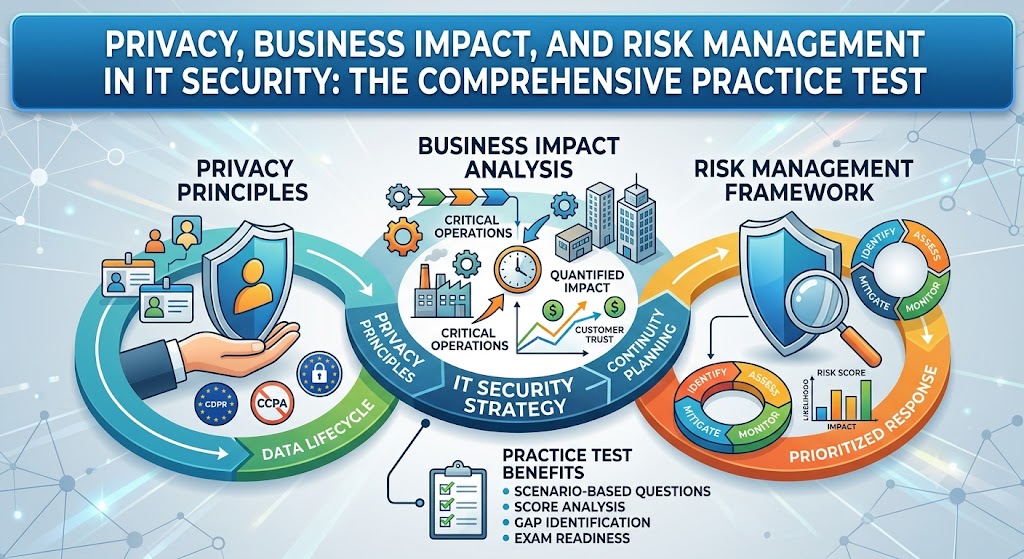
Additional Information
What the Course Entails and Exam Details
This comprehensive practice test covers the full spectrum of linking IT security to organizational governance. The core topics and syllabus areas include:
Information Security Governance: Understanding how security aligns with and supports business goals, including legal, regulatory, and contractual requirements (e.g., GDPR, CCPA/CPRA, HIPAA).
Information Security Risk Management: The complete risk management lifecycle: identification, analysis (qualitative and quantitative), evaluation, treatment (accept, avoid, mitigate, transfer), and continuous monitoring. This includes key frameworks such as NIST RMF, ISO 31000, and COBIT.
Privacy and Data Protection Principles: Applying privacy-by-design, data minimization, consent management, data subject rights, and managing the lifecycle of personal data (PII/PHI).
Business Impact Analysis (BIA): The process to differentiate critical and non-critical business functions, including how to determine Maximum Tolerable Downtime (MTD), Recovery Time Objective (RTO), Recovery Point Objective (RPO), and Work Recovery Time (WRT).
Business Continuity (BC) and Disaster Recovery (DR) Integration: Designing and testing plans that are informed by the BIA and risk assessment, ensuring the organization can survive and recover from security incidents and disasters.
What to Expect in the Final Exam
The final exam (modelled after the style of CISSP, CISM, or IAPP exams) will be a rigorous test of your ability to apply concepts to complex scenarios. You can expect:
Format: Multiple-choice, multiple-response, and scenario-based questions that require you to synthesize information and choose the "best" course of action for a business. It is a computer-based test (CBT).
Number of Questions: 120–150 questions.
Time Limit: 3.5 to 4 hours.
Passing Score: Typically requires a scaled score of 700 out of 1000 (70%) or higher, depending on the specific certifying body.
Rules: Standard high-stakes testing rules apply: no outside materials, adaptive testing (for CISSP), or fixed-form (for CISM/CIPM), proctored environment, and nondisclosure agreement (NDA).
How to Study and Exam Centers
Preparation for this exam requires a deep understanding of concepts rather than simple memorization.
Study Strategies:
Utilize Official Review Manuals: Use the official study guides and bodies of knowledge from the organization whose certification you are targeting (ISC2, ISACA, IAPP).
Focus on Scenarios: Don't just learn definitions. Practice applying the Risk Management Framework or the Privacy Operational Life Cycle to real-world business challenges.
Take Multiple Practice Tests: Use resources like this [Privacy, Business Impact, and Risk Management in IT Security Practice Test] to find your knowledge gaps, analyze why you missed questions, and build stamina for the long exam.
Form Study Groups: Collaborating with peers allows for discussing complex interpretations and varied industry experiences.
Exam Centers:
Authorized Testing Partners: Most of these exams are administered globally through authorized computer-based testing networks such as Pearson VUE or PSI.
Online Proctoring: Many certifying bodies now offer the option to take the exam from home via online proctoring, provided you meet strict technical and environment requirements.
Job Opportunities from the Course
Earning this certification and mastering these domains opens the door to senior-level, high-impact career paths, including:
Information Security Manager / Director
Chief Information Security Officer (CISO)
Data Protection Officer (DPO)
IT Risk and Compliance Manager
Privacy Manager / Privacy Architect
IT Auditor / Senior IT Auditor
Business Continuity Manager / Disaster Recovery Specialist
Cybersecurity Consultant (Strategic/Governance Focus)
Frequently Asked Questions
Reviews
5.0
Based on 0 reviews
Leave a Review
No reviews yet. Be the first to review!