
Private Pilot Checkride Oral Practice Exam
$69.00
- Buy to unlock unlimited access to all Quiz questions and Answers in this Quiz.
- After purchase you can print a PDF of the whole quiz at any point. The PDF will contain the questions and the correct answers.
About this Exam
Welcome to the ultimate preparation resource for your Private Pilot Checkride Oral Practice Exam. This is a crucial milestone on your journey to becoming a licensed pilot, representing the verbal examination phase of your final practical test. This guide and practice exam are designed for student pilots who have completed their flight training and ground school, passed their FAA knowledge test, and are now ready to demonstrate their commanding knowledge of aviation regulations, procedures, and safety to an FAA Designated Pilot Examiner (DPE). Our goal is to simulate the depth, tone, and subject matter of the actual oral exam, ensuring you step into that room with confidence and clarity.
Ready to test your knowledge?
Buy Now to Access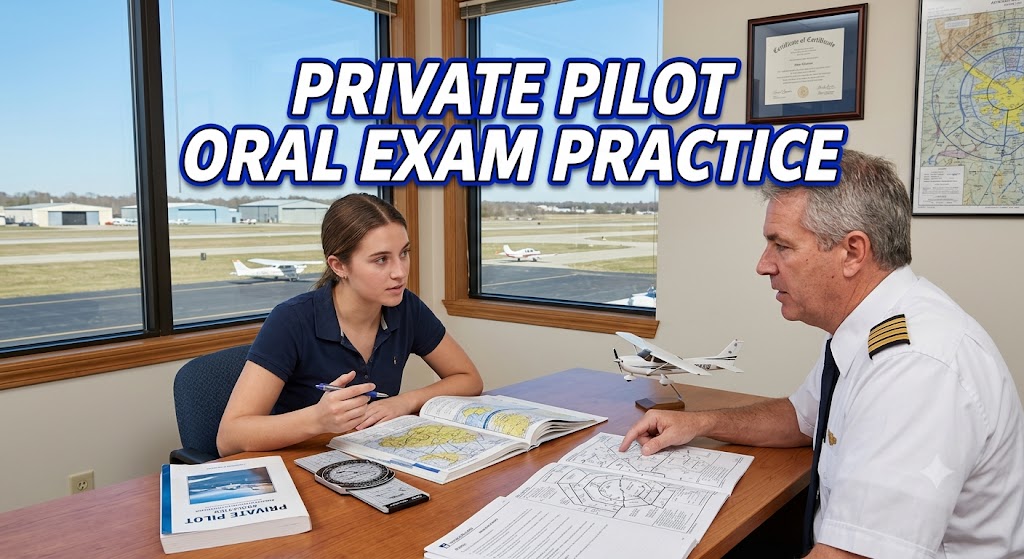
Additional Information
What the Course Entails and Exam Details
The oral portion of the private pilot checkride is not just about reciting facts; it's about demonstrating a practical understanding and sound decision-making. The examiner will evaluate your knowledge based on the Airman Certification Standards (ACS), covering critical areas including:
Preflight Preparation: Pilot qualifications, weather, cross-country flight planning, and airspace.
Preflight Procedures: Airport operations, aircraft systems, and performance limitations.
Airport Operations: Runways, taxiways, and communication procedures.
Takeoffs, Landings, and Go-Arounds: Normal and crosswind operations, and rejected takeoffs.
Performance Maneuvers: Steep turns and maneuvering during slow flight.
Navigation: VOR, GPS, and pilotage/dead reckoning.
Emergency Operations: System failures and emergency procedures.
High-Altitude Operations: Oxygen requirements and physiological factors.
Postflight Procedures: After-landing, parking, and securing the aircraft.
A strong grasp of these topics is essential to prove that you can act safely and responsibly as a pilot in command.
What to Expect in the Final Exam
The final oral exam is a one-on-one discussion with a DPE that typically lasts between 1.5 to 3 hours. It is an open-dialogue assessment, where the examiner will present realistic scenarios and ask questions to evaluate your knowledge and judgment.
Format: The exam is a verbal question-and-answer session. There are no multiple-choice questions; you must explain and apply your knowledge.
Passing Score: There is no numerical score. The examiner will grade your performance as "Satisfactory" or "Unsatisfactory" for each required task in the ACS. To pass, you must meet the standards for all areas.
Time Limit: While there isn't a strict clock, you should provide clear, concise, and accurate answers, demonstrating command of the material without unnecessary stalling.
Rules: You are permitted to use relevant resources, such as the FAR/AIM, POH/AFM, and ACS, but you must know how to locate information quickly and not rely on them for every answer. Your instructor must endorse your readiness for the test.
How to Study and Exam Centers
Preparation is paramount. Here are effective strategies to ensure success:
Study the ACS: This is your primary study guide. Know every task and the corresponding standards.
Use Mock Oral Guides: Utilize books and resources specifically designed to simulate checkride questions.
Create Flashcards: Memorize key regulations, airspace dimensions, and aircraft limitations.
Practice with Instructors and Peers: Schedule mock oral exams with your Flight Instructor and other pilots to build confidence.
Review Your Knowledge: Ensure you have a deep understanding of your aircraft's systems and flight planning.
Stay Endorsed: Make sure all your logbook endorsements and flight hours are accurate and up-to-date.
When you are ready, you will schedule your practical test (which includes the oral exam) with a Designated Pilot Examiner (DPE) authorized by the FAA. Your flight school or instructor will assist in this process. Testing does not occur at standard computer-based centers like Pearson VUE; it is an in-person, practical evaluation.
Job Opportunities from the Course
Passing your checkride and earning your Private Pilot Certificate is a monumental achievement that opens doors to exciting aviation paths. While not for commercial operation, it is a mandatory prerequisite for career-focused ratings:
Personal Aviation and Travel: Fly yourself, friends, and family for business or leisure.
Flight Instructor: The first major step toward becoming a Certified Flight Instructor (CFI).
Advanced Training: Required before pursuing Instrument, Commercial, Multi-Engine, and Airline Transport Pilot (ATP) ratings.
Corporate and Charter Pilot: The foundation for careers in non-scheduled air transportation.
Airline Pilot: A critical milestone on the path to becoming an airline pilot.
Aerial Photography and Surveying: Begin the journey to specialized commercial flight.
Aviation Management and Operations: A deep understanding of flight operations is invaluable in aviation business roles.
Frequently Asked Questions
Reviews
5.0
Based on 0 reviews
Leave a Review
No reviews yet. Be the first to review!