
Private Pilot License (PPL) Aerodynamics Practice Exam
$69.00
- Buy to unlock unlimited access to all Quiz questions and Answers in this Quiz.
- After purchase you can print a PDF of the whole quiz at any point. The PDF will contain the questions and the correct answers.
About this Exam
The Private Pilot License (PPL) Aerodynamics Practice Exam is an essential resource for students preparing to master the critical principles of flight and secure their first aviation certification. Designed for aspiring aviators—ranging from recreational flyers to future commercial pilots—this practice exam simulates the rigors of the official PPL written knowledge test. It focuses exclusively on the core scientific concepts that explain how aircraft fly. By identifying knowledge gaps and reinforcing theoretical understanding, this exam builds the confidence required to pass the formal FAA knowledge test and proceed to practical flight training.
Ready to test your knowledge?
Buy Now to Access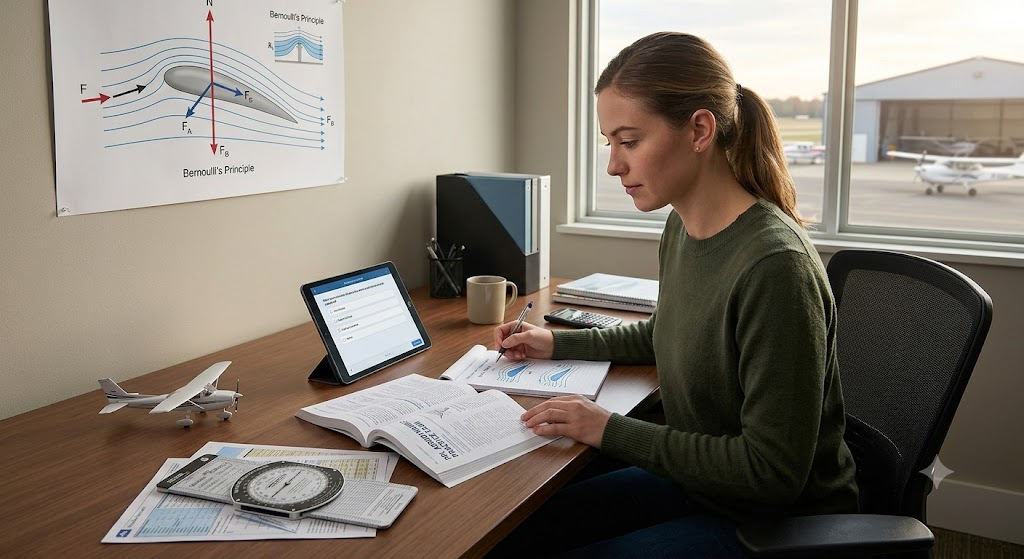
Additional Information
What the Course Entails and Exam Details
To pass the aerodynamics section of the PPL knowledge test, candidates must demonstrate a thorough understanding of physical laws and their applications. This comprehensive practice exam covers a diverse syllabus, ensuring students are proficient in:
The Four Forces of Flight: Detailed calculations and application of Lift, Drag, Thrust, and Weight, including how they interact in various flight attitudes (climb, descent, cruise, turns).
Principles of Lift Generation: Mastery of Bernoulli's Principle and Newton's Laws as they apply to airfoils and angle of attack (AOA).
Aircraft Stability and Control: Comprehensive knowledge of longitudinal, lateral, and directional stability, and the effects of primary and secondary flight controls (ailerons, elevator, rudder, trim).
Aerodynamic Drag: Distinguishing between induced drag, parasite drag (form, skin friction, interference drag), and understanding how total drag varies with airspeed.
Stalls and Spins: Critical understanding of the mechanics of an aerodynamic stall, recognizing stall symptoms, and knowing recovery procedures.
Atmospheric Effects: How density altitude, temperature, and pressure affect aircraft performance.
Weight and Balance Theory: Understanding the importance of Center of Gravity (CG) limitations and their effect on controllability and stability.
What to Expect in the Final Exam
While the exact structure of your practice exam may vary depending on the provider, the official FAA PPL Knowledge Test is a standardized process.
Exam Format: The knowledge test consists of multiple-choice questions administered via computer. The practice exam aims to mimic this format to build speed and accuracy.
Number of Questions: The complete PPL written exam generally contains between 60 and 65 questions, of which a substantial portion focuses directly on aerodynamics and aircraft performance.
Passing Score: To obtain credit for the knowledge test, applicants must achieve a minimum score of 70 percent (70%).
Time Limit: Candidates are typically allotted a strict time limit (usually around 2.5 hours) to complete the entire exam, making efficiency crucial.
Specific Rules: Only authorized materials, such as an E6B flight computer, a simple calculator, and approved testing supplements (charts and diagrams provided at the test center), are allowed. Electronics with communication capabilities are strictly prohibited. The official test must be proctored.
How to Study and Exam Centers
Effective preparation is key to conquering aerodynamics. Here are actionable strategies and information on where to sit for the final exam.
How to Study:
Utilize Official Resources: Focus your studies on the FAA's comprehensive Pilot's Handbook of Aeronautical Knowledge (PHAK), specifically the chapters detailing aerodynamics and aircraft systems.
Take Multiple Practice Exams: The most effective study method is repetition. Consistently take diverse practice exams, like this one, to simulate the test environment and identify your weak points. Review every incorrect answer thoroughly.
Join Ground School: Enrolling in an FAA-approved (Part 141) or independent ground school provides structured learning and the required endorsement to take the official exam.
Interactive Simulation and Diagrams: Visualize concepts using airflow simulators, online animations, and detailed diagrams of airfoils and force vectors. Physical models can also enhance spatial understanding.
Teach the Concepts: Explaining aerodynamic principles (like why a stall occurs) to someone else is a powerful way to reinforce your own understanding.
Exam Centers:
To take the official FAA Private Pilot Knowledge Test, you must register through an FAA-authorized testing partner. The primary vendor is currently PSI Services LLC.
Find a Center: You can locate authorized testing centers, including Pearson VUE and other affiliated facilities, through the PSI website. These physical, proctored centers ensure the integrity of the examination process.
Authorization Required: Before you can schedule your exam at a center, you must possess a proper authorization (an endorsement) from an authorized flight or ground instructor, certifying that you have received the required ground training and are prepared for the test.
Job Opportunities from the Course
Earning a Private Pilot License (PPL) is the gateway to diverse career pathways in the aviation industry.
Flight Instructor (CFI/CFII/MEI): After completing the PPL and subsequent instrument and commercial ratings, teaching aerodynamics is a critical first job.
Commercial Pilot: The entry-level requirement for virtually all paid flying jobs, including regional airlines, cargo transport, and corporate aviation.
Charter Pilot: Flying passengers or cargo on demand, often requiring strong PPL foundations in performance and planning.
Agricultural Aviator (Crop Dusting): Specialized flying demanding high skills and thorough understanding of aerodynamics in low-level operations.
Pipeline and Powerline Patrol Pilot: Low-altitude observation and monitoring.
Aerial Photography and Survey Pilot: Flying precise patterns for imaging and data collection.
Ferry Pilot: Delivering new or purchased aircraft across long distances.
Frequently Asked Questions
Reviews
5.0
Based on 0 reviews
Leave a Review
No reviews yet. Be the first to review!