
Private Pilot License (PPL) Air Law Practice Test
$69.00
- Buy to unlock unlimited access to all Quiz questions and Answers in this Quiz.
- After purchase you can print a PDF of the whole quiz at any point. The PDF will contain the questions and the correct answers.
About this Exam
The Private Pilot License (PPL) Air Law Practice Test is a vital stepping stone for aspiring pilots seeking their PPL certification. This foundational knowledge is crucial for understanding the rules, regulations, and legal framework that govern aviation operations. A Private Pilot License allows you to fly privately and with passengers (not for compensation or hire) in suitable weather conditions, and mastering Air Law ensures you operate safely, legally, and responsibly within the airspace.
This comprehensive course and examination are designed for students who are actively preparing for their initial PPL written exams, providing a simulated testing environment to build confidence and accuracy. By familiarizing yourself with the types of questions and the key regulatory areas, you significantly increase your chances of passing the actual Air Law examination on your first attempt. The material is relevant for future pilots who must develop a strong understanding of international, national, and operational regulations.
Ready to test your knowledge?
Buy Now to Access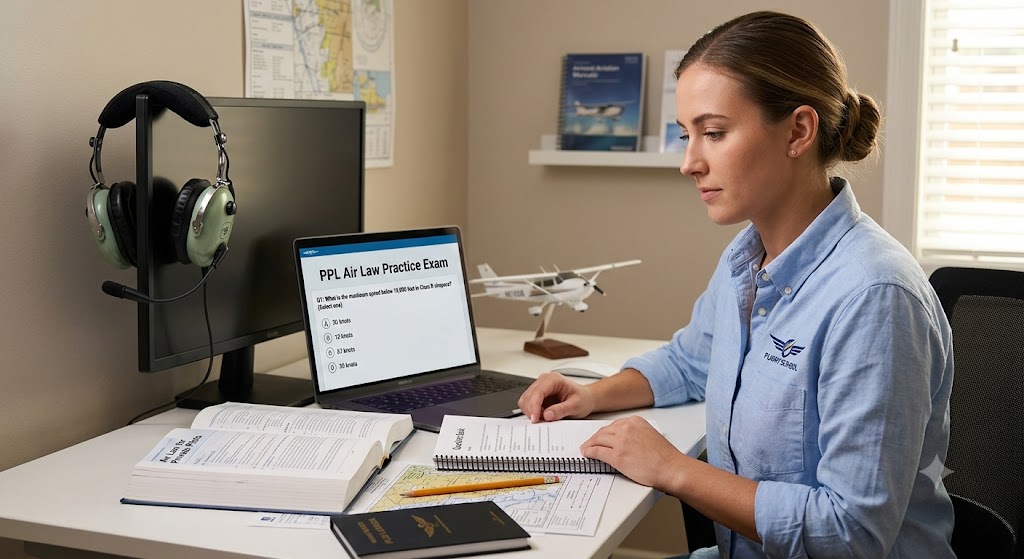
Additional Information
What the Course Entails and Exam Details
The PPL Air Law curriculum is built around the essential legal and regulatory principles of flight. It equips you with the knowledge needed to ensure every operation complies with civil aviation authority standards. This study and practice series dives into the regulatory landscape, providing clarity on how rules are structured and enforced.
The core areas and syllabus covered include:
Rules of the Air: Detailed study of international standards (ICAO Annexes) and specific national rules, covering visual flight rules (VFR), right-of-way, and operational constraints.
Airspace Classifications: Understanding different classes of controlled and uncontrolled airspace, their specific requirements, and the services provided within them.
Flight Documentation: Knowledge of required aircraft documents, pilot licensing, medical certificates, and required logbook entries.
Operational Procedures: Rules concerning takeoffs, landings, navigation, radio communications, and emergencies.
Safety and Regulations: Specific laws on alcohol and drugs in aviation, minimum altitudes, weather minimums, and accident reporting.
Search and Rescue: Responsibilities of pilots and authorities in distress situations.
By testing your understanding of these critical topics through structured practice, you'll be well-prepared to identify relevant laws and apply them effectively during your flight training and as a licensed pilot.
What to Expect in the Final Exam
While the exact structure of the official PPL Air Law exam can vary depending on your national aviation authority (such as the FAA in the US or EASA in Europe), there are common elements across most jurisdictions. When you face the actual written knowledge test, you should expect the following format and conditions:
Format: The exam is typically a multiple-choice examination. Each question will provide several options, and you must select the most correct answer based on current regulations.
Passing Score: The required passing score is generally around 70% to 80%, with some authorities using specific point totals or percentages that equate to a strong understanding of the material.
Time Limits: You will have a defined time limit to complete the test, typically ranging from one to two hours, designed to ensure you can quickly recall and apply the necessary information.
Specific Rules: No external study materials, textbooks, or personal notes are permitted during the official exam. The test is usually computer-based at an authorized testing center and must be proctored to maintain integrity. Calculators and navigation computers are typically allowed for certain calculation questions.
How to Study and Exam Centers
Effectively preparing for the PPL Air Law exam requires a combination of structured study and consistent practice. Success depends not just on memorization but on understanding the underlying safety logic of the rules. Here are essential strategies:
Actionable Study Strategies:
Engage with Quality Resources: Utilize comprehensive PPL theory books, official civil aviation publications (like the FAR/AIM or equivalent national AIP), and structured online study guides that follow the national syllabus.
Frequent Practice Tests: This is crucial. Take multiple PPL Air Law practice tests, focusing on understanding why correct answers are right and why other options are incorrect. This simulator will help identify weak points.
Break Down Regulations: Don't try to memorize everything at once. Focus on one area, like Rules of the Air, complete focused practice, then move on. Use charts and diagrams to visualize airspace categories.
Review and Retain: Make flashcards for essential acronyms, airspace requirements, and regulatory limits. Review current material from official sources, as regulations can change.
Where to Take the Exam:
The official PPL written exams are administered at authorized testing centers. These are typically specific facilities approved by the national civil aviation authority or aviation training organizations (ATO/Flight School). While learning and initial practice may happen online or in class, the final, official, proctored computer-based test must be taken at one of these physical testing centers. Check your national authority's website for specific testing locations and instructions.
Job Opportunities from the Course
While a Private Pilot License (PPL) is not designed for direct commercial employment (pilots cannot fly for compensation or hire with a PPL), obtaining this license and mastering the regulatory framework of Air Law is the essential first step toward countless aviation careers. The foundational knowledge and discipline gained are critical for safety and compliance, paving the way for these roles with further training and certifications:
Recreational Flying (Personal travel, flying friends and family)
Commercial Pilot (CPL) Path (Next major step to flying for hire)
Flight Instructor (CFI)
Air Traffic Controller (Requires specialized training, but Air Law is vital background)
Drone Pilot (Specifically for complex or certified commercial operations)
Flight Operations Officer / Dispatcher
Aviation Manager / Airline Operations (Understanding regulatory compliance)
Aircraft Insurance Professional
Aircraft Broker or Sales Agent
Airline Ground Crew / Passenger Service (Internal company mobility)
Frequently Asked Questions
Reviews
5.0
Based on 0 reviews
Leave a Review
No reviews yet. Be the first to review!