
Private Pilot License (PPL) Written Practice Exam
$69.00
- Buy to unlock unlimited access to all Quiz questions and Answers in this Quiz.
- After purchase you can print a PDF of the whole quiz at any point. The PDF will contain the questions and the correct answers.
About this Exam
The Private Pilot License (PPL) Written Practice Exam is an essential study tool designed for aspiring pilots who are working towards earning their first pilot certificate. This comprehensive resource aims to prepare students for the official Federal Aviation Administration (FAA) Private Pilot Airplane Knowledge Test. It offers a realistic simulation of the actual exam, covering all critical knowledge areas required to safely operate a small aircraft.
Ready to test your knowledge?
Buy Now to Access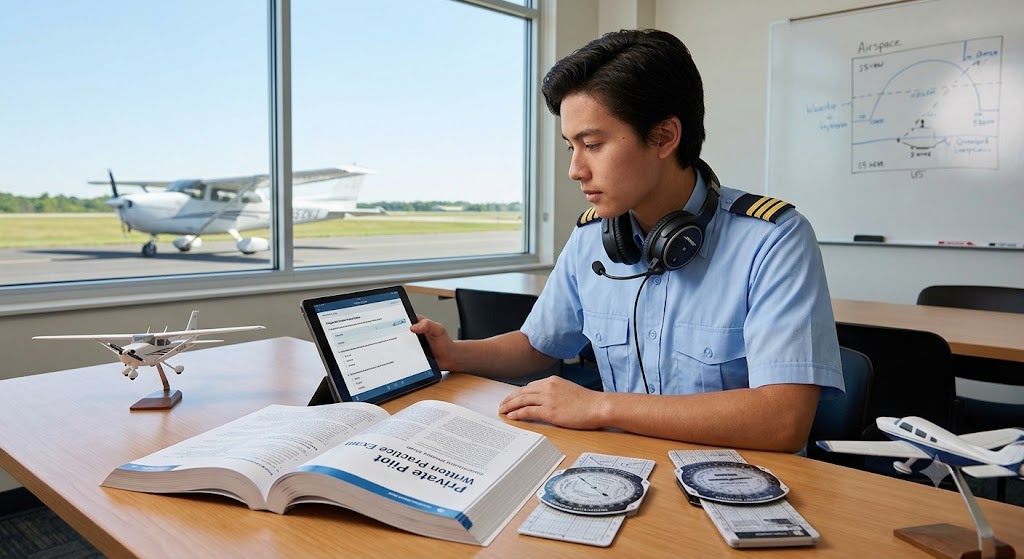
Additional Information
What the Course Entails and Exam Details
This practice exam covers the full spectrum of aeronautical knowledge required by the FAA for a Private Pilot certificate. The primary focus is on building a solid theoretical foundation. Key topics included in the extensive question bank are:
Aerodynamics and Aircraft Systems: Understanding how planes fly, control surfaces, engine operations, and basic flight instruments.
Flight Operations: Proper procedures for different phases of flight, including takeoffs, landings, and emergency operations.
Weather (Meteorology): Interpreting aviation weather reports (METARs, TAFs), understanding weather systems, and basic forecasting for pilots.
Navigation: Utilizing visual navigation techniques (dead reckoning), radio navigation aids (VORs, GPS), and reading aeronautical charts.
Federal Aviation Regulations (FARs): Mastering the rules of the sky, including airspace classifications, pilot requirements, and operating limitations.
Aircraft Performance and Weight & Balance: Calculating takeoff and landing distances, fuel consumption, and ensuring the aircraft is within its safe loading limits.
Communication Procedures: Understanding proper radio phraseology and air traffic control (ATC) procedures.
What to Expect in the Final Exam
The official FAA Private Pilot Knowledge Test is a computerized exam that you will take at an authorized testing center. While formats can occasionally be updated, you can generally expect the following for the final exam:
Exam Format: The test consists of approximately 60 multiple-choice questions. Each question typically has three possible answer choices.
Time Limit: You will typically be given 2 hours and 30 minutes to complete the entire exam.
Passing Score: A minimum score of 70% is required to pass the FAA knowledge test.
Materials: You will be provided with specific testing materials at the center, which may include a test supplement book containing figures and charts you must use to answer certain questions. You may also be allowed to bring your own approved non-programmable flight computer (E6B) and a basic calculator.
Rules: Cell phones and other unauthorized electronic devices are strictly prohibited. You will receive a score report immediately after completing the exam.
How to Study and Exam Centers
Effectively preparing for the PPL written exam requires a dedicated study plan combining several methods:
Take Multiple Practice Exams: This is the most effective strategy. Use comprehensive practice exams repeatedly to identify weak areas and get accustomed to the question format and time pressure. Review every answer, especially the ones you got wrong.
FAA Handbooks: Thoroughly read and study the core FAA publications, such as the Pilot's Handbook of Aeronautical Knowledge (PHAK) and the Airplane Flying Handbook. These are your primary sources.
Ground School Courses: Consider enrolling in an in-person or online ground school course. These structure your learning and provide valuable instructor feedback.
Flashcards and Study Guides: Use digital or physical flashcards for memorizing key definitions, regulations, and aircraft systems.
Where to Take the Exam: Official FAA knowledge tests are administered through specialized testing companies like PSI or specific flight schools that are authorized testing centers. You must register and schedule your exam in advance through their online portals.
Job Opportunities from the Course
Earning your Private Pilot License (PPL) is the fundamental first step on the path to many rewarding careers in aviation. While the PPL itself primarily allows for personal, non-commercial flying, it is the crucial gateway to higher ratings and commercial licenses. Here are the specific job titles and career paths this initial certification unlocks when combined with further training:
Specific Job Titles and Career Paths Unlocked:
Career Path: Commercial Pilot (e.g., Regional Airline, Major Airline)
Career Path: Certified Flight Instructor (CFI)
Career Path: Corporate/Charter Pilot
Career Path: Cargo Pilot
Career Path: Air Ambulance Pilot
Career Path: Aerial Photography/Surveying Pilot
Career Path: Agricultural Pilot (Crop Dusting)
Career Path: Banner Towing Pilot
Career Path: Ferry Pilot
Frequently Asked Questions
Reviews
5.0
Based on 0 reviews
Leave a Review
No reviews yet. Be the first to review!