
Probable Effect Concentration Quotients (PECQS) Practice Test
$69.00
- Buy to unlock unlimited access to all Quiz questions and Answers in this Quiz.
- After purchase you can print a PDF of the whole quiz at any point. The PDF will contain the questions and the correct answers.
About this Exam
Master the crucial concepts of ecological risk assessment with our comprehensive PECQS Practice Exam! Probable Effect Concentration Quotients (PECQS) are a pivotal tool in environmental science, allowing professionals to quantify the potential for adverse biological effects from chemical exposure in a consistent, scientifically sound manner.
This practice test is meticulously designed for environmental scientists, toxicologists, risk assessors, and students pursuing advanced qualifications in these fields. Mastering PECQS demonstrates your ability to interpret complex environmental data and effectively communicate ecological risk to stakeholders and regulatory bodies.
Get ready to enhance your expertise and prepare for professional assessments that feature this essential ecological risk assessment methodology.
Ready to test your knowledge?
Buy Now to Access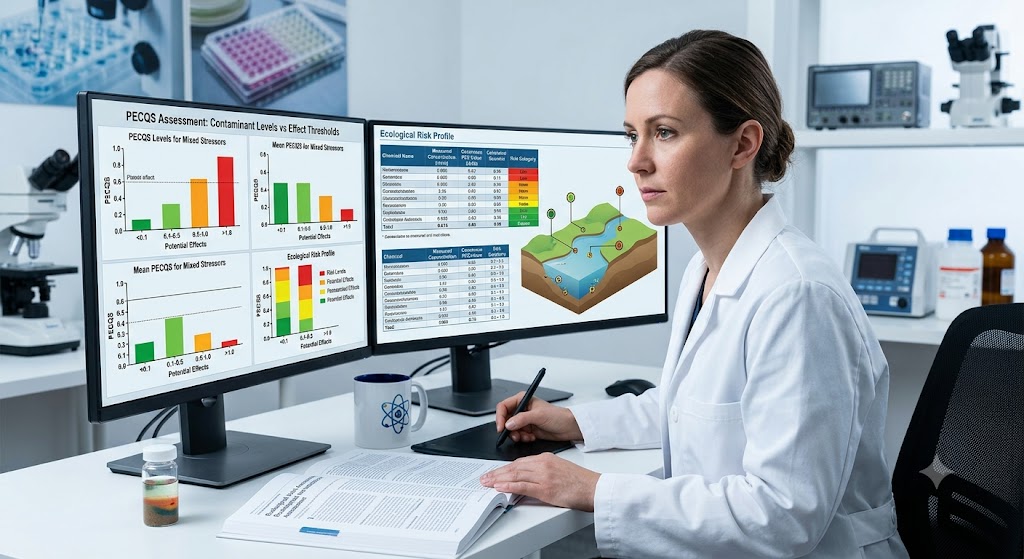
Additional Information
What the Course Entails and Exam Details
This practice exam tests your thorough understanding of the entire PECQS framework within the context of ecological risk assessment. Key areas covered include:
The Foundation of PECQS: Understand the theoretical background of combining measured chemical concentrations with established effect levels (PECs) to predict toxicity, with a focus on consensus-based guidelines for media such as sediment and water.
Calculation Mastery: Learn to precisely calculate individual PECQS for a wide range of chemicals and the mean PECQS for complex mixtures, a critical skill for assessing multi-stressor environments.
Interpretation and Application: Go beyond the numbers. Develop the expertise to interpret PECQS values and use them to make informed decisions and predictions about the likelihood of adverse ecological effects in real-world scenarios.
Risk Characterization and Communication: Learn how PECQS values are integrated into broader ecological risk characterizations and how to effectively present and explain these findings in professional and regulatory settings.
The actual exam format featured in relevant professional environmental and toxicology qualifications typically consists of a combination of multiple-choice questions, quantitative problems, and short conceptual application scenarios. This practice test mirrors those types of rigorous assessments.
What to Expect in the Final Exam
While the exact structure will vary depending on the specific certification or qualification, you can typically anticipate the following elements in an assessment of this nature:
Question Format: The final exam will primarily consist of clear and challenging multiple-choice questions, interspersed with calculation-based problems and potentially some short, scenario-based applications.
Timed Assessment: Be prepared to work under realistic time constraints. A typical assessment duration might range from 1 to 2 hours, reflecting the intensity and depth of knowledge required.
Passing Score: Professional qualifications often demand a high level of mastery. Expect a minimum passing score requirement, often around 70% to 75% or higher, reflecting the practical importance of understanding ecological risk.
Exam Integrity: Like any formal professional assessment, strict proctoring and rules will be in place to ensure academic and professional integrity. This often includes restrictions on materials and requires focused effort without outside assistance.
How to Study and Exam Centers
Effective preparation for assessments in ecological risk assessment involves a strategic approach:
Deepen Scientific Knowledge: Thoroughly review and understand the scientific literature and guidance documents relevant to PECQS and sediment/water quality guidelines. Resources from bodies like the EPA and USGS are invaluable.
Practice Calculations: Become comfortable and confident with both individual and mean PECQS calculations. Create and solve a variety of problem scenarios.
Review Case Studies: Examine real-world ecological risk assessments that utilize PECQS to understand practical applications, interpretations, and common challenges.
Utilize Practice Resources: Use practice exams, like this illustrative one, to identify knowledge gaps, familiarize yourself with different question formats, and refine your test-taking strategies.
Regarding exam locations, official assessments featuring scientific components like PECQS are not typically offered at dedicated, standalone "PECQS centers." Instead, these tests are part of broader qualifications offered through a range of authorized entities, which might include:
Academic Institutions: Many environmental science and toxicology degrees and certification programs are conducted and assessed within universities and colleges.
Professional Organizations: Environmental science and toxicology professional bodies frequently administer their own specialized certification exams.
Authorized Testing Centers and Portals: Qualifications from prominent professional boards are often delivered through established digital platforms or specialized, authorized physical testing centers that ensure security and standardized testing conditions, with some offering secure online proctoring options.
Job Opportunities from the Course
Expertise in PECQS and advanced ecological risk assessment methodologies is highly sought after across a variety of environmental and scientific sectors. Mastering this area significantly enhances your career prospects and professional standing in roles such as:
Ecological Risk Assessor: Directly applying PECQS to evaluate and quantify potential risks to ecosystems from chemical exposure for regulatory compliance, environmental quality monitoring, and remediation planning.
Environmental Toxicologist: Designing and conducting toxicological studies, interpreting effects data, and integrating research findings into risk assessment frameworks like PECQS.
Environmental Scientist / Consultant: Assisting government agencies, industry clients, and non-profits in managing environmental quality, preparing regulatory documentation, and developing sustainable solutions that incorporate robust risk assessment.
Ecotoxicological Modeler: Developing and utilizing quantitative models to predict the environmental fate, transport, and potential effects of contaminants, which frequently informs the application of PECQS.
Regulatory Specialist: Reviewing and evaluating scientific data, including PECQS-based risk assessments, to ensure compliance with environmental regulations and policies.
Environmental Data Analyst: Collecting, analyzing, and interpreting complex environmental data sets, with specialized knowledge enabling deeper insights into ecological risk characterizations.
Frequently Asked Questions
Reviews
5.0
Based on 0 reviews
Leave a Review
No reviews yet. Be the first to review!