
Process Safety Management Practice Exam
$69.00
- Buy to unlock unlimited access to all Quiz questions and Answers in this Quiz.
- After purchase you can print a PDF of the whole quiz at any point. The PDF will contain the questions and the correct answers.
About this Exam
The Process Safety Management (PSM) regulation, established by OSHA in the United States and similar global bodies, is crucial for industries handling highly hazardous chemicals. Its core objective is to prevent catastrophic releases that could cause harm to employees, the community, and the environment. This practice exam is specifically designed as a powerful study and assessment tool for professionals looking to master these complex regulations. It is ideal for Process Safety Engineers, HSE Managers, Operations Supervisors, Compliance Auditors, and anyone involved in the design, operation, maintenance, or inspection of covered processes. This practice exam enables you to evaluate your current knowledge, identify critical gaps, and build the confidence necessary to excel in a formal PSM certification or a professional competency assessment within your organization.
Ready to test your knowledge?
Buy Now to Access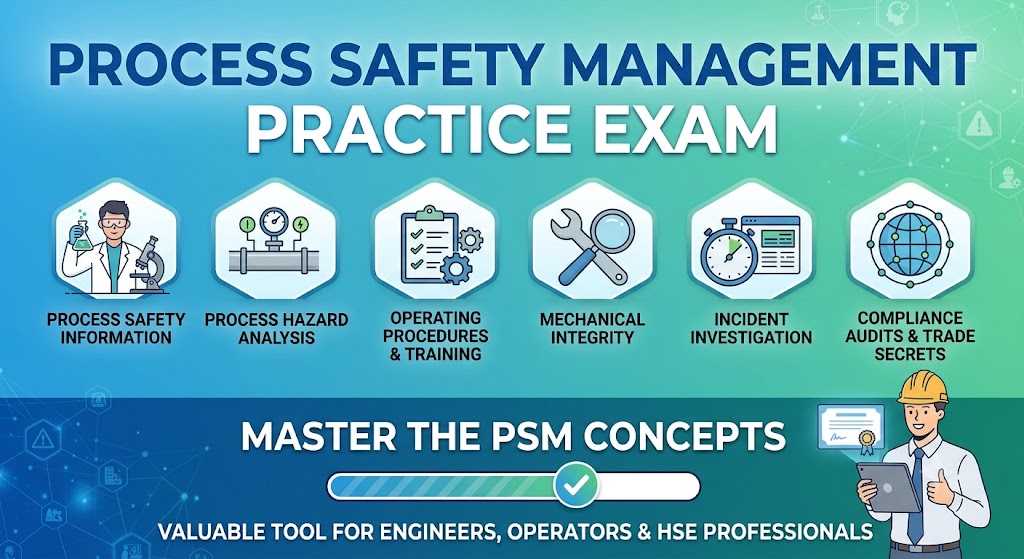
Additional Information
What the Course Entails and Exam Details
While this practice exam is a standalone assessment tool, the comprehensive "course" or syllabus it covers delves deep into the 14 essential elements of the OSHA PSM standard (or equivalent international standards). The material and subsequent exam questions are meticulously designed to validate your understanding of how to manage hazards associated with highly hazardous chemicals throughout a process's life cycle.
The core syllabus topics you must master include:
Process Safety Information (PSI): Compiling complete and accurate information concerning process chemicals, technology, and equipment.
Process Hazard Analysis (PHA): Utilizing methodologies like HAZOP or What-If to identify, evaluate, and control hazards.
Operating Procedures: Developing and implementing clear, written instructions for safe operations.
Training: Ensuring employees and contractors are fully trained on processes and safety procedures.
Contractors: Verifying contractor safety performance and training.
Pre-Startup Safety Review (PSSR): Conducting a critical review before introducing hazardous chemicals into a new or modified process.
Mechanical Integrity (MI): Establishing procedures to ensure equipment is designed, installed, and maintained properly.
Hot Work Permit: Controlling sparks and open flames in covered process areas.
Management of Change (MOC): Managing changes to process chemicals, technology, equipment, and procedures.
Incident Investigation: Analyzing incidents and near-misses to determine root causes and prevent recurrence.
Emergency Planning and Response: Developing and implementing an emergency action plan.
Compliance Audits: Conducting self-audits to certify compliance with the PSM standard at least every three years.
Trade Secrets: Ensuring that necessary information is available to those who need it while protecting proprietary data.
Employee Participation: Actively involving employees and their representatives in all elements of PSM.
What to Expect in the Final Exam
While the exact structure depends on the specific body issuing a formal certification, you should expect a challenging and comprehensive final exam. Most professional safety exams use a Multiple-Choice Question (MCQ) format, often incorporating scenario-based questions that require you to apply PSM principles to real-world industrial situations, rather than simply recalling definitions.
Key exam logistics often include:
Format: A computer-based test consisting of a specific number of questions (e.g., 50 to 100).
Passing Score: Typically ranges from 70% to 80% to demonstrate a sufficient level of competency.
Time Limit: You will be given a set duration (e.g., 2 to 3 hours) to complete the entire exam. Effective time management is critical.
Rules: The exam is usually closed-book, prohibiting the use of references or textbooks. Scratches paper is often provided and collected afterward.
How to Study and Exam Centers
Preparation is the key to success. A effective study strategy involves a multi-faceted approach.
Actionable Study Strategies:
Deep-Dive into Regulations: Begin by thoroughly reading the entire relevant standard (e.g., OSHA 29 CFR 1910.119). Understand the nuance of every requirement.
Use Authorized Study Guides: Utilize official study guides or textbooks provided by the certifying body. These resources are often tailored to the exam’s learning objectives.
Leverage Practice Exams (Like This One!): Take the practice exam early to benchmark your current knowledge. Use your results to identify weak areas. Re-take the practice exam later to track your progress and build confidence. Focus on why correct answers are right and why distractors are wrong.
Apply Concepts practically: Relate PSM elements to your daily workplace. Think about how MOC or PSSR is conducted in your facility.
Form Study Groups: Collaborating with colleagues who are also studying can clarify difficult concepts and offer different perspectives.
Exam Centers:
When you are ready to take the formal, final exam for a certification (e.g., from an organization like the Board of Certified Safety Professionals (BCSP) or specialized engineering/safety institutes), you will typically register through the certifying body's website. They will direct you to a designated testing partner.
Most major certification exams are administered at:
Pearson VUE Testing Centers: A global network of computer-based testing locations.
Prometric Testing Centers: Another large network of professional assessment centers.
Online Proctored Exams: Depending on the certification provider, you may have the option to take the exam remotely from a secure location, utilizing online proctoring technology.
Job Opportunities from the Course
Mastering the principles of Process Safety Management unlocks numerous career pathways within high-hazard industries. Organizations are constantly seeking professionals who can help them meet their regulatory requirements and, most importantly, prevent catastrophic incidents.
The specific job titles and career paths this certification and competency unlock include:
Process Safety Engineer
HSE (Health, Safety, and Environment) Manager
Compliance Auditor
Risk Management Specialist
Chemical Engineer (with PSM specialization)
Mechanical Integrity Engineer
Operations Supervisor / Manager (in covered processes)
Process Safety Coordinator
PHA (Process Hazard Analysis) Facilitator
Loss Prevention Engineer
Maintenance Manager (in high-hazard facilities)
Frequently Asked Questions
Reviews
5.0
Based on 0 reviews
Leave a Review
No reviews yet. Be the first to review!