
Professional Development Certification Practice Exam
$69.00
- Buy to unlock unlimited access to all Quiz questions and Answers in this Quiz.
- After purchase you can print a PDF of the whole quiz at any point. The PDF will contain the questions and the correct answers.
About this Exam
The Project Management Professional (PMP) certification is the world’s leading project management qualification. Administered by the Project Management Institute (PMI), the PMP validates a professional’s experience and competency in leading and directing projects. It is designed for experienced project managers across all industries, including IT, construction, finance, and healthcare, who want to solidify their skills, increase their earning potential, and gain a globally recognized credential. A PMP practice exam is an essential diagnostic tool, enabling candidates to assess their readiness, understand the logic behind official questions, and simulate the pressure of the final test.
Ready to test your knowledge?
Buy Now to Access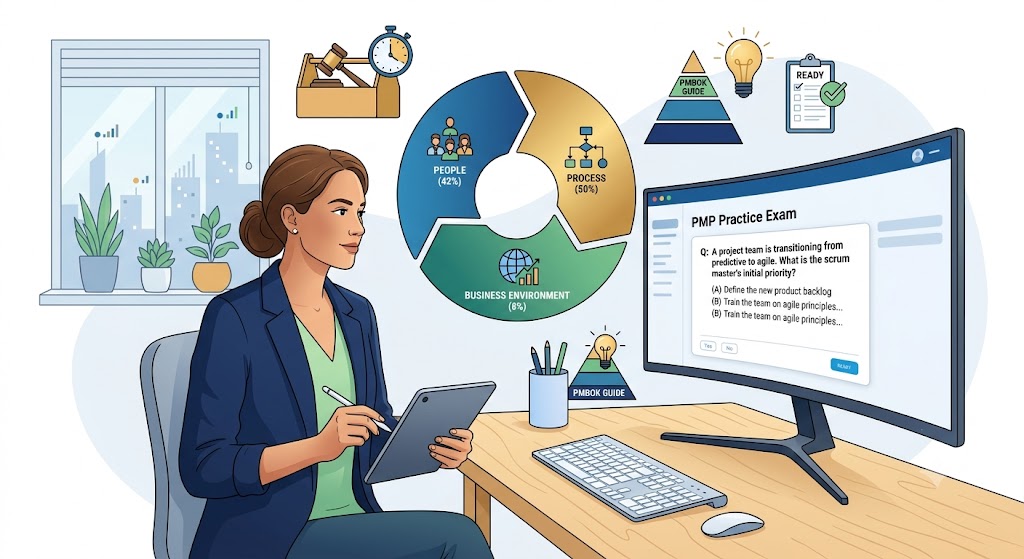
Additional Information
What the Course Entails and Exam Details
The PMP certification is not based on a specific course syllabus but on the comprehensive Project Management Body of Knowledge (PMBOK® Guide), alongside various Agile and Hybrid methodologies. The exam content is structured around three key performance domains:
People (42%): This domain focuses on the soft skills required to effectively lead a project team in a modern environment, including conflict management, team building, mentoring, and supporting virtual teams.
Process (50%): This section covers the technical aspects of managing a project from initiation to closure. It tests knowledge of various project management methodologies, including predictive (waterfall), agile, and hybrid approaches, ensuring you can select the right process for the project context.
Business Environment (8%): This domain evaluates your understanding of the connection between projects and organizational strategy. Topics include compliance, delivering organizational value, and supporting organizational change.
A robust PMP practice exam mirrors this 42/50/8 split, providing weighted questions that accurately test your knowledge in each area.
What to Expect in the Final Exam
The actual PMP exam is a rigorous, 230-minute test consisting of 180 questions. Of these 180 questions, 5 are pre-test questions that do not count towards your score. The question formats are diverse, designed to test situational analysis rather than simple memorization. You can expect:
Multiple-choice questions
Multiple-response questions
Matching questions
Hotspot questions
Limited fill-in-the-blank questions
There is no fixed passing percentage; PMI uses a sound psychometric analysis (modified Angoff) to determine the passing score based on the difficulty of the unique set of questions you receive. The exam includes two 10-minute breaks, and the entire session is professionally proctored. Understanding these structural details is vital for pacing, which is why taking a full-length, simulated PMP practice exam is highly recommended.
How to Study and Exam Centers
Effective study for the PMP requires a structured approach. Candidates should begin by deeply studying the current PMBOK® Guide and the Agile Practice Guide, both published by PMI. Using a PMP exam prep book from a reputable author can also provide simplified explanations and alternative perspectives. However, study alone is insufficient. Active learning through a PMP practice exam is critical. A high-quality practice exam must provide detailed explanations for both correct and incorrect answers, helping you correct logical gaps in your reasoning.
The PMP exam can be taken in two ways:
In-Person Testing: You can schedule your exam at a local Pearson VUE testing center. These physical centers provide a dedicated, secure, and quiet environment.
Online Proctored Testing: Alternatively, you can take the exam from the comfort of your home or office. This option requires a strong internet connection, a functioning webcam, and a private, secure, and well-lit space. The exam is administered through an online proctor via a secure browser.
Both options must be scheduled through the PMI website after your application has been approved.
Job Opportunities from the Course
Earning your PMP certification is a powerful career catalyst. Research consistentlly shows that PMP-certified project managers command significantly higher salaries compared to their non-certified counterparts and are more likely to be entrusted with high-value, critical projects. The PMP unlocks a wide range of job opportunities and career paths, including:
Project Manager
Senior Project Manager
IT Project Manager
Construction Project Manager
Program Manager
Portfolio Manager
Project Management Office (PMO) Director
Operations Manager
Consultant
Product Manager
Frequently Asked Questions
Reviews
5.0
Based on 0 reviews
Leave a Review
No reviews yet. Be the first to review!