
Professional Military Knowledge Eligibility Exam (PMK-EE) E4 Naval Heritage Practice Exam
$69.00
- Buy to unlock unlimited access to all Quiz questions and Answers in this Quiz.
- After purchase you can print a PDF of the whole quiz at any point. The PDF will contain the questions and the correct answers.
About this Exam
The Professional Military Knowledge Eligibility Exam (PMK-EE) E4 is a critical step for United States Navy Sailors seeking advancement to Petty Officer Third Class (E4). This specific exam section focusing on Naval Heritage is mandatory and must be successfully completed before a Sailor is eligible to take the Navy Wide Advancement Exam (NWAE). It ensures that all prospective E4s possess a foundational understanding of the history, traditions, and core values that define the U.S. Navy as an institution.
Ready to test your knowledge?
Buy Now to Access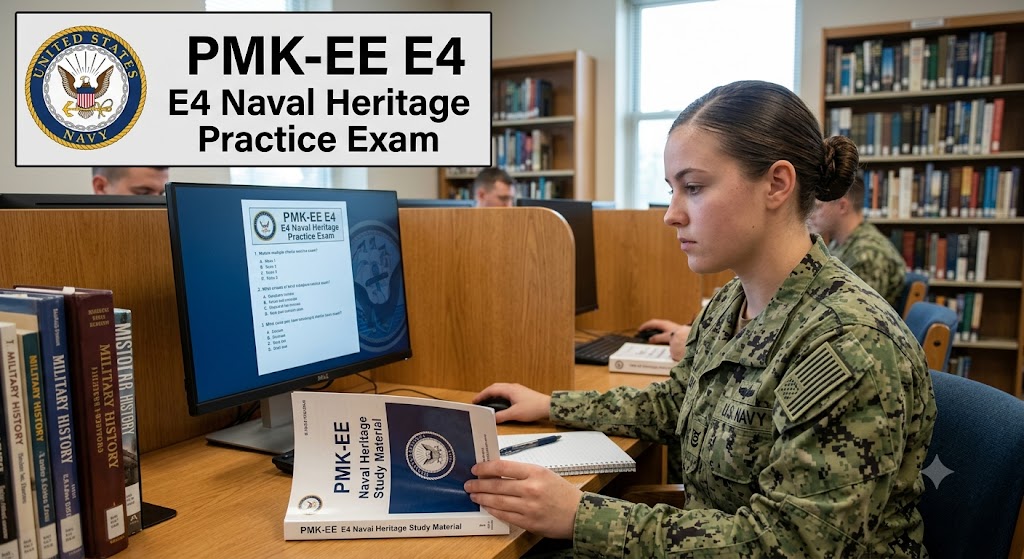
Additional Information
What the Course Entails and Exam Details
The PMK-EE E4 Naval Heritage section covers a diverse range of historical events, pivotal figures, traditions, and leadership philosophies. It tests a Sailor's grasp of the foundational elements that shaped the modern Navy. Core areas typically include:
Major historical events and significant naval conflicts from the Revolutionary War through the modern era.
Contributions and biographies of famous naval heroes and influential leaders.
The origins and evolution of the Navy's rate structure, ranks, and uniform traditions.
A detailed understanding of the core values (Honor, Courage, Commitment) and the historical context of the Sailor’s Creed.
Key concepts of naval customs, courtesies, and ceremonial traditions.
Important pieces of naval legislation and policies that have impacted the Service.
This material isn't just about dates and facts; it connects current service members to the legacy they uphold.
What to Expect in the Final Exam
The final PMK-EE E4 Naval Heritage assessment is designed to be rigorous yet fair, utilizing standard military testing practices. Here is what Sailors can generally expect:
Format: The exam consists entirely of computerized, multiple-choice questions.
Delivery: It is administered electronically through official Navy platforms.
Score: Sailors must achieve a passing score, typically 80% or higher. A failure requires retaking the entire Heritage section.
Time Limit: The exam is usually timed, allowing Sailors a specified period (e.g., 60-90 minutes) to complete all questions.
Content: Questions are derived directly from the official bibliographies provided by the Navy Advancement Center (NAC).
How to Study and Exam Centers
Preparation is paramount for success on the PMK-EE. The most effective study strategies are:
Consult the Official Bibliography: The Navy Advancement Center publishes specific reading lists and reference manuals (e.g., Naval Military Personnel Manual, official history publications) which form the basis of all exam questions.
Utilize Official Study Guides and Apps: The Navy often provides official study materials, including the PMK-EE mobile application, which includes flashcards and practice quizzes.
Practice with Mock Exams: Engaging with realistic practice tests, like the [PMK-EE E4 Naval Heritage Practice Exam], helps familiarize you with the question formatting and time constraints.
Create Structured Study Groups: Reviewing material with peers can reinforce complex historical events and traditions.
The PMK-EE is not taken at a commercial testing center like Pearson VUE. Instead, it is accessed online through official government portals. Sailors must take the exam via Navy e-Learning (NeL) or the MyNavy Portal (MNP) environment, typically using a designated computer on a military installation requiring Common Access Card (CAC) authentication.
Job Opportunities from the Course
While passing the PMK-EE E4 Naval Heritage exam does not directly grant a new job title, it is the fundamental eligibility requirement that unlocks the path to advancing to Petty Officer Third Class (E4). This advancement opens numerous career opportunities within the Navy, including:
Eligibility for the NWAE: Successful completion makes you eligible to sit for the Navy Wide Advancement Exam in your specific rating (e.g., OS3, HM3, IT3).
Increased Responsibility: Advancing to E4 marks the transition from junior Sailor to a Non-Commissioned Officer (NCO), involving greater leadership roles and supervisory duties.
Higher Pay Grade: Promotion to E4 results in a significant increase in base pay and associated allowances.
Career Progression: It is the first critical milestone in a successful long-term naval career, leading to further advancement opportunities (E5, E6, etc.) and specialized training pipelines.
Frequently Asked Questions
Reviews
5.0
Based on 0 reviews
Leave a Review
No reviews yet. Be the first to review!