
Professional Military Knowledge Eligibility Exam (PMK-EE) For E7 Practice Exam
$69.00
- Buy to unlock unlimited access to all Quiz questions and Answers in this Quiz.
- After purchase you can print a PDF of the whole quiz at any point. The PDF will contain the questions and the correct answers.
About this Exam
The Professional Military Knowledge Eligibility Exam (PMK-EE) for E7 is a critical, electronic exam that all United States Navy First Class Petty Officers (E6) must pass before they can be considered by the annual E7 selection board. It is the first major milestone in a Sailor's journey toward promotion to Chief Petty Officer.
This mandatory requirement tests knowledge crucial for senior enlisted leaders, ensuring that only the most dedicated and professionally prepared individuals advance. Successful completion unlocks the opportunity to have their record reviewed for selection to the distinguished rank of Chief Petty Officer, a pivotal career achievement.
Ready to test your knowledge?
Buy Now to Access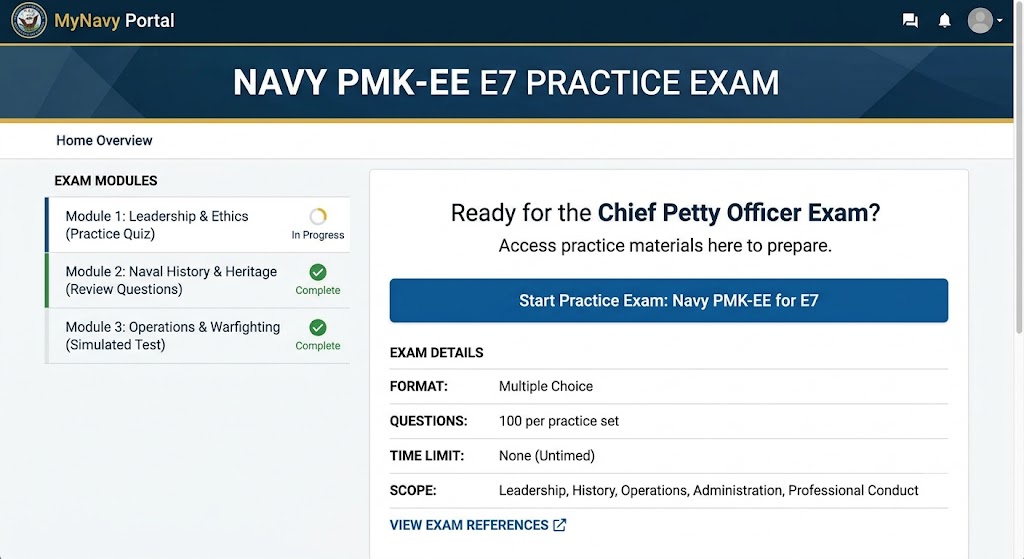
Additional Information
What the Course Entails and Exam Details
The PMK-EE for E7 covers five comprehensive subject areas essential for effective leadership at the senior enlisted level. A passing score in each of these sections demonstrates a candidate’s grasp of professional military knowledge required for E7 responsibilities. The key focus areas generally include:
Leadership and Ethics: Covers core Navy leadership philosophies, ethical decision-making, mentoring, and personnel management.
Professional Conduct: Focuses on instructions concerning sexual harassment, equal opportunity, drug and alcohol abuse, and personal finances.
Naval History and Heritage: Challenges knowledge of significant historical Navy events, major figures, battles, and the progression of the Service.
Operations and Warfighting: Includes Navy organizational structure, damage control, emergency procedures, watchstanding, and general military subjects.
Administration and Programs: Tests familiarity with Navy publications, leave policy, evaluations, career development programs, and benefits.
Candidates must prepare across all five domains to ensure readiness for the exam.
What to Expect in the Final Exam
The PMK-EE for E7 is administered purely online through the Navy Advancement Center (NAC) portal. Candidates can expect a standard multiple-choice format with questions pulled randomly from a large topic database, testing knowledge across all specified sections. A passing score of 80% or higher is required for each individual subject area to successfully complete the overall exam.
The time limit typically allows for roughly one hour to complete the full series of tests. If a candidate fails a section, they must only retake that specific section, after a mandatory waiting period. The exam is not proctored by an external entity, making it highly accessible to Sailors globally on any government computer or even personal devices with proper access.
How to Study and Exam Centers
Preparation is key to success on the PMK-EE. The most effective strategy involves active study using the comprehensive "References" tab available directly on the MyNavy Portal (MNP) within the Navy Advancement Center section.
Actionable Study Strategies: Prioritize reading official Navy instructions and publications (e.g., OPNAVINST, BUPERSINST). Use practice quizzes and flashcard applications to reinforce memory. Form study groups with other candidates to discuss topics and explain concepts, which deepens understanding. Utilize practice questions available on Navy e-Learning and the mobile Navy Advancement Center (NAC) app.
Accessing the Exam: The PMK-EE E7 is taken online through the Navy Advancement Center portal on the MyNavy Portal (MNP) website. Sailors must log in using their Common Access Card (CAC). There are no physical "exam centers" like Pearson VUE or authorized schools; the test is self-administered online. It can be accessed on NIPRNET (government network) computers, making it convenient while at sea or a permanent duty station.
Job Opportunities from the Course
Passing the PMK-EE for E7 is not just about completing a requirement; it is the prerequisite gate to achieving one of the most respected ranks in the United States military: Chief Petty Officer. Successfully completing this exam unlocks the opportunity for promotion and leadership roles such as:
Navy Chief Petty Officer (CPO): A prestigious position with significant leadership responsibilities and increased influence within the command.
Leading Chief Petty Officer (LCPO): Senior leadership at the departmental or division level, supervising large teams and ensuring operational readiness.
Division Chief: Managing personnel, technical operations, and training within a specific shipboard or shore-based division.
Training Chief: Leading and overseeing the command's training programs to enhance mission performance.
Senior Enlisted Advisor (SEA): A progression path leading to critical roles advising commanders on personnel and mission-critical matters.
Frequently Asked Questions
Reviews
5.0
Based on 0 reviews
Leave a Review
No reviews yet. Be the first to review!