
Professional Nursing EAQ – Self Concept Practice Test
$69.00
- Buy to unlock unlimited access to all Quiz questions and Answers in this Quiz.
- After purchase you can print a PDF of the whole quiz at any point. The PDF will contain the questions and the correct answers.
About this Exam
Welcome to the comprehensive overview of the Professional Nursing EAQ – Self Concept Practice Test. This formative assessment tool is powered by Elsevier Adaptive Quizzing (EAQ) and is designed specifically for nursing students and professionals preparing for high-stakes licensure exams like the NCLEX-RN® or seeking to refine their clinical understanding of patient self-perception. Understanding a patient's self-concept is fundamental to delivering holistic, patient-centered care. This practice test provides a focused environment to assess your knowledge of this critical nursing concept through dynamic, adaptive questioning. It’s an ideal resource to boost confidence, identify areas for improvement, and practice the critical thinking skills required for real-world clinical scenarios and competitive examinations.
Ready to test your knowledge?
Buy Now to Access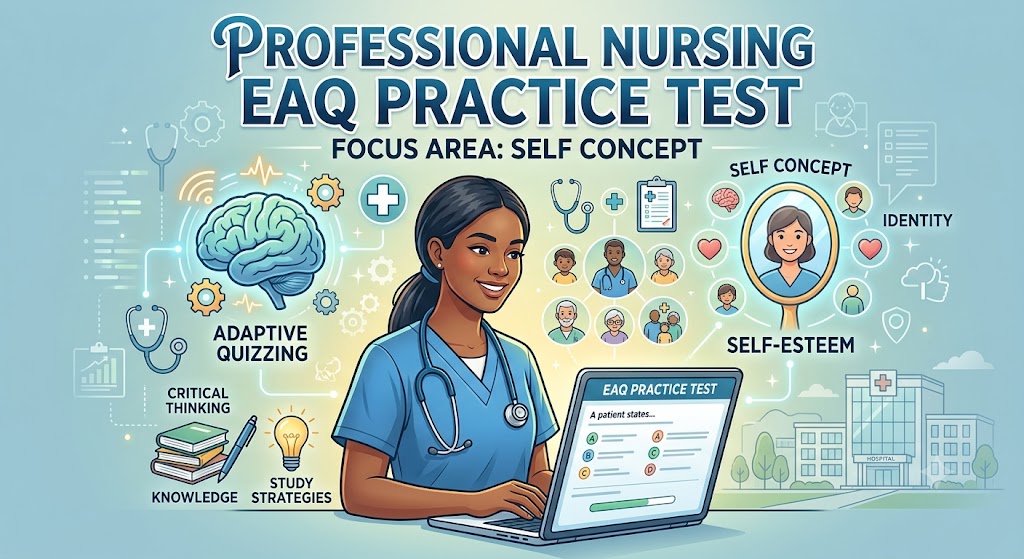
Additional Information
What the Course Entails and Exam Details
The Self-Concept Practice Test focuses on a core tenet of nursing fundamentals and psychosocial well-being. EAQ uses an intelligent, adaptive algorithm that serves up personalized questions based on your previous performance, ensuring that your practice time is spent effectively. Key topics and skills covered in this specific EAQ set include:
Understanding Self-Concept: Definitions, components, and factors affecting self-perception across the lifespan.
Assessment of Self-Concept: Techniques and critical elements in assessing a patient’s identity, body image, self-esteem, and role performance.
Identification of Alterations: Recognising manifestations of low self-esteem, distorted body image, role conflict, and personal identity confusion.
Nursing Interventions: Developing and implementing therapeutic communication, supportive actions, and education strategies to promote a positive self-concept in patients facing health challenges or transitions.
Holistic Care & Communication: Applying knowledge of self-concept to provide empathetic care, improve therapeutic rapport, and respect diversity in patient experience.
Factors and Indicators: Understanding internal (psychological, cultural) and external (social, health-related) factors and key behavioral and verbal indicators of self-concept status.
While "EAQ" is a platform that hosts many modules, this practice test specifically targets the "Self Concept" content domain. It functions as a focused learning experience rather than a standalone formal course.
What to Expect in the Final Exam
As this is a practice test on the EAQ platform, it is important to understand its purpose and typical functioning compared to a final, graded certification or licensure exam:
Format: Questions are usually multiple-choice, select all that apply (SATA), drag-and-drop, matching, or based on clinical scenarios. EAQ questions often simulate the style and complexity of NCLEX items.
Adaptive Nature: The platform will adjust the difficulty of subsequent questions based on your correctness, targeting your current level of mastery and helping you advance.
Practice Mode vs. Assessment Mode: Depending on how your institution configures it, you may use it in a study mode with rationales provided immediately, or a simulated exam mode with feedback at the end.
Passing Score/Requirements: In a practice context, a "passing score" isn't standard in the same way as the NCLEX. EAQ is typically used to gauge mastery levels across content areas. Your goal is to achieve consistency, improve your proficiency scores, and decrease your reliance on explanations. The passing standard would be defined by your individual nursing program or your personal goal for knowledge retention.
Time Limits and Question Count: The number of questions and presence of a timer can vary. You can often set custom practice sessions (e.g., 20 questions, 60 minutes) or work through entire content banks.
Rules: The core rule is to use it honestly as a learning tool. While generally flexible, it encourages independent thought and ethical practice for true readiness.
How to Study and Exam Centers
Actionable Study Strategies:
Review Your Course Material: Before diving into the practice test, review relevant chapters in your nursing fundamentals or medical-surgical textbooks. Pay close attention to definitions, assessment findings, and standard nursing interventions.
Utilize EAQ Correctly: Read the rationales for every question you answer, both correct and incorrect. This is where the real learning happens. Understand the "why" behind the best response and why other options were less suitable.
Focused Study: Identify the concepts or types of questions you consistently struggle with in the EAQ and go back to your educational resources for deeper review on those specific areas.
Practice Critical Thinking: For each question, ask yourself: what is the patient’s primary need or problem? What information is most relevant? How does the nurse's role best address this with a positive self-concept in mind?
Consistent Practice: Dedicate regular study blocks to using the EAQ. Short, focused sessions are often more effective than marathon cramming.
Group Discussion: Discuss challenging scenarios or concepts related to self-concept with peers to gain different perspectives and solidify understanding.
How to Access (Exam Centers):
Access: This Professional Nursing EAQ practice test is not taken at a physical testing center like Pearson VUE. It is generally accessed through an online portal provided by your nursing school or an authorised individual subscription to Elsevier resources (like Evolve). You would log in using your academic or personal credentials from any location with internet access.
Verification: Ensure your access is current and that you have navigated to the correct EAQ modules and the "Self Concept" practice bank as assigned or desired. Consult your institution's specific instructions for initial setup and access.
Job Opportunities from the Course
A robust understanding of self-concept and psychosocial patient care, as reinforced by this EAQ practice test and associated coursework, is essential across nearly all nursing roles and is particularly valuable for specialized career paths. Here are job titles and areas where this expertise is key:
Registered Nurse (RN) / Licensed Practical Nurse (LPN/LVN): Foundational to holistic care in hospitals, clinics, and long-term care facilities.
Mental Health / Psychiatric Nurse: Crucial for managing patients with depression, anxiety, eating disorders, and personality disorders.
Oncology Nurse: Supporting patients facing life-altering diagnoses and treatment side effects.
Medical-Surgical Nurse: Vital for patients undergoing major surgeries, body changes, or living with chronic illness.
Gerontological Nurse: Understanding self-concept transitions in older adults facing loss or cognitive changes.
Pediatric / Adolescent Nurse: Supporting children and teens through identity development and health challenges.
Maternal-Newborn Nurse: Supporting positive self-concept in new mothers during major life transitions.
Home Health Nurse: Providing tailored support in the patient's home environment.
Hospice and Palliative Care Nurse: Ensuring dignity and supportive care during end-of-life.
Community Health Nurse: Promotes well-being within populations, including psychosocial support programs.
Counselor (with further qualification): Advanced career path leveraging counseling and deep understanding of self-perception.
Nurse Educator / Academic: Teaching these core concepts to future generations of nurses.
Advanced Practice Roles (e.g., Clinical Nurse Specialist): Specialized roles that incorporate profound understanding of holistic health concepts.
Case Manager: Assessing patient needs holistically, including psychosocial support requirements for effective care plans.
Frequently Asked Questions
Reviews
5.0
Based on 0 reviews
Leave a Review
No reviews yet. Be the first to review!