
Property and Casualty Insurance Practice Exam
$69.00
- Buy to unlock unlimited access to all Quiz questions and Answers in this Quiz.
- After purchase you can print a PDF of the whole quiz at any point. The PDF will contain the questions and the correct answers.
About this Exam
The Property and Casualty Insurance Licensing Exam is a mandatory requirement for individuals seeking to legally sell, solicit, or negotiate property and casualty insurance products in their state. This comprehensive certification validates an applicant’s understanding of essential insurance concepts, policy coverages, and state-specific regulations.
Designed for aspiring insurance agents, brokers, and risk management professionals, this exam ensures that practitioners possess the knowledge necessary to advise clients responsibly and ethically regarding protecting their assets—such as homes, automobiles, and businesses—and managing liability risks. Passing this exam is the critical first step toward building a successful career in the dynamic insurance industry.
Ready to test your knowledge?
Buy Now to Access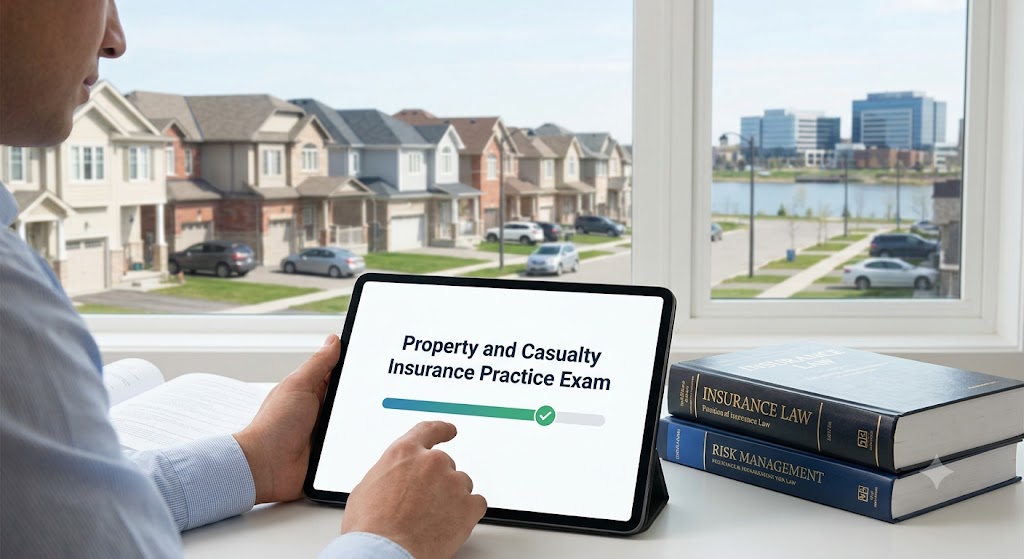
Additional Information
What the Course Entails and Exam Details
This examination assesses a candidate's knowledge across a broad syllabus divided into two primary sections: General Insurance Concepts and State-Specific Laws and Regulations.
The general section covers core topics including:
Insurance Basics: Principles of risk, insurable interest, indemnity, and the structure of insurance contracts.
Property Insurance: Detailed analysis of standard policies like Homeowners (HO), Dwelling, and Commercial Property, including covered perils, exclusions, and valuation methods.
Casualty Insurance: Liability concepts, negligence, and coverages provided by Automobile (Personal and Commercial), Workers’ Compensation, General Liability, and Professional Liability policies.
Standard Policy Provisions: Common clauses such as cancellation, non-renewal, deductibles, and coinsurance.
The second major component focuses exclusively on the laws and regulations specific to the state in which the candidate is seeking licensure, covering topics like licensing requirements, unfair trade practices, and state insurance department oversight.
What to Expect in the Final Exam
While exact specifications vary slightly by state, candidates can generally expect the state licensing exam to follow a standardized format. The final examination is a computer-based test consisting of multiple-choice questions.
The number of questions typically ranges from 100 to 150, and candidates are usually allotted a time limit of two to three hours to complete the test. A passing score, often set around 70%, is required to obtain the license.
The exam is administered in a strictly proctored environment to maintain integrity. It is a closed-book examination, and personal belongings are typically prohibited in the testing room. Immediate unofficial score results are often provided upon completion of the exam.
How to Study and Exam Centers
Preparation is paramount for success on the Property and Casualty exam. A comprehensive study strategy should include utilizing official state candidate handbooks, enrolling in a dedicated pre-licensing education course (either online or classroom-based), and leveraging practice exams to simulate the test-taking experience.
Focus on spaced repetition for vocabulary and understanding the subtle differences between various policy forms. Taking timed practice tests will not only highlight areas needing improvement but also help manage pacing on exam day.
Regarding logistics, the actual licensing exam is administered through authorized testing vendors. The primary providers nationwide are professional testing services such as Pearson VUE and Prometric. To register, candidates must typically visit the website of their state’s Department of Insurance or the specific testing vendor to schedule an appointment at a convenient, authorized physical testing center. Some states may offer proctored online testing options.
Job Opportunities from the Course
Successfully passing the Property and Casualty exam and obtaining your license unlocks numerous career paths within the insurance and financial services sectors.
Potential job titles include:
Insurance Agent (Producer): Representing one or multiple insurance companies to sell policies to individuals and businesses.
Insurance Broker: Acting on behalf of clients to find the best coverage options from various insurers.
Claims Adjuster: Investigating insurance claims to determine the extent of the insurer's liability.
Underwriter Assistant: Supporting underwriters in evaluating risks and determining policy terms and premiums.
Risk Manager: Identifying, analyzing, and mitigating risks for corporations or organizations.
Agency Manager: Overseeing the operations and sales team of an insurance agency.
Customer Service Representative (CSR): Assisting policyholders with policy changes, questions, and claims processing.
Frequently Asked Questions
Reviews
5.0
Based on 0 reviews
Leave a Review
No reviews yet. Be the first to review!