
Prosthetic CPM Practice Exam
$69.00
- Buy to unlock unlimited access to all Quiz questions and Answers in this Quiz.
- After purchase you can print a PDF of the whole quiz at any point. The PDF will contain the questions and the correct answers.
About this Exam
The Prosthetic Clinical Patient Management (CPM) exam is the final, practical hurdle on your path to becoming a Certified Prosthetist (CP) or a Certified Prosthetist-Orthotist (CPO). Designed for individuals who have completed their NCOPE-accredited residency, this high-stakes, hands-on exam evaluates your clinical skills, decision-making, and ability to manage real-world patient scenarios safely and effectively. It's not just a test of what you know, but how you apply that knowledge to provide quality, compassionate patient care. Passing this exam demonstrates your readiness to enter independent practice with the highest standards of the profession.
Ready to test your knowledge?
Buy Now to Access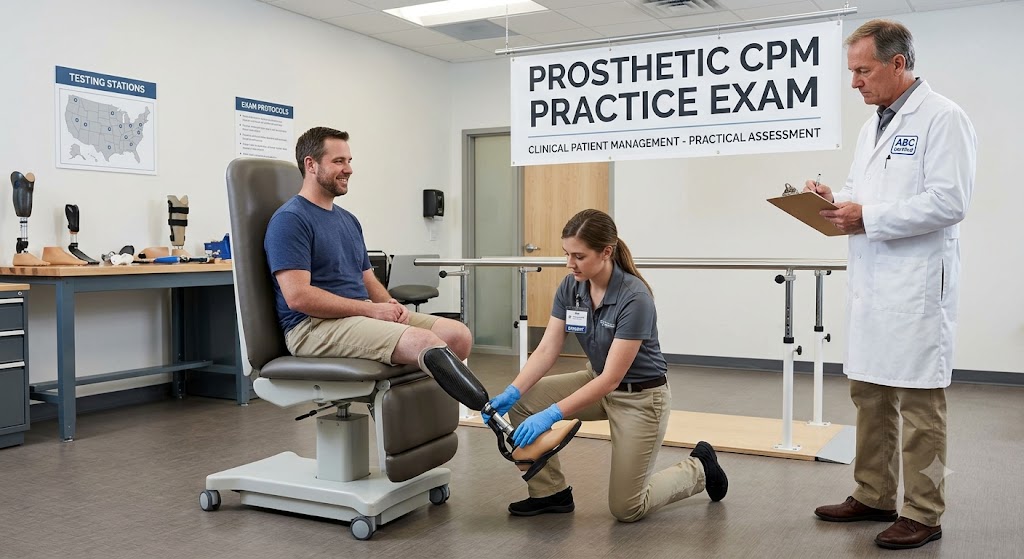
Additional Information
What the Course Entails and Exam Details
The content for the CPM exam is directly drawn from the Practice Analysis of the prosthetic profession, ensuring it tests the core competencies required for safe and effective practice. The exam focuses on three primary domains:
Patient Assessment: This includes history taking, physical examination (ROM, MMT, skin integrity), and observational gait analysis.
Formulation of the Treatment Plan: Based on your assessment, you must create a comprehensive plan, including prescription criteria, justification for component selection, and realistic expected outcomes.
Implementation of the Treatment Plan: This is the execution phase, involving measurement, casting, fitting, dynamic alignment, troubleshooting, patient education, and follow-up care.
You will be tested across various levels of amputation, including transtibial, transfemoral, partial foot, and upper extremity, with scenarios that may involve immediate post-operative, initial, or preparatory fittings, as well as definitive care. The exam is divided into distinct, 60-minute modules.
What to Expect in the Final Exam
The Prosthetic CPM exam is unique: it is not multiple-choice or a simulation on a computer. It is a full-day, in-person practical exam. You will interact with a trained, actual person acting as a "patient model," and your performance will be evaluated in real-time by a team of certified examiners.
Format: Three hands-on practical modules, each lasting 60 minutes.
Modules: Each module presents a specific clinical scenario (e.g., transtibial fitting, transfemoral alignment), where you must perform tasks like evaluation, impression, fitting, or problem-solving.
Passing Score: The exam is scored using a detailed rubric. To pass, you must demonstrate competence in critical tasks, including safety, which is paramount. A single, critical error related to patient safety can result in failure.
Time Limit: Each of the three modules is strictly timed at 60 minutes. You will also have a brief orientation and downtime between modules in a candidate lounge.
Rules: You must use the tools and materials provided on the authorized tool list; personal tools are not permitted. Professional clinical attire is required. Your interaction with the patient model must be safe, professional, and respectful.
How to Study and Exam Centers
Preparing for the CPM exam requires moving from textbook learning to hands-on mastery. The best study method is a structured practice that simulates the exam experience.
Actionable Study Strategies:
Mock Exams: Dedicate time with peers or mentors to perform mock exams with a 60-minute time limit. Use the official ABC Test Content Outline (TCO) and Sample Patient Scenarios as a guide.
Review Resident Manuals: Focus on the practical implementation of procedures you learned during your residency.
Focus on Communication: Practice explaining your clinical rationale, prescription criteria, and patient instructions clearly and concisely, as you will need to articulate your actions to the examiners.
Practice with Different Scenarios: Don't just focus on the 'perfect' fitting. Practice problem-solving and troubleshooting alignment, suspension, and socket fit.
Exam Centers:
The Clinical Patient Management (CPM) exams are held exclusively at the American Board for Certification (ABC) Testing Center in Tampa, Florida. The exam is administered only three times per year. You must apply by the deadline and have completed your residency requirements to be eligible to sit for the test.
Job Opportunities from the Course
Successfully passing the Prosthetic CPM exam is the final achievement on your path to becoming a certified practitioner. While the exam itself is a credential, the resulting certification unlocks a clear career trajectory and various professional roles.
Primary Career Paths and Job Titles:
Certified Prosthetist (CP)
Certified Prosthetist-Orthotist (CPO) (upon completing the companion orthotic residency and exams)
Staff Prosthetist
Clinical Manager / Director of Prosthetic Services
Prosthetic Consultant
University Educator (with additional academic qualifications)
Research Prosthetist
Frequently Asked Questions
Reviews
5.0
Based on 0 reviews
Leave a Review
No reviews yet. Be the first to review!