
Prosthetics Dentistry II Practice Test
$69.00
- Buy to unlock unlimited access to all Quiz questions and Answers in this Quiz.
- After purchase you can print a PDF of the whole quiz at any point. The PDF will contain the questions and the correct answers.
About this Exam
The [Prosthetics Dentistry II Practice Test] is a vital educational tool designed for dental students, dental technology professionals, and candidates preparing for advanced certification in the field of prosthetic dentistry. This level of qualification focuses on complex restorative procedures, demanding a high level of precision and clinical knowledge. The exam is engineered to evaluate your expertise in handling multifaceted prosthetic challenges, including advanced implant-supported restorations, complex full-mouth rehabilitation, and intricate partial denture designs. Mastering this content demonstrates a commitment to achieving the highest standards of restorative care.
Ready to test your knowledge?
Buy Now to Access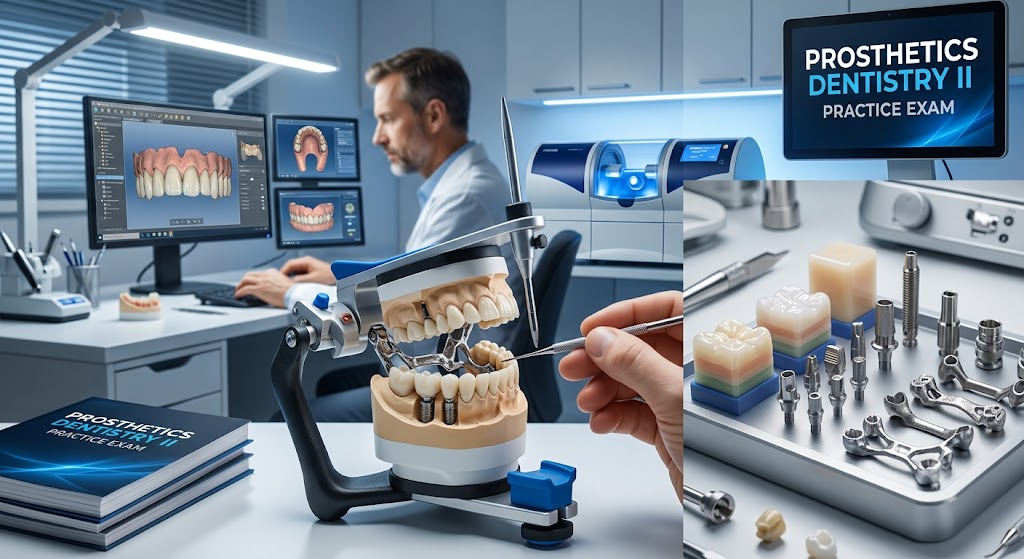
Additional Information
What the Course Entails and Exam Details
This rigorous curriculum and subsequent examination require a profound understanding of several advanced dental disciplines. Candidates must prove competency in theoretical knowledge and practical analysis across several core areas:
Complex Fixed Prosthodontics: Including deep knowledge of multi-unit bridges, sophisticated ceramic restorations, and comprehensive full-mouth reconstruction protocols.
Advanced Implant Prosthetics: Focus on both fixed and removable solutions, emphasizing the engineering principles, biomechanics, and aesthetic outcomes of implant-supported prostheses.
Advanced Occlusion: A critical understanding of mandibular dynamics, facebow techniques, complex articulated jaw relationships, and the management of occlusal vertical dimension in complex cases.
Complex Removable Partial Dentures: Detailing advanced framework design, the integration of precision attachments, and solutions for significantly compromised dental arches.
Digital Dentistry Workflow: Comprehensive coverage of intraoral scanning, CAD/CAM design principles, and 3D printing/milling technologies used in fabricating modern prosthetics.
What to Expect in the Final Exam
Preparing for the Prosthetics Dentistry II final exam requires specific preparation based on its advanced structure. Candidates can typically anticipate the following format and regulations:
Exam Format: The test usually consists of 120-150 complex multiple-choice questions (MCQs). A significant portion is case-based, requiring the analysis of clinical data, radiographs, and study models to synthesize a correct treatment plan.
Time Limit: Candidates are generally allocated between 2.5 and 3.5 hours to complete the examination. Strong time management is essential due to the analytical nature of the scenario-based questions.
Passing Score: The standard passing grade is usually around 70-75%, although this may vary slightly depending on the specific certifying body and curriculum standards.
Exam Rules: The examination is strictly proctored. Personal belongings, reference materials, and electronic devices are prohibited within the testing environment. Ensure you are familiar with the specific proctoring rules provided by your test administrator.
How to Study and Exam Centers
Achievement on this exam requires dedicated study and structured practice. Here are essential strategies for your preparation:
Utilize the [Prosthetics Dentistry II Practice Test]: This is your foundational tool. It familiarizes you with the question formats, builds endurance for the multi-hour test, and highlights your specific knowledge gaps, allowing for targeted review.
Review Advanced Textbooks: Focus your study on comprehensive, peer-reviewed textbooks dedicated to advanced prosthodontics, implant dentistry, and complex occlusion.
Clinical Case Review: Review your own cases or documented complex scenarios. Critically analyze the rationale for material selection, design choices, and sequence of care in every step.
Study Groups: Engaging in discussions with peers or mentors can provide fresh perspectives on complex prosthetic puzzles and help solidify your conceptual understanding.
Exam Centers:
Prosthetics Dentistry II examinations are typically hosted by authorized professional testing centers globally, often specializing in high-stakes medical and dental certifications (such as Pearson VUE or specialized university computer labs). Additionally, many accredited institutions offer secure, live online proctored examinations, allowing you to take the test from a dedicated quiet location. Consult your specific program coordinator for direct links and location availability.
Job Opportunities from the Course
A qualification in Advanced Prosthetics Dentistry II opens several prestigious career paths and specialization options within the dental healthcare sector:
Advanced Prosthodontics Specialist in a high-end private practice
Certified Dental Laboratory Technologist specializing in complex restorations
Dental School Clinical Instructor for Prosthodontics
Research and Development Consultant for advanced dental material manufacturing companies
Dental Laboratory Manager or Director of Operations
Prosthetic Treatment Coordinator for large multidisciplinary dental clinics
Frequently Asked Questions
Reviews
5.0
Based on 0 reviews
Leave a Review
No reviews yet. Be the first to review!