
Protection Devices Practice Test
$69.00
- Buy to unlock unlimited access to all Quiz questions and Answers in this Quiz.
- After purchase you can print a PDF of the whole quiz at any point. The PDF will contain the questions and the correct answers.
About this Exam
This comprehensive protection devices course and associated exam provide essential certification for electrical professionals who design, install, and maintain electrical systems.
The program is specifically designed for practicing electrical engineers, technicians, industrial electricians, and safety officers looking to validate their expertise in implementing crucial electrical safety components and systems.
It ensures participants possess the critical knowledge required to effectively safeguard personnel, equipment, and entire facilities from electrical faults and hazardous conditions.
Ready to test your knowledge?
Buy Now to Access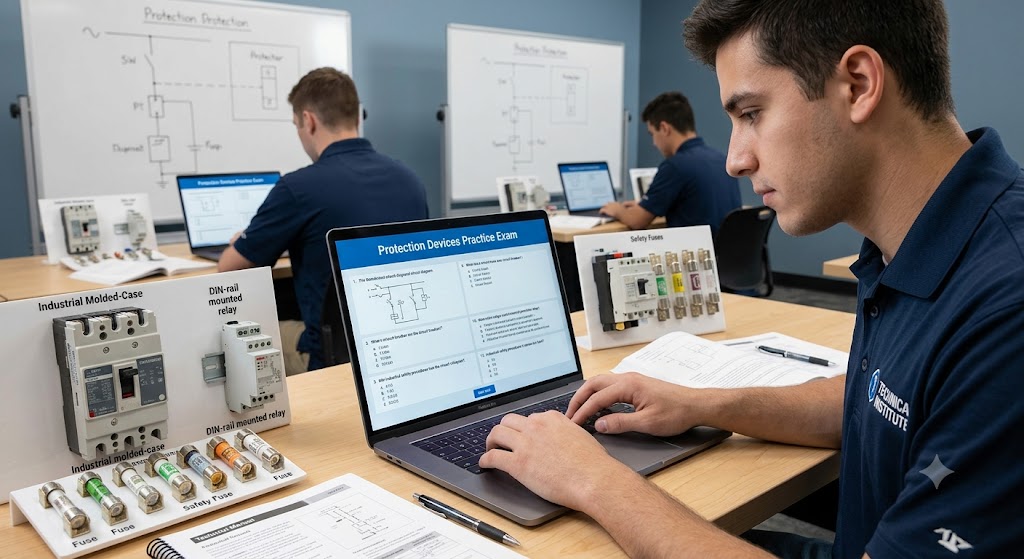
Additional Information
What the Course Entails and Exam Details
The core curriculum of this protection devices certification program thoroughly covers the theoretical and practical application of electrical safeguarding technologies. Candidates are rigorously tested on their understanding and application of the following key topics:
Fundamental Electrical Fault Theory: Understanding short circuits, overloads, and ground faults.
Circuit Breakers and Fuses: Principles, application, selecting the correct ratings, and cascading coordination.
Protective Relays: Functions of various types, including overcurrent, voltage, and differential protection.
Earthing and Grounding Systems: Effective design and implementation for safety.
Surge Protection Devices (SPDs): Selecting and installing SPDs to guard against transient overvoltages.
Industrial Control and Safety: Integrating protection into manufacturing and process environments.
Electrical Codes and Standards: Mastery of relevant safety regulations (e.g., NEC, IEC, NFPA).
What to Expect in the Final Exam
The final assessment is a comprehensive, multi-part examination that evaluates both your theoretical understanding and practical problem-solving skills. Candidates can typically expect the following format and requirements:
Format: A balanced combination of detailed multiple-choice questions assessing core knowledge and realistic, problem-based scenarios where candidates must analyze complex electrical faults and design effective protection schemes for provided circuit diagrams.
Practical Component: In some formats, a limited simulated practical assessment may be included to test your ability to configure or select specific devices.
Time Limit: Approximately 2.5 to 3 hours.
Passing Score: Typically requires achieving a score of 75% or higher to demonstrate proficiency.
Rule: Standard proctoring rules apply, whether the exam is taken in-person at an official testing center or online.
How to Study and Exam Centers
Successfully navigating this challenging exam requires thorough preparation. We recommend a structured study plan that includes the following effective strategies:
Official Study Guides: Utilize the course provider's comprehensive official textbook, technical manuals, and recommended reading materials as your primary resources.
Review Practical Examples: Spend significant time reviewing fault current calculations, coordination studies, and practicing with sample electrical schematics.
Mock Practice Exams: Take multiple timed mock exams to experience the test format, manage your time effectively, and identify specific knowledge gaps that need addressing.
Workplace Application: Apply your learning to your current projects and analyze real-world electrical systems to reinforce your understanding.
Where and How to Take the Exam
Candidates can usually choose from several official channels to sit for this assessment:
Pearson VUE and Authorized Testing Centers: Scheduled sessions are available at thousands of professional testing locations globally.
Online Proctoring Portals: Many providers offer the convenience of taking the proctored exam remotely via a secure browser connection from your own quiet space.
Authorized Industry Bodies and Technical Schools: Special exam dates may be organized by professional associations or vocational colleges that host the certification program.
Job Opportunities from the Course
Successfully completing this certification demonstrates a high level of technical proficiency and significantly enhances your career prospects in numerous electrical and technical fields. Key job titles and career paths unlocked by this qualification include:
Protection Engineer
Substation Technician
Industrial Electrician (with specialized focus)
Field Service Engineer
Electrical Power System Planner
Control Systems Engineer
Electrical Safety Inspector
Maintenance Supervisor (Electrical)
Engineering Consultant (Electrical Protection)
Frequently Asked Questions
Reviews
5.0
Based on 0 reviews
Leave a Review
No reviews yet. Be the first to review!