
Protein Trafficking Practice Test
$69.00
- Buy to unlock unlimited access to all Quiz questions and Answers in this Quiz.
- After purchase you can print a PDF of the whole quiz at any point. The PDF will contain the questions and the correct answers.
About this Exam
The Protein Trafficking Practice Exam is an invaluable resource for students of cell biology, biochemistry, and related life sciences. It is meticulously designed for undergraduate and graduate students preparing for a final exam in cell biology, as well as anyone looking to brush up on this critical aspect of cellular function. The exam provides a comprehensive check of your understanding of how proteins are synthesized, modified, and transported within a cell to their required locations. Mastering this content is fundamental to grasping cellular organization, communication, and disease. This practice test is a powerful tool to assess your knowledge, identify areas for improvement, and build confidence before your official assessment.
Ready to test your knowledge?
Buy Now to Access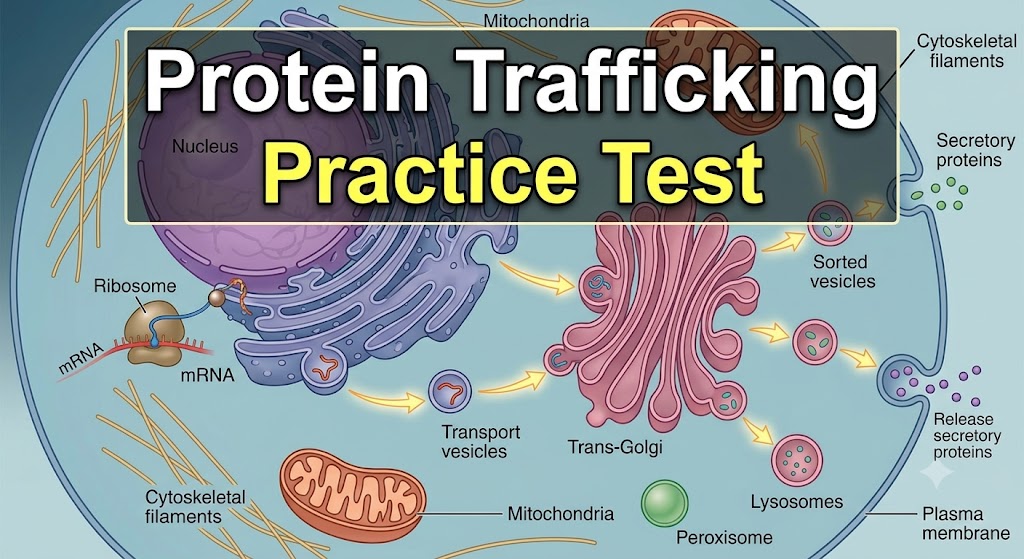
Additional Information
What the Course Entails and Exam Details
A rigorous course in protein trafficking and the subsequent exam explore the intricate processes ensuring proteins are delivered to their correct subcellular compartments. Key topics include:
The Secretory Pathway: Detailing the sequence of events from synthesis on the rough endoplasmic reticulum (ER) through modification in the Golgi complex to final secretion.
Organelle Targeting Signals: The specific sequence or structural motifs (signal peptides) that direct proteins to the ER, nucleus, mitochondria, chloroplasts, lysosomes, and peroxisomes.
Vesicular Transport: The mechanisms of vesicle formation, budding, transport via the cytoskeleton, and fusion with target membranes (SNARE proteins, coat proteins like COP II, COPI, and clathrin).
Protein Folding and Quality Control: The roles of chaperones in the ER and the consequences of protein misfolding (ERAD, unfolded protein response).
Post-translational Modifications: N-linked glycosylation, O-linked glycosylation, proteolytic processing, and signal peptide cleavage, and their roles in trafficking and function.
What to Expect in the Final Exam
The final exam on protein trafficking is typically formatted to test both conceptual understanding and detailed knowledge. You can expect a variety of question types, including:
Multiple-Choice Questions: Assessing your ability to recall facts and understand core concepts, such as identifying targeting signals or the functions of specific organelles and transport proteins.
Scenario-Based and Descriptive Questions: These require you to apply your knowledge to new situations or describe the entire pathway a specific protein would follow from its initial synthesis.
Diagram Labeling and Analysis: You may be asked to label components of the secretory pathway or interpret results from experiments on protein trafficking.
The exam usually has a time limit, often around 90-120 minutes, which demands efficient problem-solving. A common passing score is 70-80%, but this varies by institution. The practice test helps you become familiar with these structures, improving your speed and accuracy.
How to Study and Exam Centers
Effective study strategies are crucial for mastering protein trafficking:
Utilize Visual Aids: The key to success is visualizing the cell as a dynamic transport system. Use diagrams, illustrations, and videos to map the various pathways and their components.
Create Comparison Charts: Make tables to compare the sorting and transport mechanisms for different organelles (e.g., cotranslational vs. post-translational translocation).
Flashcards for Targeting Signals: Commit the specific signal sequences and their receptors to memory using flashcards.
Practice with Multiple Questions: Repeatedly taking the practice test will reveal recurring patterns and common pitfalls. Focus on understanding why a correct answer is correct and why other options are not.
The official final exam is usually administered at the end of a university-level cell biology course, either online via a secure university portal or in a physical classroom or university testing center. It is not typically taken through external centers like Pearson VUE. However, for specialized bioscience certifications, always verify the specific location requirements with your provider.
Job Opportunities from the Course
A deep understanding of protein trafficking is indispensable for numerous careers in the life sciences. Mastering this topic opens the door to opportunities such as:
Cell Biologist: Investigating the fundamental processes within cells.
Research Scientist: Leading research projects in academic, government, or industrial labs, often focused on drug discovery or disease mechanisms related to protein misfolding (e.g., Alzheimer's, Cystic Fibrosis).
Biotechnologist: Applying biological systems to develop new products and processes.
Pharmaceutical Researcher: Designing drugs that target specific steps in the trafficking pathway or correct protein localization issues.
Laboratory Manager: Overseeing research operations and training staff in advanced cell biology techniques.
Lecturer/Professor in Biological Sciences: Teaching and mentoring the next generation of scientists.
Science Writer/Editor: Communicating complex scientific concepts clearly to professional and lay audiences.
Frequently Asked Questions
Reviews
5.0
Based on 0 reviews
Leave a Review
No reviews yet. Be the first to review!