
PRPA Defensive Tactics Practice Exam
$69.00
- Buy to unlock unlimited access to all Quiz questions and Answers in this Quiz.
- After purchase you can print a PDF of the whole quiz at any point. The PDF will contain the questions and the correct answers.
About this Exam
The PRPA Defensive Tactics certification is a crucial credential for professionals working in high-stakes environments where physical control and self-defense skills are necessary.
This comprehensive exam is meticulously designed for security personnel, private investigators, law enforcement candidates, and individuals seeking standardized validation of their defensive tactics capabilities.
It ensures that certified professionals possess the necessary skills to manage physical confrontations safely, legally, and effectively, minimizing risk to themselves and others.
Ready to test your knowledge?
Buy Now to Access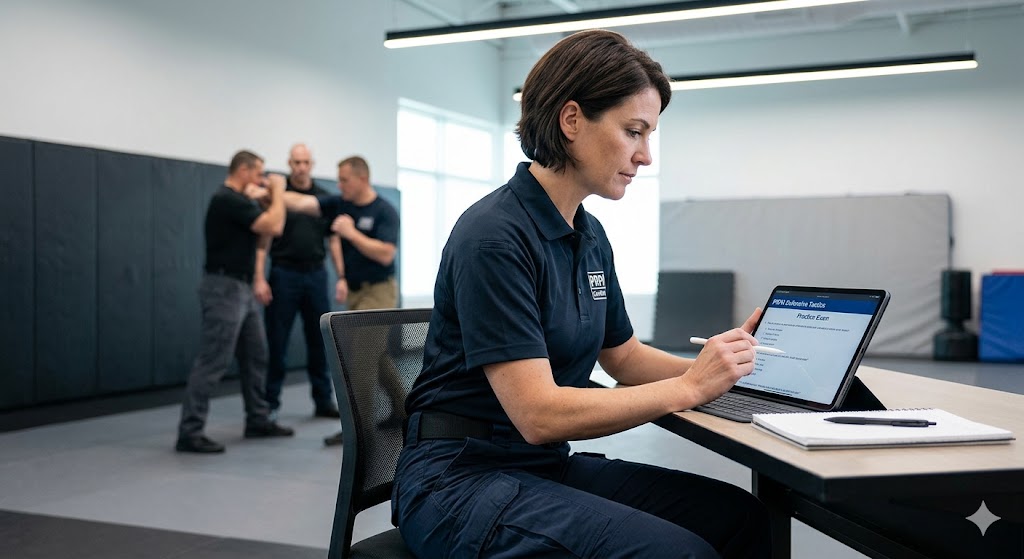
Additional Information
What the Course Entails and Exam Details
The PRPA Defensive Tactics course covers a rigorous curriculum that balances theoretical knowledge with practical, hands-on skills.
Participants must demonstrate proficiency across several core domains:
The Legal Use-of-Force Continuum: Understanding when and how much physical force is legally justifiable.
Dynamic Risk Assessment and Threat Identification: Analyzing situations and identifying potential dangers before they escalate.
Verbal De-escalation Techniques: Mastering communication skills to resolve confrontations peacefully and prevent the need for physical force.
Practical Control and Restraint Techniques: Hands-on skills for takedowns, joint locks, pain compliance, and safe restraint.
Defensive Maneuvers and Blocking: Protecting oneself from physical attacks.
Handcuffing and Subject Searching: Standard operating procedures for safe and effective restraint and search.
The comprehensive PRPA exam validates proficiency in all these critical areas through a combined written and practical assessment.
What to Expect in the Final Exam
The final certification exam is demanding and structured into two primary sections that candidates must successfully pass.
First, there is a written examination, typically consisting of 50-75 multiple-choice questions.
This part of the exam tests the candidate's understanding of the legal principles, use-of-force continuum, and dynamic risk assessment models.
You will have a set time limit, often around 90 minutes, to complete this written portion, which requires a passing score of at least 70-80% to move forward.
The second part is a practical, skills-based assessment conducted in a physical training environment.
During this section, you will be required to demonstrate proficiency in various control, restraint, and defensive techniques in front of certified examiners.
Passing both the written and practical components is essential to obtain your PRPA Defensive Tactics Certification.
How to Study and Exam Centers
To succeed on the PRPA Defensive Tactics exam, students must employ a dual-track study strategy that covers both mental and physical preparation.
Utilize practice exams and study guides to master the written material; focusing on the legal framework for the use of force is especially critical for this portion of the test.
Flashcards can be incredibly helpful for memorizing the steps of dynamic risk assessment and the use-of-force models.
For the practical assessment, you must commit to consistent, supervised physical training.
Practice the required control, restraint, and defensive techniques repeatedly with a qualified partner or instructor until the movements become fluent and instinctive.
Final certification exams are generally administered at authorized physical testing centers, dedicated security academies, or approved law enforcement training facilities.
Candidates usually register through these authorized providers, as they must maintain the appropriate environment and certified examiners for the practical skills assessment.
Standardized computer-based testing centers like Pearson VUE are typically only used for the written component of this exam.
Job Opportunities from the Course
Earning your PRPA Defensive Tactics certification unlocks multiple career opportunities in the security and protection sectors.
Professional Private Investigator
Corporate Security Officer
Armed Security Guard
Bouncer or Venue Security
Personal Protection Specialist (Bodyguard)
Corrections Officer (Specific requirements vary by jurisdiction)
Court Bailiff
Frequently Asked Questions
Reviews
5.0
Based on 0 reviews
Leave a Review
No reviews yet. Be the first to review!