
Psychological First Aid Online Practice Test
$69.00
- Buy to unlock unlimited access to all Quiz questions and Answers in this Quiz.
- After purchase you can print a PDF of the whole quiz at any point. The PDF will contain the questions and the correct answers.
About this Exam
The Psychological First Aid (PFA) certification is an essential credential designed for individuals who may be the first to offer support to people in the immediate aftermath of a crisis, disaster, or other traumatic event. It is a humane, supportive response that helps stabilize individuals, reduce their initial distress, and connect them with further care. This course is for anyone who could find themselves in a helping role, including first responders, mental health workers, teachers, community leaders, public service staff, and even concerned family and friends. Its primary goal is not to provide long-term therapy but to provide immediate, practical support.
Ready to test your knowledge?
Buy Now to Access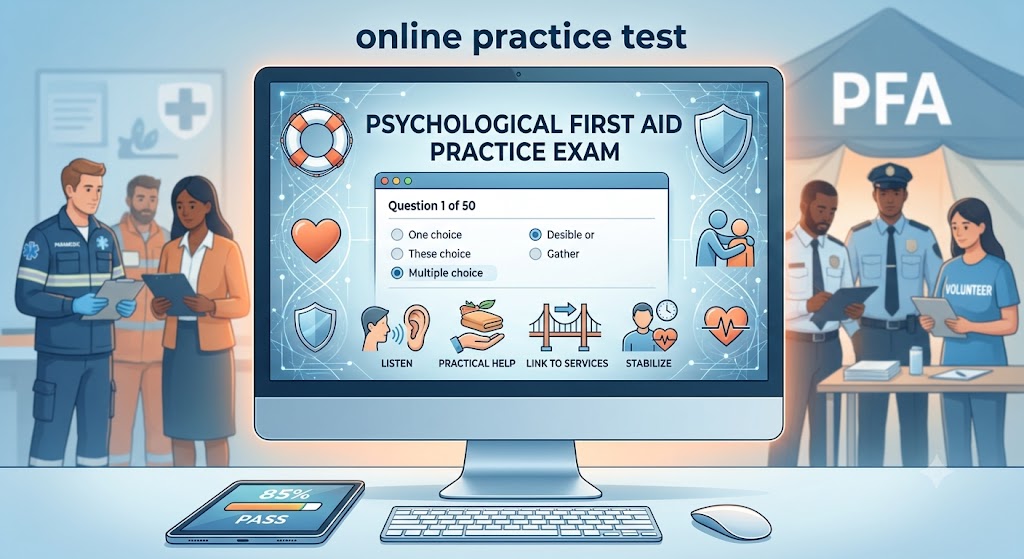
Additional Information
What the Course Entails and Exam Details
This training covers a range of essential skills, often following an established model, such as the RAPID (Reflective listening, Assessment of needs, Prioritization, Intervention, Disposition) or Look, Listen, Link framework. Core topics include:
• Understanding the concepts of human resilience and trauma.
• Recognizing common cognitive, emotional, behavioral, and physical reactions to stress and crisis.
• Learning how to offer humane and supportive assistance responsibly.
• Establishing human connection with people in distress in a non-intrusive way.
• Effective rapport building through reflective listening.
• Techniques for prioritizing and assessing immediate needs.
• Intervention strategies to promote safety, calm, and hope.
• Making referrals to connect survivors with practical and specialized help.
• Ensuring the safety and well-being of the helper themselves.
What to Expect in the Final Exam
The Psychological First Aid exam is typically an online, timed assessment consisting of approximately 30 to 50 multiple-choice questions. These questions are often scenario-based, requiring you to apply the PFA principles you have learned to real-world situations. To pass, you generally need to achieve a score of 70% to 80%. You may be given a limited number of attempts to pass, and a specific time limit (e.g., 60 minutes) to complete the test. The exam rules are usually strict, and passing proves you have mastered the core competencies necessary to provide immediate support to individuals in distress.
How to Study and Exam Centers
Effective study strategies for the PFA exam include engaging with the training modules, paying close attention to visual aids and simulated scenarios, and taking detailed notes on key models and actions. It is crucial to take all available practice quizzes, like this [Psychological First Aid Online Practice Test], as they replicate the final exam format and allow you to identify gaps in your understanding. You can find comprehensive study guides and additional learning resources online through certified training providers like the World Health Organization (WHO), the American Red Cross, and major university portals. The exam is typically conducted online, which means you can take it at your convenience on a personal computer. There are no physical testing centers required for the basic certification. Upon successful completion of the course and the final exam, you will receive your certificate directly from the issuing organization.
Job Opportunities from the Course
A Psychological First Aid certification enhances your value in any role that involves interacting with people, particularly in high-stress environments. Specific job titles that benefit from this credential include:
• Crisis Intervention Worker
• Disaster Response Team Member
• Mental Health Therapy Aide
• Security Officer
• First Responder (EMT, Paramedic, Firefighter, Police)
• School Counselor or Teacher
• Community Outreach Worker
• Military Family Support Specialist
• Public Health Worker
• Human Resources Specialist
• Employee Assistance Program (EAP) Coordinator
• Non-Profit Staff Member
• Social Work Assistant
Frequently Asked Questions
Reviews
5.0
Based on 0 reviews
Leave a Review
No reviews yet. Be the first to review!