
Psychology Approaches Practice Test
$69.00
- Buy to unlock unlimited access to all Quiz questions and Answers in this Quiz.
- After purchase you can print a PDF of the whole quiz at any point. The PDF will contain the questions and the correct answers.
About this Exam
The Psychology Approaches Practice Exam is a comprehensive and engaging tool designed to assess and solidify your understanding of the major theoretical frameworks in psychology. Whether you are a dedicated psychology student preparing for advanced courses, an individual aiming for official certification or licensure in a psychology-related field, or someone simply passionate about the diverse ways human behavior is understood, this exam provides an invaluable opportunity. It is crafted for individuals who want a robust, well-rounded grasp of the behavioral, cognitive, psychodynamic, humanistic, and biological perspectives, ensuring you are thoroughly prepared for the foundational knowledge required in academics and professional practice. Taking this practice test will give you the confidence that comes from a genuine understanding, not just rote memorization.
Ready to test your knowledge?
Buy Now to Access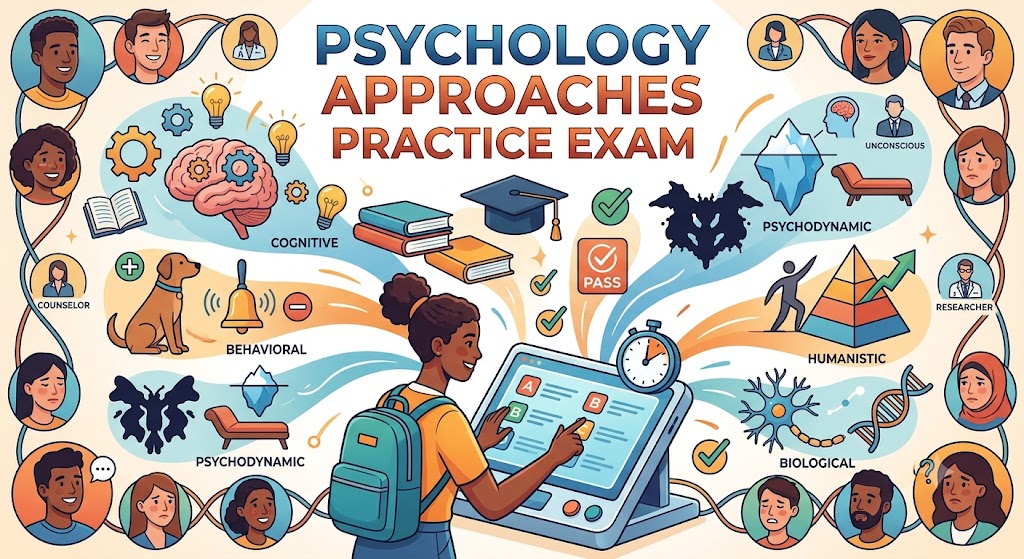
Additional Information
What the Course Entails and Exam Details
This practice exam delves deep into the core concepts and historical developments of major psychology approaches. The foundational "course" that this exam is based on, though often delivered through diverse educational channels, typically covers the following key theoretical lenses. The Behavioral Approach, including classical conditioning (Pavlov) and operant conditioning (Skinner), explores how environment and consequences shape observable actions. The Cognitive Approach focuses on internal mental processes, including perception, memory, problem-solving, and decision-making, considering how information is processed, stored, and retrieved. The Psychodynamic Approach, rooted in the work of Freud, examines the unconscious mind, early childhood experiences, and interpersonal relationships as powerful drivers of behavior. The Humanistic Approach emphasizes individual potential, self-actualization, and the importance of subjective experience, often referencing key figures like Rogers and Maslow. Finally, the Biological Approach (and its related subfields) investigates the physiological underpinnings of behavior, including genetics, neurochemistry, brain structure, and evolution. The exam will test your ability to not just define these terms, but to apply them to scenarios, identify key theoretical figures, compare and contrast the models, and evaluate the research methods associated with each distinct approach.
What to Expect in the Final Exam
While actual comprehensive or licensing exams vary in detail, the Psychology Approaches Practice Exam is structured to mirror common and effective testing methods. You can generally expect a substantial section of high-quality multiple-choice questions, the primary format for assessing broad knowledge base. These questions will range from direct recall of foundational concepts to complex application and analysis scenarios. For instance, you might be presented with a case study or a specific behavioral pattern and asked to analyze it through the lens of one or more of the approaches or identify which theory best explains the situation.
The practice test is designed with typical academic and professional exam pressures in mind. The time limit will be established to challenge your fluency with the material, likely requiring you to answer approximately one minute per question (for example, a 90-minute time limit for 75 questions). The required passing score, intended to demonstrate a strong level of proficiency suitable for advancement, is usually set around 70-80% for practice purposes to ensure real readiness. This specific iteration of the practice test does not typically include a practical or essay component, focusing intensely on broad and detailed knowledge, but taking multiple varied practice tests can better prepare you for exams with multiple formats. Remember, this is a simulated experience designed for practice and review, offering immediate feedback to guide your further study.
How to Study and Exam Centers
Effective preparation for this practice exam and any subsequent official testing requires a proactive and diverse study strategy. First and foremost, you should engage in continuous and deep review of key textbooks, lecture notes, and reliable academic resources dedicated to introductory and comprehensive psychology. Do not just memorize terms; strive to understand the nuances, strengths, and limitations of each approach. Use flashcards for definitions and key figures, but supplement this with detailed summaries and comparative analysis of the various frameworks. Active study methods like teaching concepts to others, creating mind maps, and participating in group discussions can also significantly enhance your retention and comprehension. Importantly, take multiple practice tests—like this one—to identify your areas of strength and weakness and to become comfortable with the timing and question styles you will encounter. Treat each practice test as a diagnostic tool, not just a rehearsal.
Regarding the location of actual testing, this is a practice test and is almost always delivered in a flexible, digital format. You will access this practice test through online portals, learning management systems, or specific educational websites from the convenience of your own computer or device. The flexibility allows you to practice at your own pace and schedule. However, for any final official certification, licensing, or academic exams linked to this knowledge, they may be administered in physical, proctored testing centers such as those operated by Pearson VUE, or via specific academic institutions or testing organizations. Always check the requirements for your specific ultimate exam to understand where and how to schedule the official test and what rules are in place for identity verification and security. Your practice efforts are the bridge to success in that final proctored environment.
Job Opportunities from the Course
A strong understanding of psychology approaches, solidified by this comprehensive practice, opens doors to a variety of rewarding careers. The knowledge gained applies not only to the specialized field of psychology but across many roles involving understanding human interaction, motivation, and well-being.
Mental Health Counselor (Requires further specialized licensure and clinical hours)
Human Resources Specialist (Applying behavioral principles to workplace dynamics)
Marketing Analyst (Understanding consumer behavior using cognitive models)
Research Assistant (Conducting studies across various approaches)
Case Manager in Social Services (Analyzing client needs from multiple perspectives)
Substance Abuse Counselor (Often requiring specific certification and licensing)
Teacher (Integrating developmental and humanistic principles into education)
User Experience (UX) Researcher (Applying cognitive principles to design)
Frequently Asked Questions
Reviews
5.0
Based on 0 reviews
Leave a Review
No reviews yet. Be the first to review!