
Psychology MCAT Practice Exam
$69.00
- Buy to unlock unlimited access to all Quiz questions and Answers in this Quiz.
- After purchase you can print a PDF of the whole quiz at any point. The PDF will contain the questions and the correct answers.
About this Exam
The Medical College Admission Test (MCAT) is a standardized, multiple-choice examination designed to assess your problem-solving, critical thinking, and knowledge of natural, behavioral, and social science concepts and principles prerequisite to the study of medicine.
Specifically, the "Psychological, Social, and Biological Foundations of Behavior" section (commonly referred to as the Psychology/Sociology section) evaluates your understanding of the ways psychological, social, and biological factors influence perceptions and reactions to the world, behavior, and behavior change. This section is essential for future physicians who must understand how a patient's background and history impact their health and treatment.
This Psychology MCAT practice exam is meticulously designed for pre-medical students seeking a realistic simulation of the actual test environment and a comprehensive assessment of their readiness for this critical section of the MCAT.
Ready to test your knowledge?
Buy Now to Access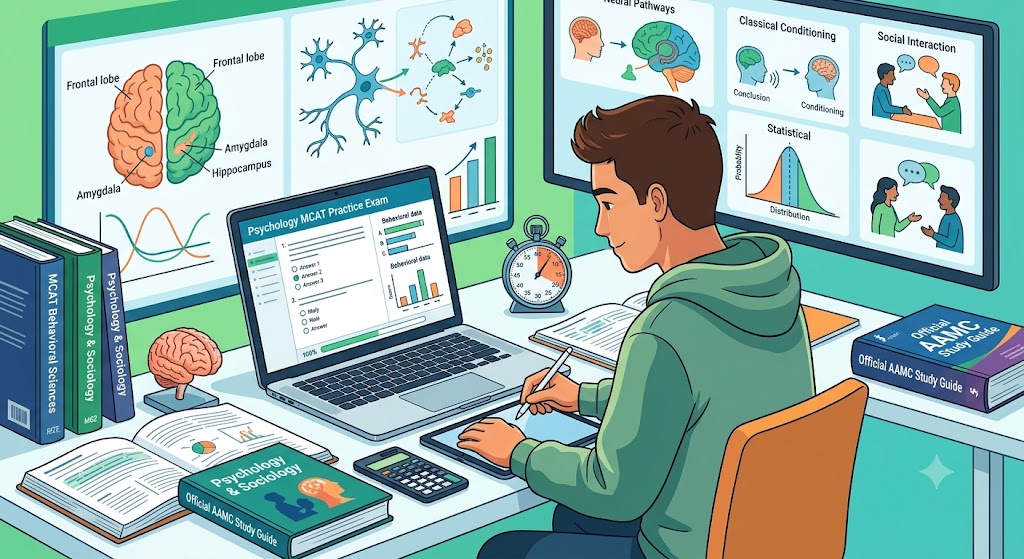
Additional Information
What the Course Entails and Exam Details
The Psychology MCAT content focuses on foundational concepts that are crucial for medical practice. Our comprehensive practice resource covers all key areas defined by the AAMC (Association of American Medical Colleges), including:
Foundational Concept 1: Sensing the environment, integrating the human with the environment, and responding to the environment. This includes sensation, perception, and attention.
Foundational Concept 2: Understanding how behavior is determined, identifying behavioral change, and managing behavioral health. This covers learning, memory, and cognition.
Foundational Concept 3: Understanding the self and others, managing social interactions, and understanding social structure. Topics include social thinking, social influence, and social processes.
Foundational Concept 4: Cultural and social differences and how they impact health. This area explores social stratification, demographic characteristics, and health disparities.
Scientific Inquiry and Reasoning Skills (SIRS): Throughout the section, you will be tested on your ability to apply knowledge, reason about design and execution of research, use data and statistical inference, and understand ethics in behavioral sciences.
This is not a course but rather a full-length, timed practice exam (59 questions) designed to mirror the structure and complexity of the actual MCAT Psychology section.
What to Expect in the Final Exam
When you take the actual MCAT, the Psychological, Social, and Biological Foundations of Behavior section is the fourth and final section of the day.
Format: 59 multiple-choice questions, which consist of 10 passage-based sets with 4 to 7 questions each, and 15 independent, standalone questions.
Time Limit: You will have exactly 95 minutes to complete this section. This requires efficient time management (approximately 1 minute and 36 seconds per question).
Passing Score: The MCAT does not have a single "passing score." Each of the four sections is scored on a scale ranging from 118 (lowest) to 132 (highest), with the midpoint at 125. Medical schools consider your composite score (which ranges from 472 to 528) and your percentile rank in the context of your entire application. A high score in this section indicates a strong foundation in behavioral science.
Rules: The MCAT is administered in a secure, proctored environment. No outside materials are allowed. All questions must be answered within the section's time limit; you cannot return to a previous section once you have submitted it. Strict adherence to security protocols is enforced.
How to Study and Exam Centers
Effective preparation for the Psychology MCAT requires a multi-faceted approach.
Comprehensive Content Review: Utilize reputable MCAT prep books, official AAMC resources (like the Official Guide and Content Outline), and reliable online materials to master the vast amount of terminology, theories, and concepts in psychology and sociology.
Active Learning and Application: Don't just read; engage with the material. Create detailed flashcards (digital or physical) for terms and theories. Summarize research studies. Connect concepts to real-world medical scenarios.
Targeted Practice: Use official AAMC question packs and full-length practice exams. These are the single most important resource because they use actual retired MCAT questions and format, mirroring the difficulty and nuance of the test you will encounter on game day.
Simulated Testing: Take practice exams under strict, timed conditions, mirroring the MCAT schedule. This builds endurance and improves time management.
Review Wrong Answers: Analyze why you missed a question. Was it a content gap, a reasoning error, or a misreading? This is crucial for targeted improvement.
Where and how to take the exam: The official MCAT is administered at authorized Pearson VUE professional test centers worldwide. You must register through the AAMC website. Your Psychology MCAT practice exam (like the one this guide references) is an online tool that you access through a secure student portal from your own location.
Job Opportunities from the Course
A strong score on the MCAT, including the Psychology section, is a prerequisite for admission to medical school and other health professions programs. While the exam itself is not a certification for employment, it is the crucial gatekeeper to careers that require advanced medical training, including:
Physician (MD/DO)
Surgeon
Psychiatrist (after specialized medical training)
Pediatrician
Neurologist
Anesthesiologist
Primary Care Doctor
Medical Researcher (focusing on Behavioral or Social Medicine)
Healthcare Administrator
Medical Educator (after further academic training)
Frequently Asked Questions
Reviews
5.0
Based on 0 reviews
Leave a Review
No reviews yet. Be the first to review!