
Psychosocial Integrity Practice Test
$69.00
- Buy to unlock unlimited access to all Quiz questions and Answers in this Quiz.
- After purchase you can print a PDF of the whole quiz at any point. The PDF will contain the questions and the correct answers.
About this Exam
The [Psychosocial Integrity Practice Test] is a vital resource for nursing students preparing for the NCLEX-RN and NCLEX-PN licensure examinations. "Psychosocial Integrity" is one of the foundational "Client Needs" categories defined by the National Council of State Boards of Nursing (NCSBN), designed to assess a candidate's ability to provide holistic nursing care. This content area focuses on the nurse’s role in supporting and promoting the emotional, mental, and social well-being of clients across the lifespan. Whether you are aspiring to become a Registered Nurse (RN) or a Licensed Practical/Vocational Nurse (LPN/LVN), mastering this section is non-negotiable, as it directly impacts your ability to help patients cope with illness, manage stress, and navigate complex life events.
Ready to test your knowledge?
Buy Now to Access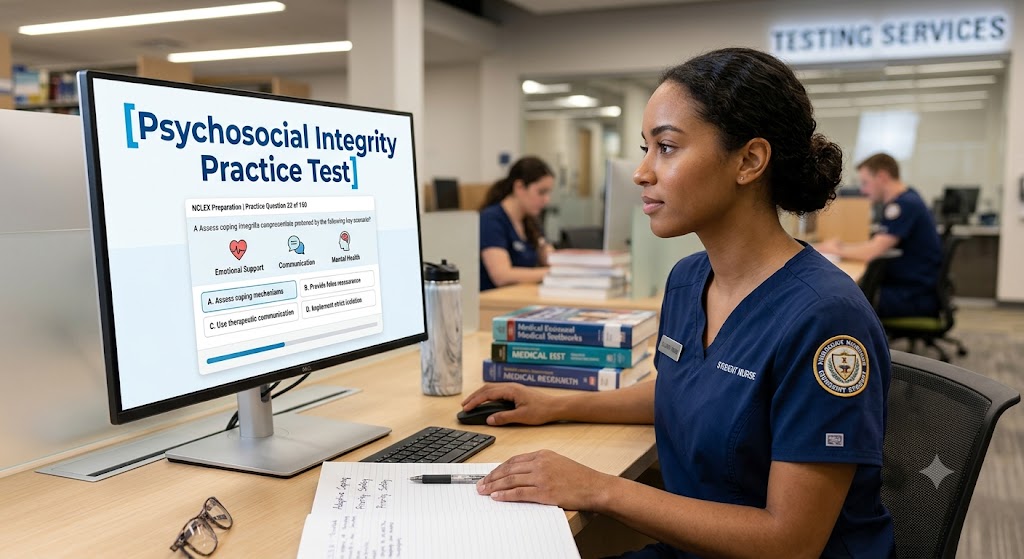
Additional Information
What the Course Entails and Exam Details
This section of the exam focuses on how a nurse facilitates a client's ability to adapt to and cope with health and wellness changes. The core course content and associated practice test evaluate your knowledge in the following critical areas:
Therapeutic Communication: Developing trust, using active listening, and employing specific verbal and non-verbal techniques to support clients and families.
Mental Health Concepts: Recognizing and intervening in acute and chronic mental health conditions, including depression, anxiety, schizophrenia, and bipolar disorder.
Coping Mechanisms: Assessing both adaptive and maladaptive behaviors in response to stress, illness, or crisis.
Crisis Intervention: Providing immediate and short-term assistance to support clients through traumatic events, grief, and loss.
Cultural Awareness and Influences on Health: Adapting nursing care to respect a client's cultural, spiritual, and social beliefs.
Family Dynamics: Evaluating and supporting functional and dysfunctional family relationships that impact client care.
Substance Use and Abuse: Understanding the nurse's role in caring for clients with addiction and during withdrawal.
What to Expect in the Final Exam
Psychosocial Integrity is not a standalone exam but a significant domain within the comprehensive NCLEX licensure exam. Questions in this category can account for up to 12% of the NCLEX-RN and up to 15% of the NCLEX-PN, making it a pivotal area for success.
The final exam uses a computer-adaptive testing (CAT) format, meaning the difficulty of the questions adjusts based on your performance. Expect a variety of question formats, including standard multiple-choice, "Select All That Apply" (SATA), and complex "Next Generation NCLEX" (NGN) case studies and fill-in-the-blank items.
For both RN and PN candidates, the exam is pass/fail, and there is a time limit, typically up to five hours, to complete a variable number of questions.
How to Study and Exam Centers
Effective study strategies are key to conquering the psychosocial component. First, thoroughly review the official NCSBN NCLEX Test Plan, which details the specific sub-topics you must master. Second, dedicate a significant amount of your preparation to therapeutic communication. On the NCLEX, you must always choose the most therapeutic response, prioritizing non-judgmental validation and open-ended exploration.
Use high-quality NCLEX question banks to practice. The most effective way to learn is to analyze the rationales for both correct and incorrect answers. This process builds critical thinking and priority-setting skills. Focus on safety first—always prioritize the intervention that ensures the patient's immediate safety and that of others.
The final NCLEX exam is administered globally at Pearson VUE professional testing centers. You must register through Pearson VUE, fulfill your state's specific licensure requirements, and obtain an Authorization to Test (ATT) before you can schedule your appointment at a physical location.
Job Opportunities from the Course
A strong grasp of psychosocial integrity is foundational for all nursing roles, but it opens doors to specific high-demand career paths and specialties:
Psychiatric-Mental Health Nurse (RN/LPN)
Addiction and Substance Abuse Nurse
Acute Care Nurse (Emergency Department/ICU)
Crisis Intervention Team Member
Community Health Nurse
Case Manager
Correctional Facility Nurse
Geriatric/Long-Term Care Nurse
Pediatric/School Nurse
Maternal-Child Health Nurse
Frequently Asked Questions
Reviews
5.0
Based on 0 reviews
Leave a Review
No reviews yet. Be the first to review!