
Public Debate Practice Exam
$69.00
- Buy to unlock unlimited access to all Quiz questions and Answers in this Quiz.
- After purchase you can print a PDF of the whole quiz at any point. The PDF will contain the questions and the correct answers.
About this Exam
The Public Debate Practice Exam is a comprehensive assessment tool designed for individuals looking to formalize their knowledge and expertise in competitive speech and debate. It is tailored for aspiring judges, future coaches, and advanced competitors who must master the precise rules, structural methodologies, and ethical standards of leading national and international debate organizations, such as the National Speech and Debate Association (NSDA) or the World Schools Debate format. This practice exam validates a candidate's readiness for official accreditation, confirming they can fairly and expertly evaluate rounds in various formats, including Public Forum, Lincoln-Douglas, Parliamentary, and Congressional Debate.
Ready to test your knowledge?
Buy Now to Access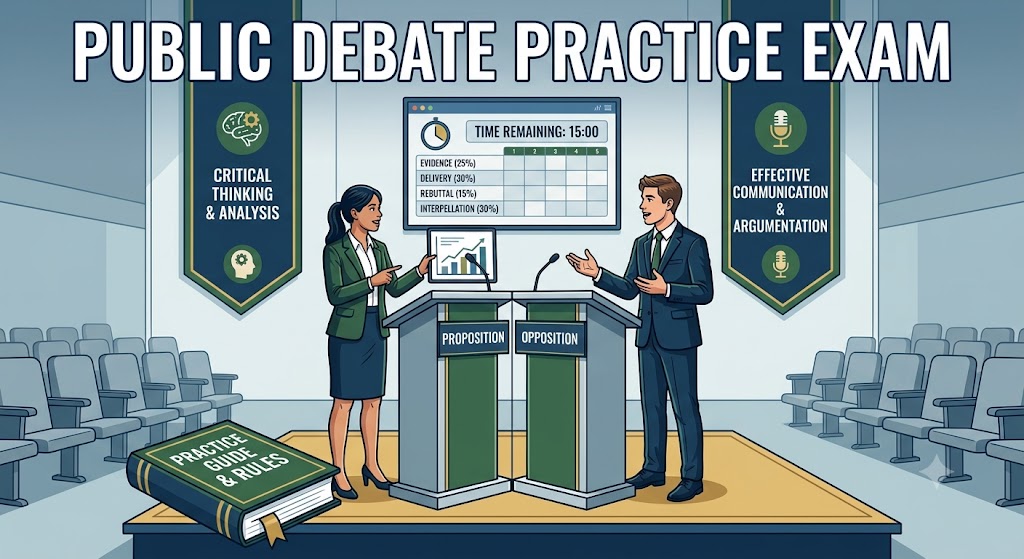
Additional Information
What the Course Entails and Exam Details
To succeed on the practice exam, candidates must demonstrate proficiency across the theoretical and practical foundations of public debate. The curriculum covers a wide spectrum, ensuring a robust command of essential skills. Key focus areas include:
Debate Fundamentals: Mastery of core concepts, including assertion, reasoning, evidence, and impact (AREI), burden of proof, and resolutional analysis.
Format and Structure: In-depth knowledge of standard timings, speech order, and rules for major debate types.
Logical Reasoning and Fallacies: The ability to identify, name, and evaluate common logical flaws and to critique the strength of various forms of argumentation.
Evidence and Research Standards: Protocols for citing, cutting, and validating evidence, including the ethics of evidence use.
Flowing and Decision Making: Practical skills for tracking a round (flowing) and applying consistent, impartial frameworks to determine a winner.
Judge Ethics and Equity: Principles for providing constructive feedback, avoiding bias, and maintaining a positive, inclusive competitive environment.
What to Expect in the Final Exam
The practice exam is structured to simulate the rigor and content of official accreditation tests. It focuses on theoretical application and procedural knowledge. While formats may vary slightly by organization, candidates should prepare for the following:
Format: The exam typically consists of a blend of detailed multiple-choice questions and scenario-based case studies.
Time Limit: Candidates are usually given 60 to 90 minutes to complete the test.
Passing Score: A high level of proficiency is required, often with a passing benchmark of 80% or 100% for judge certification.
Content Areas: Questions assess knowledge of specific rules (e.g., maximum heckle length, POI rules), procedural duties, and ethical responses to conflict.
How to Study and Exam Centers
A methodical approach to study is crucial for success. Start by thoroughly reviewing the comprehensive rulebooks provided by your target debate organization. Engage with official self-guided learning modules and watch sample rounds, practicing 'flowing' the debate and writing a final decision. Take advantage of all available practice exams to familiarize yourself with the question style and identify knowledge gaps.
Regarding testing locations, the Public Debate Practice Exam and official accreditation tests are overwhelmingly delivered through secure online portals. Major organizations, such as the NSDA, provide access to their certification exams through specialized platforms linked to member accounts. While physical testing centers (like authorized schools or regional tournament hubs) may sometimes host group testing sessions or seminars, the primary and most accessible method is remote, on-demand testing.
Job Opportunities from the Course
Achieving certification or demonstrating advanced competence through these assessments unlocks varied career paths where rigorous analysis and structured communication are paramount.
Speech and Debate Coach (K-12 and Collegiate)
Accredited Debate Judge
Forensics and Speech Program Director
Competitive Public Speaking Teacher
Corporate Communication Consultant
Advocacy and Public Policy Manager
Paralegal or Litigation Support Specialist
Conflict Resolution Specialist
Educational Facilitator in Critical Thinking
Frequently Asked Questions
Reviews
5.0
Based on 0 reviews
Leave a Review
No reviews yet. Be the first to review!