
Public Health Pest Control Practice Exam
$69.00
- Buy to unlock unlimited access to all Quiz questions and Answers in this Quiz.
- After purchase you can print a PDF of the whole quiz at any point. The PDF will contain the questions and the correct answers.
About this Exam
The Public Health Pest Control certification is a specialized designation for professionals dedicated to protecting communities from pests that directly impact human health and well-being. This certification is essential for individuals working in vector control programs, municipal services, public health departments, and commercial pest control companies that focus on managing disease-carrying organisms like mosquitoes, rodents, ticks, and other vectors. It ensures that applicators and managers understand the specific biology, habits, and control methods required for these unique challenges, operating safely and effectively within a public health context.
Ready to test your knowledge?
Buy Now to Access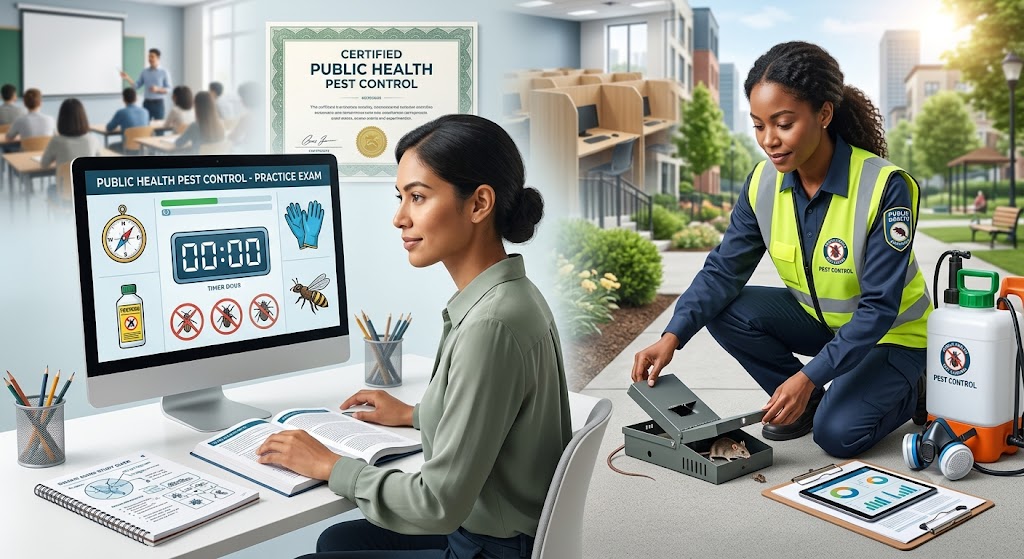
Additional Information
What the Course Entails and Exam Details
This comprehensive course covers a wide range of topics critical to public health pest management. Key areas of study typically include:
Pest Identification & Biology: Learning to recognize specific vectors (e.g., various mosquito species, urban rodents, ticks, cockroaches) and understanding their life cycles, behaviors, and habitats.
Disease Transmission: Understanding how public health pests transmit dangerous pathogens like West Nile virus, Zika virus, Lyme disease, and various bacterial infections.
Integrated Pest Management (IPM): Principles of employing a combination of biological, chemical, mechanical, and cultural control strategies to achieve sustainable and environmentally conscious solutions.
Vector Control Strategies: Specific techniques for managing mosquito populations (larviciding, adulticiding, source reduction), rodent control in urban and residential areas, and tick management.
Pesticide Labels & Regulations: Expert comprehension of pesticide labels, application rates, legal restrictions, EPA guidelines, and worker protection standards.
Safety Protocols & Personal Protective Equipment (PPE): Rigorous training on safe pesticide handling, mixing, application, transportation, and appropriate PPE selection and use.
Environmental Protection: Minimizing non-target effects, preventing groundwater contamination, and protecting ecological balance.
Equipment Calibration & Application: Knowledge of various application tools (foggers, sprayers, bait stations) and their proper calibration for accurate and effective use.
The exam details, such as the number of questions, duration, and passing score, can vary significantly depending on the specific state, country, or certifying body (e.g., state Department of Agriculture, environmental agencies). It is often structured as a proctored, written (often multiple-choice) or increasingly computer-based assessment.
What to Expect in the Final Exam
You should be prepared for a rigorous examination. The final test is generally structured in a multiple-choice format, designed to evaluate both theoretical knowledge and practical application skills across all the key domains mentioned above.
Key expectations for the final exam include:
Proctored Environment: The exam is typically taken under the supervision of a proctor in a secure setting, either in person or through an approved online proctoring service.
Time Limit: There is usually a set time limit, which can range from 1 to 3 hours or more, depending on the number of questions and the exam's complexity. Be sure to check your specific regulations.
Closed Book: Most public health pest control exams are closed-book, meaning you will not be allowed to use any study materials, notes, or electronic devices during the test.
Passing Score: Requirements for a passing score differ but generally fall between 70% and 80%.
Specific Rules: Each certifying authority may have specific rules regarding acceptable identification, allowed materials (such as basic calculators or approved label resources), and conduct during the exam. Thoroughly review these in advance.
Results & Certification: Results are typically provided either immediately upon completion of computer-based tests or within a specified timeframe for written exams. Once you pass, you will receive your certification.
How to Study and Exam Centers
Preparation is paramount for success on the Public Health Pest Control Exam. We recommend a structured study plan:
Review Official Study Materials: Obtain and thoroughly study the official manuals, study guides, and national core training materials provided by your certifying body or state pesticide safety education program (PSEP).
Take Practice Exams: Utilize available practice exams and question banks. These help you understand the question format, identify your strengths and weaknesses, and build exam-taking confidence.
Focus on Key Concepts: Pay close attention to pesticide laws, label interpretation, safety protocols, pest biology, and specific control techniques for major vectors.
Attend Training Courses: Consider enrolling in state-approved training programs, workshops, or review sessions, which can provide valuable in-depth knowledge and allow for interaction with instructors.
Create Flashcards: Use flashcards to memorize key terminology, scientific names, regulations, and conversion factors.
Exam Centers & Where to Take the Exam:
State & Government Testing Centers: Many exams are administered directly by the licensing department of the state’s department of agriculture, environmental quality, or public health in regional or central offices.
Online Proctored Platforms: Some authorities offer secure online exams through proctoring services (e.g., ProctorU, or dedicated government portals), allowing you to test from home or an approved location.
Pearson VUE & Other Testing Centers: Specific certifying bodies may utilize large, authorized testing center networks like Pearson VUE, which have numerous physical locations.
Authorized Schools & Institutes: Local universities, colleges, or specialized training institutes may also be authorized to host these exams, particularly in conjunction with training programs.
Always consult your specific state or certifying body’s website for official information on available study resources, registration processes, approved study materials, and the location/options for taking the examination.
Job Opportunities from the Course
A Public Health Pest Control certification unlocks a variety of impactful and specialized career paths. Here is a list of job titles and career opportunities that this certification can make possible:
Public Health Pest Control Technician
Vector Control Specialist / Mosquito Control Technician
Municipal Pest Management Worker
Municipal Vector Control Officer
Sanitation Inspector / Environmental Health Specialist
Public Works Pest Controller
Health Department Vector Analyst
Disease Vector Surveillance Specialist
Agricultural Technician (with a focus on public health pest categories)
Lead Pest Control Operator (for commercial companies handling large-scale or municipal contracts)
Training & Education Specialist (for pest control companies or public agencies)
Research Assistant (in vector biology or control methods)
Consultant (for communities, businesses, or government agencies on public health pest issues)
Pest Control Company Manager (overseeing public health accounts and staff certification)
Frequently Asked Questions
Reviews
5.0
Based on 0 reviews
Leave a Review
No reviews yet. Be the first to review!