
Public Safety Answering Point (PSAP) Training Release Practice Test
$69.00
- Buy to unlock unlimited access to all Quiz questions and Answers in this Quiz.
- After purchase you can print a PDF of the whole quiz at any point. The PDF will contain the questions and the correct answers.
About this Exam
The Public Safety Answering Point (PSAP) Training Release Practice Test is a crucial milestone for aspiring 911 dispatchers and emergency call takers.
This comprehensive exam is specifically designed to evaluate whether a trainee has absorbed the fundamental knowledge and practical skills required to transition from supervised training to independent call handling and dispatch operations.
It is intended for individuals currently enrolled in a PSAP training program who have completed the initial classroom and sit-along phases and are preparing for their final sign-off to work solo in a high-stakes, emergency environment.
Ready to test your knowledge?
Buy Now to Access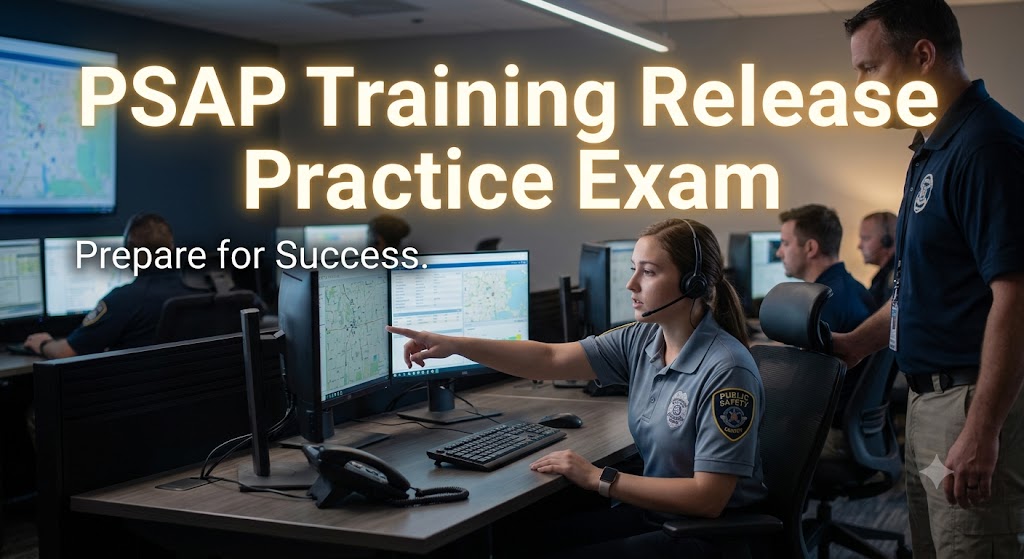
Additional Information
What the Course Entails and Exam Details
The PSAP training curriculum, which this practice test mirrors, covers a wide array of life-saving skills.
Trainees are expected to master several key competencies.
First, call handling protocols: this includes active listening, empathy, gathering critical information quickly (Where, What, Who, When, and Weapons), and classifying incidents accurately.
Second, Emergency Medical Dispatch (EMD): if applicable to the agency, this involves providing pre-arrival instructions to callers for medical emergencies.
Third, system operations: trainees must demonstrate proficiency in using Computer-Aided Dispatch (CAD) software, telephone systems, and radio consoles.
Fourth, radio communications: this covers clear, concise transmissions and adherence to agency radio codes and etiquette.
Finally, stress management and multitasking: the ability to maintain composure under extreme pressure and handle multiple priorities simultaneously is paramount.
The exact "course" structure is typically set by the individual agency, but it often adheres to national or state standards for emergency telecommunicators.
What to Expect in the Final Exam
While the format can vary slightly by agency, the final PSAP Training Release Evaluation generally consists of two distinct components.
The first component is a Written or Computer-Based Examination.
This portion focuses on the cognitive aspects of the job.
You should expect multiple-choice questions, true/false statements, and perhaps scenario-based matching.
The questions will test your knowledge of standard operating procedures (SOPs), emergency classifications, geography (major landmarks and jurisdictions), legal liabilities, and agency policies.
A common passing score requirement is 80% or higher, reflecting the zero-tolerance for error in this profession.
There is typically a set time limit for this portion, simulating the need for quick recall.
The second, and often more critical, component is the Practical Evaluation or "Simulation."
During this phase, you will handle simulated or "dead-line" emergency calls.
You will be expected to demonstrate your competence in applying the protocols you’ve learned.
Your performance will be evaluated by training officers on specific criteria, including accuracy, speed, professionalism, and adherence to established protocols.
This evaluation determines your readiness for solo dispatch duty.
How to Study and Exam Centers
Studying for the PSAP Training Release requires a combination of review and practical repetition.
Here are a few actionable strategies.
First, master your agency’s SOPs: This is your primary resource. Create flashcards for critical procedures and call types.
Second, practice active listening: Review recordings of past calls (both good and bad examples) and practice extracting key information while staying engaged with the caller.
Third, take practice tests: Use resources like this one, or agency-provided practice questions, to identify knowledge gaps and get comfortable with the exam format.
Fourth, utilize role-playing: Have experienced dispatchers or fellow trainees run call scenarios with you, challenging you with complex or stressful situations.
Finally, review geographic information: Use maps of your jurisdiction to practice locating addresses, cross-streets, and common landmarks.
Exam Centers: It is important to understand that the final "exam" and evaluation for a PSAP Training Release rarely take place at a third-party testing center like Pearson VUE.
Instead, the written exam and the practical evaluation are almost always conducted "in-house" at the specific PSAP or agency where you are employed.
Your training coordinators or supervisor will schedule your release evaluation as the culmination of your agency-specific training program.
Job Opportunities from the Course
Successfully completing the PSAP training program and passing the release exam is the gateway to a rewarding career in public safety.
The fundamental skills you acquire unlock several related career paths.
Here is a list of job opportunities that this training can lead to.
911 Dispatcher / Emergency Telecommunicator: This is the direct result of passing the exam, making you eligible for full-time, independent dispatch duties for police, fire, or EMS.
Communications Officer: A title often synonymous with a 911 dispatcher, sometimes encompassing a wider range of communication responsibilities within a large public safety agency.
Public Safety Dispatcher Supervisor: With significant experience and demonstrated leadership, successful dispatchers can advance to supervisory roles, managing teams and overseeing call center operations.
CAD/Records Technician: A background in CAD systems and public safety protocols is valuable for roles focusing on maintaining and organizing public safety records and technical systems.
Emergency Management Specialist: Understanding the workflow of emergency response from the front lines can be a significant asset when moving into broader emergency planning and management roles at a local or county level.
Frequently Asked Questions
Reviews
5.0
Based on 0 reviews
Leave a Review
No reviews yet. Be the first to review!