
QCAA Cognitive Verbs Practice Test
$69.00
- Buy to unlock unlimited access to all Quiz questions and Answers in this Quiz.
- After purchase you can print a PDF of the whole quiz at any point. The PDF will contain the questions and the correct answers.
About this Exam
Welcome to your essential resource for mastering the QCAA Cognitive Verbs! This isn't just about learning a list of words; it’s about understanding the engine that drives every Queensland curriculum assessment. In your senior schooling, every exam question is a code, and the cognitive verbs (like analyze, evaluate, or justify) are the keys to unlocking the maximum marks.
Success in your QCAA journey hinges on your ability to not only know what you are being asked to do but to demonstrate the precise level of thinking required. This "Practice Exam" is designed for all senior Queensland students who are serious about their studies. It serves as your guide and practice ground to decode assessment questions, apply the correct cognitive process, and clearly communicate your understanding, regardless of the subject. Use this to prepare not just for one specific test, but to enhance your academic performance across all your QCAA courses.
Ready to test your knowledge?
Buy Now to Access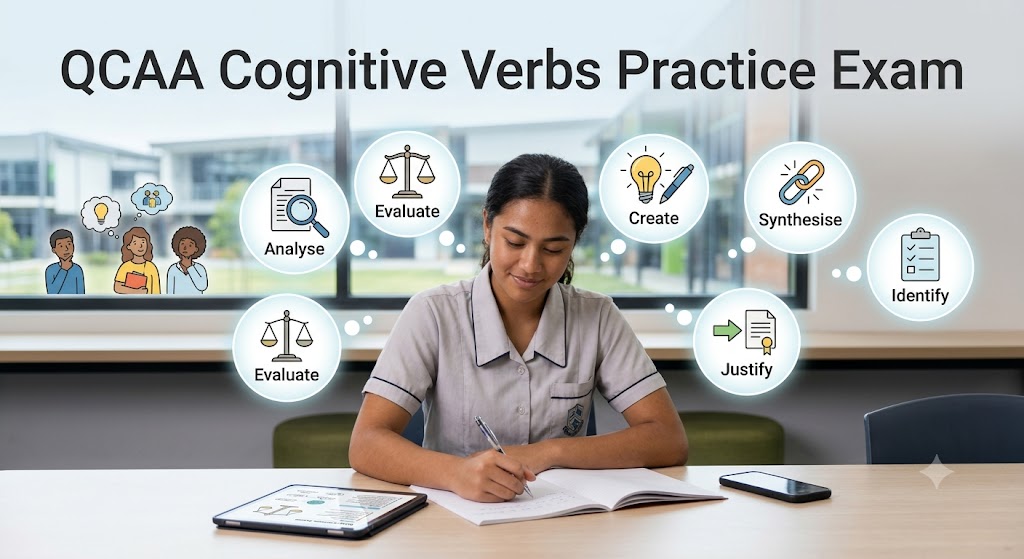
Additional Information
What the Course Entails and Exam Details
This preparation isn't a course with a specific syllabus or an exam you sign up for on its own. Instead, it is an essential part of the QCAA (Queensland Curriculum and Assessment Authority) framework for all senior subjects. To prepare, you must delve into the QCAA Cognitive Verb glossary.
You will learn to differentiate and apply over 50 specific verbs, classified by their thinking levels (often based on Bloom's Taxonomy or Marzano & Kendall's system). Core areas and skills covered through this practice include:
Understanding levels of thinking: Grasping the depth of complexity required, from basic recall to complex creation and evaluation.
Decoding question structure: Identifying the verb and understanding its implications for your answer.
Applying subject-specific context: Recognizing that "analyze" in History requires different evidence and structure than "analyze" in Physics.
Demonstrating critical thought: Clearly articulating your reasoning, presenting arguments, and synthesizing information according to the verb’s demand.
The "Exam Details" are also not for a single test. The structure of QCAA assessments varies dramatically across subjects. You can expect:
Diverse Formats: Subject exams can include multiple choice, short answer questions, extended responses, essays, performance tasks, projects, scientific investigations, and oral presentations.
Varying passing requirements: Scoring and "passing" are tied to subject-specific criteria, internal assessments, external exams, and the calculation of your final QCE (Queensland Certificate of Education) or ATAR (Australian Tertiary Admission Rank).
Time limits: Each assessment and exam has its own designated time, specific to the subject and year level.
Rules: Rigorous QCAA-defined rules for all assessments, particularly for external exams, must be strictly followed.
Therefore, this "Practice Exam" is designed to cultivate the essential thinking and response skills you need for ALL these actual assessments.
What to Expect in the Final Exam
Since there is no single final exam for the QCAA Cognitive Verbs, you must instead focus on what to expect in your individual subject-based QCAA assessments.
A Practice Test session on the cognitive verbs themselves might ask you conceptual questions like "What is the key difference between 'evaluate' and 'analyze'?", or provide a sample question and ask you to "Identify the cognitive verb and explain what action is required in a 200-word response."
In your actual, Subject-Specific Final Exams (external assessments) and major internal assessments, you can expect questions phrased using these specific cognitive verbs to demand a certain depth of response:
A lower-level question might ask you to "Identify" a function or "Describe" a process.
A higher-level question might require you to "Compare and contrast" two ideas, "Evaluate the effectiveness" of a solution, "Justify an argument" with evidence, or "Analyze" complex data to draw conclusions.
You will be marked on how directly and comprehensively your response addresses the specific demand of the cognitive verb in that subject’s context.
The rules and format for these actual exams (external ones, for example) are strictly controlled. They can involve multiple-choice bubbles, extended handwritten answers, formula writing, or extended essays in some subjects, with precise time limits and strict invigilation.
How to Study and Exam Centers
Effective preparation is about regular, active application of the cognitive verbs. Here’s how to study:
Create Your Cheat Sheet/Flashcards: Don't just use the official definitions; rewrite them in your own, simple words for better retention.
Analyze Past Papers: This is crucial. Get hold of previous QCAA subject exams (available on the official website or through your school). Look at the questions, identify the cognitive verb, and check the sample responses or marking guidelines to see how a high-scoring answer addressed it.
Focus on 'Subject + Verb': Practice applying the same verb to different subjects. "Analyze" works differently in English, Math, and Biology. Talk to your teachers about subject-specific expectations.
Draft and Get Feedback: Write responses to practice questions and ask your teachers for feedback, specifically focusing on whether your response demonstrated the correct depth of thought required by the verb.
Practice Active Learning: In your everyday study, try to rephrase facts or concepts by using different cognitive verbs (e.g., from describing how a computer works to evaluating its societal impact).
Time Yourself: When practicing past paper questions, stick to the exam timing to build stamina and practice effective time management for each question type.
Where and how to take the exams? For your official QCAA assessments:
Exam Centers: The vast majority of internal and external QCAA subject assessments are completed within your own school or at an official, pre-authorized school/venue. For official external exams, your school will provide specific details on the center location and procedures.
Registration: Your school manages your general QCAA registration and schedules your internal assessments. For some external assessments, registration and access might be facilitated through the official QCAA portal or specific processes communicated via your school. Always keep in touch with your school’s guidance counselors or QCAA coordinators.
Job Opportunities from the Course
While mastering the QCAA Cognitive Verbs does not, in itself, lead to a specific job certification, it is a critical skill set that directly enables success throughout your senior schooling and provides a foundation for high-level academic achievement and diverse future careers. A strong understanding and application of these verbs, demonstrated through excellent results across your QCAA subjects, contribute significantly to your final ATAR.
Strong overall academic performance, enabled by these high-level cognitive and critical thinking skills, is the direct pathway to competitive university courses and future academically demanding, successful careers, including job titles and pathways such as:
Higher Education: Essential for success in demanding degree courses like Law, Medicine, Engineering, Education, Business, Creative Arts, Computer Science, and all academic research paths.
Critical Thinker: In all future roles, the ability to analyze, evaluate, and synthesize information is highly valued and can contribute to a career as a Consultant, Strategic Planner, or Problem-Solver.
Analytical Roles: Mastering analysis can lead to a career as an Analyst (Data, Business, Financial, Medical), Researcher, or Scientist.
Evaluative and Judging Careers: Skills in evaluation are critical for Legal Professionals (Lawyers, Barristers, Judges), Policy Makers, Quality Control Managers, or Arbitrators.
Communication & Argument: Strong communication, justification, and synthesis skills are vital for success in Writing, Journalism, Public Relations, Marketing, and Education.
Creative and Synthesis Roles: Skills in creating and synthesis are required in fields like Design (Architects, Graphic Designers), Innovation, Leadership, and Product Development.
Understanding and Explaining: Essential skills for Teachers, Educators, Trainers, Communicators, and Customer Relations Specialists.
Frequently Asked Questions
Reviews
5.0
Based on 0 reviews
Leave a Review
No reviews yet. Be the first to review!