
QMED Oiler Certification Practice exam
$69.00
- Buy to unlock unlimited access to all Quiz questions and Answers in this Quiz.
- After purchase you can print a PDF of the whole quiz at any point. The PDF will contain the questions and the correct answers.
About this Exam
The QMED Oiler certification, short for Qualified Member of the Engine Department (Oiler), is a critical national rating issued by the United States Coast Guard (USCG).
This certification is designed for mariners seeking to work as skilled, non-licensed members within a vessel's engineering team, serving as a primary stepping stone to becoming a licensed marine engineer.
An Oiler's core responsibility is ensuring the seamless, reliable operation of the main propulsion systems and crucial auxiliary machinery.
This practice exam is tailored for applicants preparing for the USCG examination or for students enrolled in USCG-approved courses, offering a comprehensive way to test knowledge and build confidence before the final test.
It is for anyone who wants to advance their maritime career from a entry-level position like Wiper, to a rating with more responsibility and higher pay.
Ready to test your knowledge?
Buy Now to Access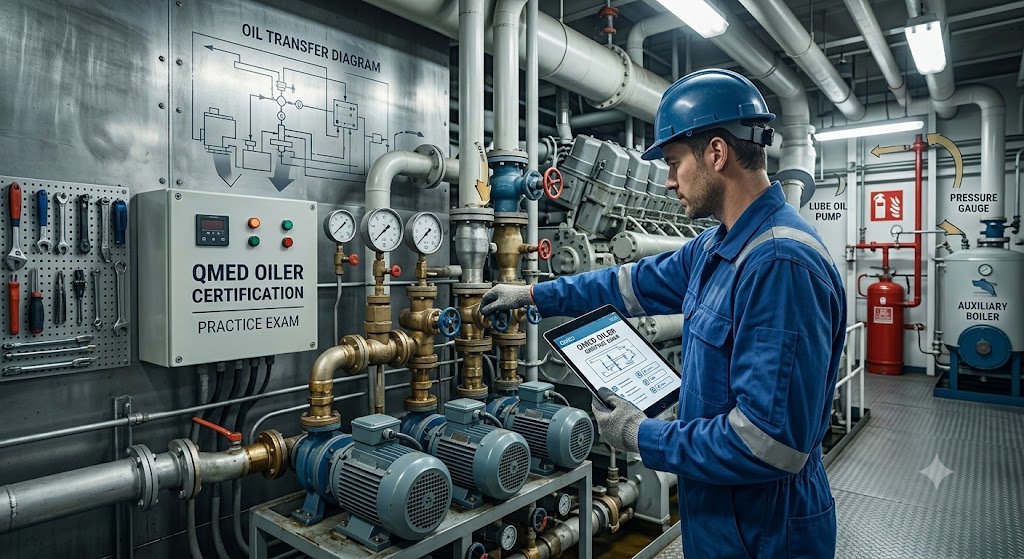
Additional Information
What the Course Entails and Exam Details
A QMED Oiler course, and consequently the certification exam, covers a broad spectrum of marine engineering fundamentals.
Prospective Oilers must master a vast body of knowledge, which typically includes:
Marine Engineering Principles: Understanding the basic thermodynamics, mechanics, and terminology of marine propulsion.
Diesel Engine Operation and Maintenance: Internal combustion engine cycles, fuel systems, lubrication systems, cooling systems, and troubleshooting of medium and slow-speed diesel engines.
Auxiliary Machinery: Operation, maintenance, and repair of pumps (centrifugal, positive displacement), air compressors, evaporators, heat exchangers, and associated piping systems.
Auxiliary Boilers and Steam Systems: Fundamentals of boiler operation, water treatment, fuel burning, and steam distribution systems, as well as automatic controls.
Lubrication: Different types of lubricants, their properties, application methods, oil analysis, and troubleshooting lubrication failures.
Safety Procedures and Equipment: Comprehensive fire prevention, firefighting, pollution prevention (MARPOL), personal protective equipment (PPE), and emergency response.
Electricity: Basic AC/DC circuits, generators, motors, and electrical safety.
Hand Tools and Measuring Instruments: Proper use and maintenance of technical tools in a marine environment.
What to Expect in the Final Exam
The final QMED Oiler examination, administered directly by the USCG at a Regional Exam Center (REC) or as part of an approved course, consists of multiple-choice questions.
For the national rating, the examination is generally split into two parts, known as:
Q804 Oiler - Part I: This section primarily covers diesel engine propulsion, auxiliary boilers, and steering systems.
Q805 Oiler - Part II: This section covers general maritime engineering knowledge, safety, electricity, pumps, refrigeration, and other auxiliary systems.
Each part typically contains 50 questions, and a passing score of at least 70% is required on each individual part.
There is a time limit for each exam, which is usually around 3.5 to 4 hours.
If you are taking a USCG-approved course, the final exam structure might vary slightly, but it will adhere to the same content standards and proctoring rules, and will often be taken on a computer-based system.
How to Study and Exam Centers
Preparation for the QMED Oiler exam demands a multi-faceted approach.
Effective study strategies include:
Use Sample Exams: The USCG provides official sample examinations (like Q804 and Q805) with answer keys, which are invaluable for understanding the question style and content distribution.
Practice with Online Modules: Utilize dedicated maritime study portals that offer vast question banks, timed practice tests, and explanations for correct answers. This interactive approach helps identify weaknesses.
Review Coast Guard Publications: Read through relevant sections of the Code of Federal Regulations (CFRs), specifically 46 CFR Part 12, which details the requirements for national ratings.
Create Flashcards: Memorize definitions, formulas, and visual diagrams of machinery and systems.
Hands-on Experience: If possible, correlate theoretical knowledge with practical experience on a vessel or in a technical workshop, focusing on the equipment you are studying.
When you are ready to take the exam, you have two primary options:
USCG Regional Exam Centers (RECs): You must apply through the USCG National Maritime Center (NMC) and schedule your exam at one of the 17 RECs located across the United States.
Approved Maritime Training Schools: Many private maritime academies and training centers offer USCG-approved QMED Oiler courses. These courses culminate in a final proctored exam, and successful completion can be used in lieu of the USCG examination at an REC.
Job Opportunities from the Course
Earning a QMED Oiler certification unlocks diverse and rewarding career paths within the maritime industry.
It is a key credential for advancement and offers a stable professional life on the water.
Here are the primary job titles and career opportunities that this certification unlocks:
Oiler: The direct role, responsible for lubrication, monitoring, and general maintenance of engine room machinery on all types of commercial vessels, including tankers, container ships, cruise ships, tugboats, and offshore supply vessels.
Unlicensed Junior Engineer: In this capacity, you will perform more complex maintenance and troubleshooting, often with more specific focus on systems like electrical or refrigeration, preparing for a licensed position.
Engine Room Advancement: The QMED Oiler endorsement is a necessary prerequisite to obtain more advanced unlicensed ratings, such as QMED-Any Rating or to begin the 'hawsepipe' progression to become a Licensed Third Assistant Engineer.
Technical Vessel Support: Some shoreside positions, particularly in ship repair and technical service, value the deep practical knowledge and system understanding of a certified Oiler.
Maritime Instructor: With experience, you can teach unlicensed engineering courses at maritime schools, giving back to the next generation of mariners.
Frequently Asked Questions
Reviews
5.0
Based on 0 reviews
Leave a Review
No reviews yet. Be the first to review!