
QMED Sea School Practice Test
$69.00
- Buy to unlock unlimited access to all Quiz questions and Answers in this Quiz.
- After purchase you can print a PDF of the whole quiz at any point. The PDF will contain the questions and the correct answers.
About this Exam
The Qualified Member of the Engine Department (QMED) is a critical United States Coast Guard (USCG) merchant mariner credential, acting as the senior rating within a vessel's engine room, just below a licensed engineering officer. Our comprehensive QMED Sea School Practice Exam is designed for ambitious mariners who have already accumulated the required 180 days of sea service as a wiper or in another entry-level engineering role. It serves as an indispensable tool for anyone seeking a specific QMED rating, such as Oiler, Fireman/Watertender, Pumpman/Machinist, Electrician/Refrigerating Engineer, or Junior Engineer, preparing them to confidently navigate the official USCG examination.
Ready to test your knowledge?
Buy Now to Access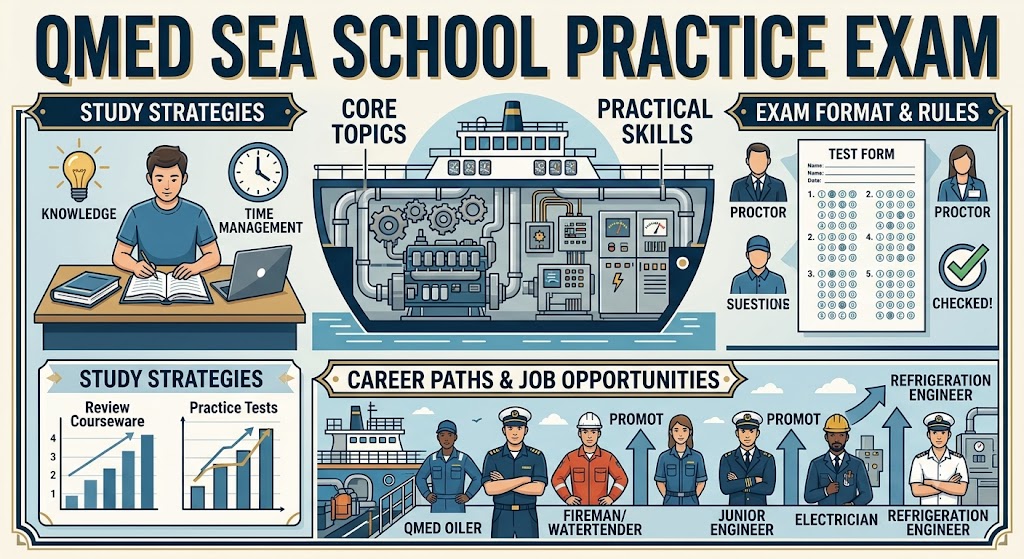
Additional Information
What the Course Entails and Exam Details
While this practice exam itself is a self-assessment tool, the corresponding coursework at an approved Sea School will deeply cover the theoretical and practical knowledge required by 46 CFR Part 12 for national rating endorsements. The official QMED exam is modular, and students will find practice questions tailored to the specific endorsement they seek, mirroring the actual subjects:
QMED – General Subjects: Basic principles of marine engineering, safety, and pollution prevention.
Diesel/Motor Propulsion: Detailed study of internal combustion engines, fuel systems, and lubricants.
Steam Propulsion: Boiler fundamentals, steam cycles, and associated auxiliary machinery.
Electricity: Marine electrical systems, circuits, generation, and distribution equipment.
Refrigeration/Air Conditioning: Thermodynamic cycles, refrigerants, and system troubleshooting.
Auxiliary Machinery: Pumps, valves, piping systems, steering gear, and desalination plants.
Practical Skills: Proper use of hand tools, measuring instruments, and basic maintenance procedures.
What to Expect in the Final Exam
The official USCG examination, which you must pass at a Regional Exam Center (REC), consists of multiple-choice questions administered in a proctored environment. It is important to remember that our QMED Sea School Practice Exam is designed to simulate this experience but allows multiple attempts online, whereas the official exam has strict rules. Here is a breakdown of what to expect for each actual rating module:
Format: Each official module (e.g., Motor, General) consists of approximately 50 to 70 multiple-choice questions.
Passing Score: A minimum score of 70% is required to pass each individual module.
Time Limits: You will be allocated a specific time limit, typically 2 to 3 hours per module, to complete the exam.
Retakes: If you fail a module, strict USCG retake guidelines apply, often involving waiting periods and re-application fees.
Materials: You will be provided with necessary illustrations and a non-programmable calculator for mathematical questions in the exam room.
How to Study and Exam Centers
Success in the QMED exam demands consistent, hands-on study. Beyond using this QMED Sea School Practice Exam as your primary progress tracker, we recommend integrating the following strategies:
Analyze the USCG Sample Exams: Download and study the official sample examinations provided by the USCG National Maritime Center, as they provide an exact preview of the official question style and format.
Focus on Illustrations: Become intimately familiar with the diagrams and machinery illustrations referenced in the USCG exams; many questions rely on correctly interpreting these components.
Enroll in an Approved Course: While self-study is possible, taking an approved QMED course at a maritime school (like Sea School) provides structured learning and hands-on training that are invaluable.
Simulate Exam Conditions: When taking your practice tests, set a timer and create a distraction-free environment to build mental stamina and improve time management.
To take the official exam, you must submit a completed Merchant Mariner Credential (MMC) application to the USCG, have it approved, and then schedule your in-person testing at one of the 17 Regional Exam Centers (RECs) located across the United States. Your approved Sea School may also offer testing services for certain USCG-approved courses, and you should inquire directly with them about those options.
Job Opportunities from the Course
Earning your QMED endorsement, validated by passing the official exam, unlocks a wide variety of advanced career paths within the maritime industry. The specific jobs available depend on the individual ratings you acquire. Successful completion of the QMED-Oiler or QMED-Junior Engineer ratings, for example, forms the foundational step toward becoming a licensed Engineering Officer (3rd Assistant Engineer). Here are some of the key career opportunities available immediately upon obtaining your QMED:
Marine Oiler: Performs lubrication and operational watches on primary and auxiliary machinery.
Marine Fireman/Watertender: Operates boilers and manages steam, feedwater, and fuel oil systems.
Junior Engineer: Acts as a utility engineer with broad knowledge of both deck and engine department systems.
Marine Electrician: Maintains shipboard electrical generation, power distribution, and electronic control systems.
Marine Machinist: Operates engine room machine shop tools like lathes and drills for custom repairs.
Pumpman: Specializes in the maintenance and operation of cargo, ballast, and auxiliary piping systems.
Path to 3rd Assistant Engineer (Unrestricted): With appropriate additional sea service and endorsements, a QMED can qualify for the exam to become a licensed marine engineering officer.
Frequently Asked Questions
Reviews
5.0
Based on 0 reviews
Leave a Review
No reviews yet. Be the first to review!