
Qualified Applicator License (QAL) Category F – Aquatic Practice Exam
$69.00
- Buy to unlock unlimited access to all Quiz questions and Answers in this Quiz.
- After purchase you can print a PDF of the whole quiz at any point. The PDF will contain the questions and the correct answers.
About this Exam
The Qualified Applicator License (QAL) Category F – Aquatic certification is a specialized credential issued by the California Department of Pesticide Regulation (DPR).
It is designed specifically for individuals who apply or supervise the application of pesticides, including herbicides and algaecides, to water bodies.
This includes, but is not limited to, irrigation canals, reservoirs, rivers, ornamental ponds, lakes, and drainage systems.
This certification is essential for professionals who must manage vegetation and pests in aquatic environments while adhering strictly to environmental regulations.
Achieving this license ensures you possess the critical knowledge needed to protect water quality, public health, and non-target species during treatment.
Ready to test your knowledge?
Buy Now to Access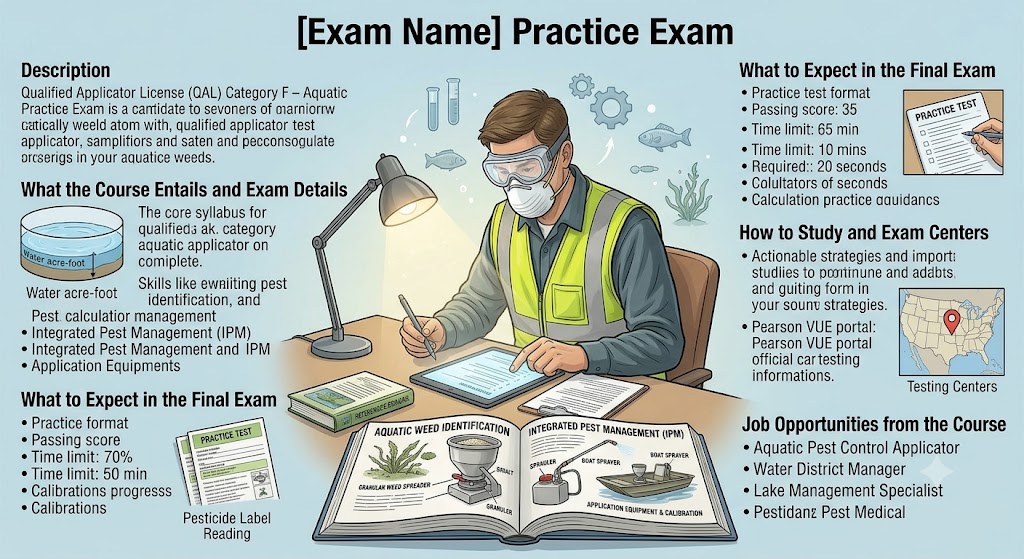
Additional Information
What the Course Entails and Exam Details
The path to receiving your Category F license begins with understanding the core syllabus, which covers both theoretical knowledge and practical field applications.
The key topics include:
Pesticide Laws and Regulations
You must demonstrate a deep understanding of federal (FIFRA) and California state laws regarding the sale, use, storage, and disposal of aquatic pesticides. This includes permitting requirements for applications to waters of the state.
Aquatic Pest Identification
This involves recognizing common aquatic weeds (submerged, emergent, and floating), algae types, and aquatic invertebrates or vertebrates that require management. You must understand their life cycles and ecology to apply treatments effectively.
Integrated Pest Management (IPM) in Aquatic Systems
The curriculum emphasizes using IPM principles, focusing on prioritizing non-chemical controls (like mechanical harvesting, biological controls, and cultural practices) before resorting to chemical applications.
Pesticide Formulations and Adjuvants
You will study the different types of pesticide formulations specific to aquatic use (like granules, liquids, and pellets) and how surfactants or sinking agents improve efficacy in moving or static water.
Application Equipment and Calibration
A critical skill is understanding the correct operational use of specialized aquatic application equipment, including boat-mounted sprayers, direct injection systems, and granular spreaders. Precise calibration is essential to prevent over-application and ensure environmental safety.
Environmental Safety and Ecotoxicology
This section covers the fate of pesticides in the aquatic environment, including dissipation rates, breakdown, and potential impact on non-target organisms (fish, invertebrates, and birds).
Human Health and Worker Safety
You will review pesticide toxicity, the appropriate personal protective equipment (PPE), and proper handling practices to minimize risk to applicators and the public.
What to Expect in the Final Exam
The final QAL Category F Aquatic exam is a comprehensive assessment of your competency.
It is a closed-book, multiple-choice examination.
The exam typically consists of 50 to 100 questions, though this can vary.
While the exact passing score criteria are set by the DPR, you generally must achieve a minimum score of 70% to be eligible for licensure.
The time limit for the specialized Category F exam is usually 1.5 to 2 hours, which is typically taken sequentially with the required core "Laws, Regulations, and Basic Principles" exam, which has its own time limit.
The questions are designed to test your ability to apply your knowledge to real-world scenarios, such as determining the correct pesticide volume for a specific water acre-foot calculation.
How to Study and Exam Centers
Preparation is paramount for success on the QAL exams.
The single most important study resource is the official DPR study manual for Category F.
Study Strategies
Leverage Practice Exams: Utilizing dedicated practice exams (like this one) is essential. They familiarize you with the question formatting, highlight your weak areas, and help you improve your pacing.
Attend Review Courses: Many private consulting firms and organizations (like the California Aquatic Plant Management Society) offer preparation courses. These provide invaluable insights and expert instruction.
Master Water Volume Calculations: Practice calculating area (acres) and volume (acre-feet). A significant portion of the practical application questions will involve these essential mathematics.
Focus on Pesticide Labels: Learn how to read aquatic pesticide labels comprehensively. This is where you will find information on rates, restrictions, and target species.
Exam Centers and Registration
The QAL exams are administered through a partnership between the California DPR and a third-party testing vendor.
To take the exam, you must first submit an application to the DPR along with the required licensing and examination fees.
Once approved, you will receive an Authorization to Test (ATT) letter.
This letter will direct you to schedule your exam through the vendor, often Pearson VUE or a similar certified testing center.
These computerized testing centers are located in major cities throughout California.
Ensure you arrive early with the appropriate identification required by the testing center.
Job Opportunities from the Course
Earning your QAL Category F Aquatic certification significantly increases your employability and opens doors to several specialized, well-paying career paths. This credential validates your expertise to both public and private employers.
The specific job titles and career paths this certification unlocks include:
Aquatic Pest Control Applicator: Applying herbicides, algaecides, and other treatments in the field.
Vector Control Technician / Manager: Managing mosquito and vector populations (when applying pesticides to water bodies).
Water District Resource Manager: Overseeing vegetation management in canals, reservoirs, and drainage systems.
Lake Management Specialist: Working with private communities or municipalities to maintain recreational lakes and ponds.
Park and Recreation Specialist: Managing water features in parks and public spaces.
Irrigation Canal Supervisor: Coordinating weed control in complex agricultural water delivery systems.
Environmental Consultant: Advising clients on regulatory compliance and effective aquatic IPM strategies.
Frequently Asked Questions
Reviews
5.0
Based on 0 reviews
Leave a Review
No reviews yet. Be the first to review!