
Qualified Applicator License (QAL) Right of Way Practice Exam
$69.00
- Buy to unlock unlimited access to all Quiz questions and Answers in this Quiz.
- After purchase you can print a PDF of the whole quiz at any point. The PDF will contain the questions and the correct answers.
About this Exam
The Qualified Applicator License (QAL) Right of Way certification is a crucial credential for professionals managing vegetation and pests along public infrastructure. This specialized exam is designed for individuals seeking state licensure to safely and effectively apply pesticides in areas such as roadsides, railways, utility lines, and pipelines. It is essential for municipal workers, highway department personnel, utility contractors, and private applicators who need to ensure compliance with stringent safety and environmental regulations while maintaining critical infrastructure.
Ready to test your knowledge?
Buy Now to Access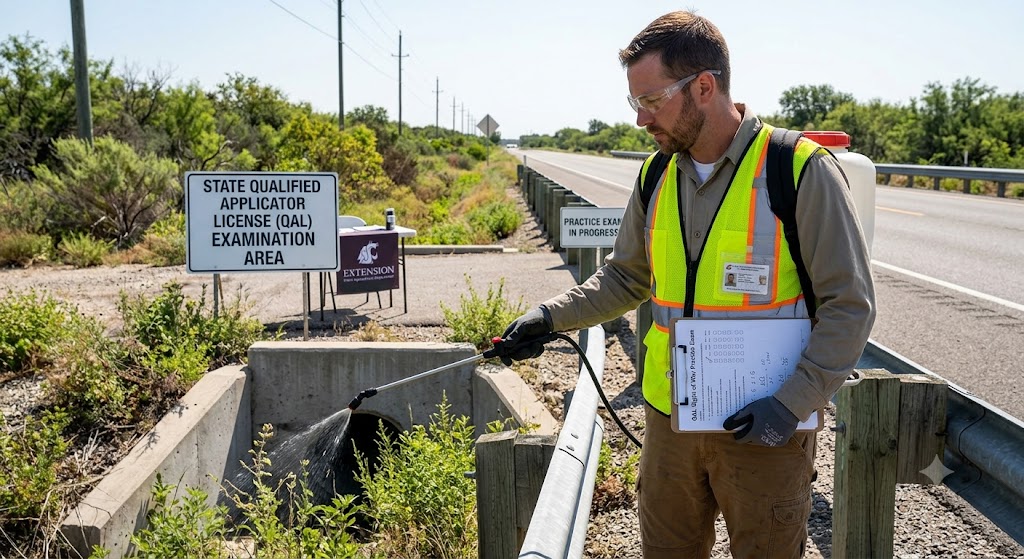
Additional Information
What the Course Entails and Exam Details
The knowledge base required for the QAL Right of Way exam is comprehensive, focusing heavily on specialized vegetation management. The core topics covered include:
Integrated Pest Management (IPM): Understanding ecological principles to minimize pesticide reliance through mechanical, cultural, and biological controls.
Weed Identification: Recognizing major noxious weeds and target vegetation specific to right-of-way environments.
Herbicide Selection and Application: Choosing the correct formulations and methods (e.g., broadcast, spot treatment, basal bark) for different terrains and targets.
Equipment Calibration: Precise calculations for determining application rates and ensuring equipment is functioning correctly to avoid over- or under-application.
Laws and Regulations: In-depth knowledge of federal and state pesticide laws, including labeling requirements and safety standards.
Environmental Stewardship: Implementing drift control, protecting water sources, and managing runoff in sensitive public zones.
What to Expect in the Final Exam
The final QAL Right of Way examination is a rigorous assessment of your operational competency and safety knowledge. While format details vary by jurisdiction, standard characteristics include:
Format: The exam typically consists of multiple-choice questions designed to test both factual knowledge and situational decision-making.
Passing Score: A passing grade is usually set at a minimum of 70% or 75%.
Time Limit: Candidates are generally allotted 2 to 3 hours to complete the examination.
Specific Rules: The exam is strictly proctored. While specific rules depend on the state agency (such as the California Department of Pesticide Regulation, CDPR), common practices involve closed-book conditions, allowing only non-programmable calculators for the required mathematical calibration questions.
How to Study and Exam Centers
Preparation is vital for passing the QAL Right of Way exam. We recommend following these proven study strategies:
Utilize Comprehensive Practice Exams: This practice exam itself is an excellent diagnostic tool to simulate the actual testing environment and identify knowledge gaps.
Study the State Manuals: Obtain the official study guides provided by your state’s Department of Agriculture or Pesticide Regulation agency.
Master the Calculations: Practice equipment calibration problems repeatedly. This is often the most challenging section for applicators.
Focus on Label Interpretation: Review sample pesticide labels to quickly find critical information regarding safety, application rates, and environmental hazards.
Form Study Groups: Collaborating with colleagues pursuing the same licensure can provide valuable insight and motivation.
Exam Centers and Registration:
The actual QAL Right of Way certification exam is administered by state-specific regulatory bodies. Typically, candidates register through their State Department of Agriculture. Testing usually takes place at designated state agency field offices, authorized community colleges, or professional testing centers (such as Pearson VUE, depending on the state’s partnership). You must locate your specific state regulator's website to find authorized locations and available testing dates.
Job Opportunities from the Course
Securing your Qualified Applicator License (QAL) Right of Way certification significantly expands your career options within the specialized vegetation management and public works sectors. The license qualifies you for specific roles across various industries:
Right-of-Way Herbicide Applicator
Highway Vegetation Manager
Utility Line Clearance Arborist (with complementary certs)
Railway Vegetation Technician
Municipal Pest Control Specialist (Vegetation focused)
Utility Forester
Noxious Weed Control Supervisor
Industrial Vegetation Management Consultant
Frequently Asked Questions
Reviews
5.0
Based on 0 reviews
Leave a Review
No reviews yet. Be the first to review!