
Quality Control Radiographic Equipment Practice Test
$69.00
- Buy to unlock unlimited access to all Quiz questions and Answers in this Quiz.
- After purchase you can print a PDF of the whole quiz at any point. The PDF will contain the questions and the correct answers.
About this Exam
The Quality Control Radiographic Equipment Practice Test is a comprehensive and essential tool for healthcare professionals seeking to specialize in the crucial field of medical imaging quality assurance. This exam is designed for Registered Radiologic Technologists (R.T.s), biomedical equipment technicians, medical physicists, and QC coordinators who are responsible for ensuring the optimal performance, safety, and regulatory compliance of diagnostic X-ray systems.
By validating your knowledge through this practice test, you demonstrate your commitment to patient safety, image excellence, and the accurate functionality of life-saving medical imaging technology. It is a vital step for those pursuing specialized certifications or advancing their careers in quality management within radiology departments.
Ready to test your knowledge?
Buy Now to Access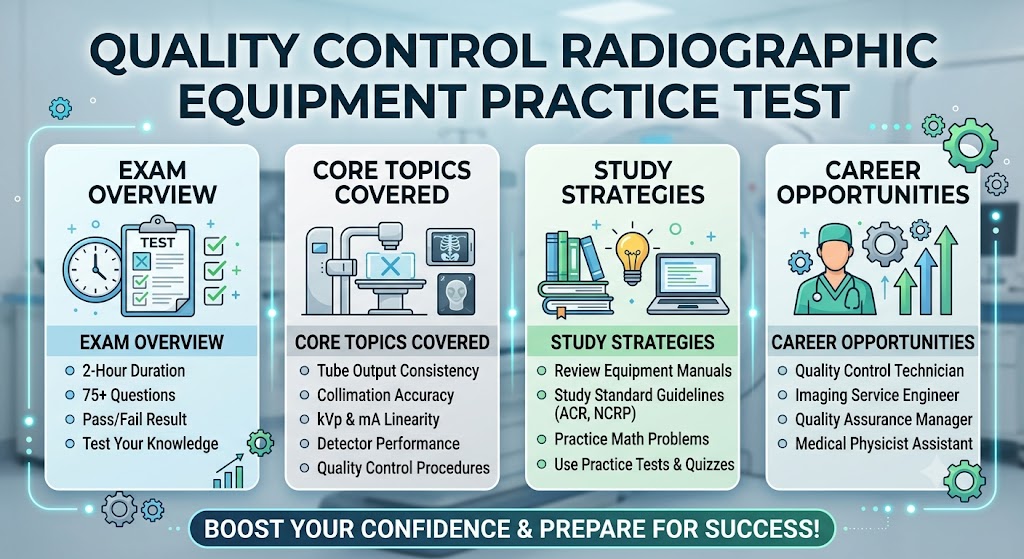
Additional Information
What the Course Entails and Exam Details
This specialized path focuses on the fundamental principles and practical applications of quality control (QC) procedures for various radiographic imaging systems, including static X-ray units, mobile machines, and fluoroscopy systems. The practice test covers a wide range of essential topics, ensuring you have the expertise needed to conduct rigorous evaluations.
Core Topics Include:
X-Ray Tube & Generator Performance: Measurement of reproducibility, kVp accuracy, and mA/mAs linearity.
Beam Filtration & Collimation: Determining the Half-Value Layer (HVL) and evaluating x-ray field/light field congruence.
Image Receptor Evaluation: Testing the performance of digital (DR) and computed radiography (CR) plates, including dynamic range, artifact detection, and spatial resolution.
Phantom Imaging & Analysis: Utilizing standard phantoms to assess low-contrast and high-contrast resolution, noise, and uniformty.
Fluoroscopy Specific Tests: Assessing automatic brightness control (ABC) and maximum entrance skin exposure rates.
Regulatory Compliance & Documentation: Understanding state and federal regulations (e.g., MQSA), equipment standards, and maintaining accurate QC logs.
Troubleshooting and Safety Protocols: Identifying equipment malfunctions and enforcing ALARA (As Low As Reasonably Achievable) principles for patient and staff safety.
What to Expect in the Final Exam
While exact details depend on the specific certifying body or organizational requirement, the final exam typically evaluates both theoretical knowledge and practical comprehension.
Format: The primary component is usually a computer-based, multiple-choice examination.
Number of Questions: You can expect approximately 75 to 125 questions.
Time Limit: A timeframe of 2 to 3 hours is common.
Passing Score: Most exams require a passing score of 70% to 75% or higher.
Content: Questions will require you to interpret data from QC tests, calculate linearity or reproducibility from sample data, identify image artifacts from sample phantoms, and select the correct regulatory standard or protocol for a given scenario.
How to Study and Exam Centers
Preparing for this test requires a blend of conceptual understanding and practical familiarity with QC procedures.
Study Strategies:
Review Standard Guidelines: Study the quality assurance guidelines from respected organizations such as the American College of Radiology (ACR), the American Association of Physicists in Medicine (AAPM), and the National Council on Radiation Protection and Measurements (NCRP).
Study Equipment Manuals: Thoroughly review the service and operator manuals for the specific radiographic equipment you work with.
Practice Calculations: Master the mathematical formulas for calculating HVL, mAs linearity, and exposure reproducibility.
Use the Practice Test: Take the Quality Control Radiographic Equipment Practice Test multiple times. Analyze your results to pinpoint weak areas and focus your study efforts.
Hands-on Practice: Whenever possible, perform actual QC tests under supervision. Understanding how to use phantoms, dosimeters, and analyze data in a real-world setting is invaluable.
Exam Centers:
The location of your test will depend on the path you are taking.
Organizational/Internal Exams: If this test is for facility-specific competency, it will be administered internally by your radiology department or QC manager.
Specialized State Licensing: Some state health departments may require specific exams, which are often administered at state centers or through authorized testing partners.
Certified Testing Partners: For national specialized certifications, exams are usually delivered through established, high-security computer-based testing networks such as Pearson VUE or Prometric.
Job Opportunities from the Course
This specialized knowledge base opens doors to several high-demand career paths and increased responsibilities.
Job Opportunities Include:
Quality Control (QC) Radiologic Technologist
Lead Quality Assurance (QA) Technologist
Radiology Quality Management Coordinator
Biomedical Imaging Equipment Technician (BMET)
Medical Physicist Assistant
Imaging Service Engineer
Hospital Safety Officer (Radiation Safety)
Frequently Asked Questions
Reviews
5.0
Based on 0 reviews
Leave a Review
No reviews yet. Be the first to review!