
Queensland Bar Practice Exam
$69.00
- Buy to unlock unlimited access to all Quiz questions and Answers in this Quiz.
- After purchase you can print a PDF of the whole quiz at any point. The PDF will contain the questions and the correct answers.
About this Exam
The Queensland Bar Exam is the prestigious and rigorous gateway for legal professionals aspiring to become barristers in Queensland, Australia.
It is specifically designed for law graduates, seasoned solicitors, and legal practitioners who wish to transition from general practice to the specialized advocacy required at the private Bar.
This examination acts as a strict filtering mechanism to ensure that only candidates with an exceptional grasp of legal ethics, evidentiary rules, and courtroom procedure are admitted to the Bar Practice Course.
Taking a practice exam is an absolutely essential step for candidates to familiarize themselves with the intense academic and analytical demands of the real test.
By utilizing comprehensive practice materials, aspiring barristers can confidently gauge their readiness and identify critical areas for improvement before taking the official exams administered by the Bar Association of Queensland.
Ready to test your knowledge?
Buy Now to Access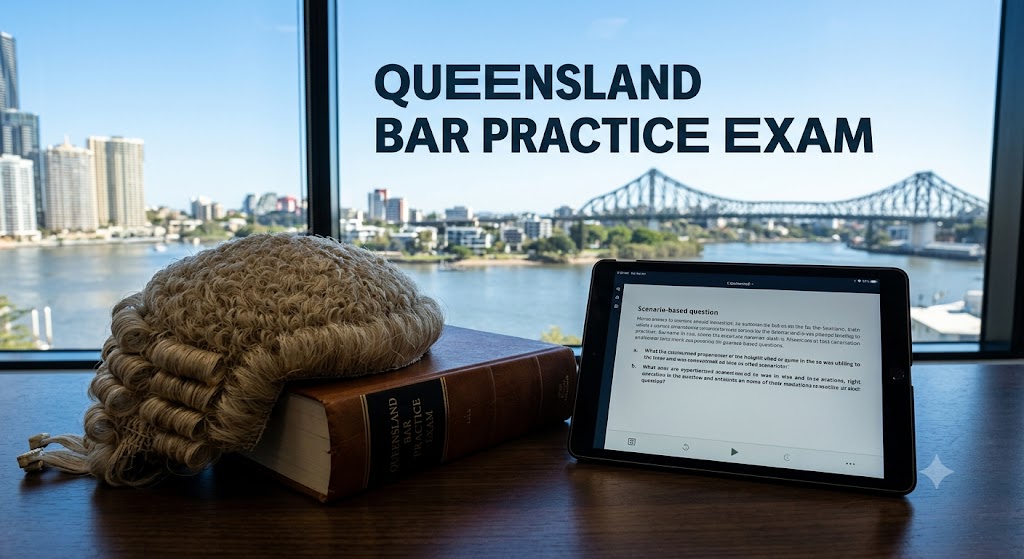
Additional Information
What the Course Entails and Exam Details
The syllabus for the Queensland Bar Examination is extensive, demanding a deep and practical understanding of three core pillars: Legal Ethics, Practice and Procedure, and Evidence.
For Legal Ethics, candidates must thoroughly understand the Barristers' Conduct Rules, focusing on the paramount duty to the court, client confidentiality, and conflict of interest resolution.
The Practice and Procedure segment delves heavily into the Uniform Civil Procedure Rules (UCPR) and the Criminal Code, testing a candidate's ability to navigate complex jurisdictional issues, pleadings, and the mechanics of civil and criminal trials.
The Evidence component requires a masterful command of the Evidence Act 1977 (Qld) and the common law principles governing the admissibility of evidence, hearsay, privilege, and the examination of witnesses.
Candidates are not simply tested on rote memorization but rather on their ability to apply these intricate legal frameworks to complex, real-world factual scenarios.
Mastering these subjects ensures that the candidate is fully prepared to handle the spontaneous and high-pressure environment of courtroom advocacy.
What to Expect in the Final Exam
The final Queensland Bar Examination traditionally consists of three separate papers, each dedicated to one of the core syllabus topics mentioned above.
Candidates should expect a grueling format consisting primarily of complex, multi-issue problem questions and short-answer scenarios that mimic actual legal briefs.
Each paper is strictly timed, typically allowing between two to three hours for completion, which places a significant premium on quick legal reasoning and concise, accurate writing.
The passing score requirement is notoriously high; candidates must generally achieve a mark of 75% or higher in each individual paper to successfully pass and progress to the Bar Practice Course.
Calculators and unauthorized electronic devices are strictly prohibited, though the exam is often "open book" to a limited extent, allowing candidates to bring in specific, unmarked or lightly annotated pieces of primary legislation.
Due to the unforgiving nature of the grading scale, precision in legal citation and logical structure is just as critical as reaching the correct legal conclusion.
How to Study and Exam Centers
Effective preparation for this high-stakes exam requires a strategic, disciplined approach that spans several months of dedicated study.
Candidates should focus heavily on actively working through past papers and practice exams under strictly timed, simulated exam conditions to build stamina and time management skills.
Forming study groups with fellow candidates can be incredibly beneficial for debating complex ethical dilemmas and discussing the nuances of evidentiary rules.
It is crucial to heavily tab and familiarize yourself with the authorized legislative materials you are permitted to take into the exam room, ensuring you can locate crucial subsections within seconds.
The official examinations are exclusively administered by the Bar Association of Queensland (BAQ).
Testing usually takes place at designated, physically proctored venues in Brisbane, such as universities or conference centers hired specifically by the BAQ for the exam period.
Candidates must monitor the official Bar Association of Queensland website closely for registration deadlines, exact venue announcements, and any updates to the rules regarding remote or online testing alternatives.
Job Opportunities from the Course
Successfully passing the exam and completing the subsequent Bar Practice Course unlocks the highly respected career path of an independent advocate.
Barrister: The most direct path, working as an independent advocate in private practice, representing clients in civil, criminal, or family courts.
Crown Prosecutor: Working directly for the state or federal Director of Public Prosecutions (DPP), handling complex criminal trials on behalf of the Crown.
In-House Counsel Advocate: Serving within a large corporation or government agency, providing specialized litigation strategy and acting as lead counsel in internal disputes.
Public Defender: Representing legally aided clients in serious criminal matters, ensuring fair trials for marginalized individuals.
Magistrate or Judge: While a long-term career goal, successful practice at the Bar is the primary stepping stone for future appointments to the judiciary.
Specialist Mediator or Arbitrator: Utilizing advanced legal knowledge and negotiation skills to resolve high-stakes disputes outside of the traditional courtroom setting.
Frequently Asked Questions
Reviews
5.0
Based on 0 reviews
Leave a Review
No reviews yet. Be the first to review!