
RAC Global Scope (RAC-GS) Practice Test
$69.00
- Buy to unlock unlimited access to all Quiz questions and Answers in this Quiz.
- After purchase you can print a PDF of the whole quiz at any point. The PDF will contain the questions and the correct answers.
About this Exam
The Regulatory Affairs Certification (RAC) is the leading credential for regulatory professionals in the healthcare product sector, and the specialized RAC Global (formerly known as RAC-GS, or Global Scope) exam represents a milestone for those aiming to demonstrate comprehensive knowledge.
This certification is designed for mid-level professionals, typically with 3-5 years of experience, who work with healthcare products across multiple regions, including medical devices, IVDs, pharmaceuticals, medicinal products, and biologics. The exam assesses critical thinking and the application of regulatory knowledge throughout the product lifecycle on a global scale.
Ready to test your knowledge?
Buy Now to Access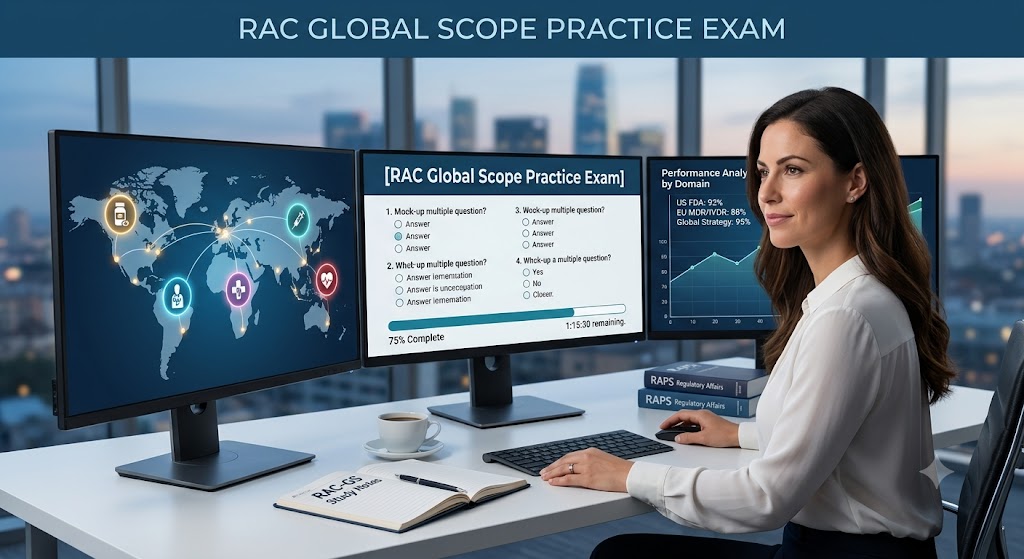
Additional Information
What the Course Entails and Exam Details
Preparing for the RAC Global exam involves mastering a vast and interconnected ecosystem of international regulations and standards. The practice test helps you refine your understanding of core competencies, which include:
Global Regulatory Frameworks: An in-depth understanding of the major regulatory bodies, such as the US FDA and European Medicines Agency (EMA), and their respective processes for product approval and post-market surveillance.
International Standards and Guidelines: Application of guidelines from organizations like the International Council for Harmonisation (ICH), the Global Harmonization Task Force (GHTF, now IMDRF), the World Health Organization (WHO), and the International Organization for Standardization (ISO).
Product Lifecycle Management: Managing regulatory activities from the earliest stages of development, through clinical trials, to registration, and extending into post-market compliance and lifecycle changes.
Cross-Functional Strategy: Development of integrated regulatory strategies that balance commercial goals with compliance across different jurisdictions.
The current exam structure, updated for accuracy, typically divides focus between: US FDA regulations (~30%), European regulations and guidances (~30%), and Global regulatory practice (~40%).
What to Expect in the Final Exam
The actual RAC Global certification exam is a computer-based test delivered in a proctored environment. It is rigorous, and the practice test is your simulation for success. Here is a breakdown of the official exam format:
Format: 100 multiple-choice questions, which can include scenario-based problems and call for analysis and decision-making, not just factual recall.
Time Limit: 2 hours (120 minutes), demanding efficient time management. You must balance speed with accuracy.
Scoring: The exam results are reported on a scaled score of 0-99, with 75 being the passing score. The passing rate is historically between 40-50%, emphasizing the value of thorough preparation.
Rules: Standard testing protocols apply, including the use of authorized test centers and a prohibition on any non-approved materials.
How to Study and Exam Centers
Effective preparation for the RAC Global is an investment of 3-4 months. The most successful approach is a multi-modal strategy:
Baseline Assessment: Start by taking an initial diagnostic RAC Global Scope Practice Test. This will reveal your current knowledge gaps and help you create a targeted study plan.
Official Study Materials: The Regulatory Affairs Professionals Society (RAPS) offers the 'Fundamentals of Regulatory Affairs' books, specialized toolboxes with practice assessments, flashcards, and e-learning courses organized by domain. These are essential resources.
Review Source Documents: Do not rely solely on summaries. Study the actual regulations (e.g., EU MDR/IVDR, 21 CFR) and guidance documents from the major bodies.
Simulate the Exam: In the final weeks, take multiple full-length practice tests under real exam conditions (timed and without interruptions) to build mental stamina.
Exam Centers and Registration:The RAC Global exam is administered through Pearson VUE. You can register on the RAPS website, and then schedule your appointment at any of Pearson's thousands of physical testing centers worldwide. Online proctored testing, allowing you to take the exam from a secure remote location, is also an option.
Job Opportunities from the Course
A RAC Global certification is a potent career accelerant, opening doors to advanced roles and higher earning potential in a range of industries, including pharmaceutical companies, medical device manufacturers, biotechnology firms, consultancies, and regulatory agencies themselves.
Typical job titles unlocked or advanced by this certification include:
Regulatory Affairs Specialist / Senior Specialist
Regulatory Affairs Manager / Senior Manager
Regulatory Affairs Associate / Senior Associate
Director of Regulatory Affairs
Vice President of Regulatory Affairs
Global Regulatory Lead
Regulatory Consultant
Head of Quality & Regulatory Affairs
Frequently Asked Questions
Reviews
5.0
Based on 0 reviews
Leave a Review
No reviews yet. Be the first to review!