
Radar/Lidar Recertification Practice Exam
$69.00
- Buy to unlock unlimited access to all Quiz questions and Answers in this Quiz.
- After purchase you can print a PDF of the whole quiz at any point. The PDF will contain the questions and the correct answers.
About this Exam
The Radar Lidar Recertification is a mandatory assessment process designed for experienced public safety professionals, primarily law enforcement officers, who operate speed measurement systems. This program ensures that operators maintain high proficiency in the technical principles, operational procedures, and legal requirements surrounding both Radio Detection and Ranging (RADAR) and Light Detection and Ranging (LIDAR) technologies. It verifies that officers can accurately and effectively utilize these speed enforcement tools, ensuring public safety on the roadways and legal defensibility of the evidence they collect.
Ready to test your knowledge?
Buy Now to Access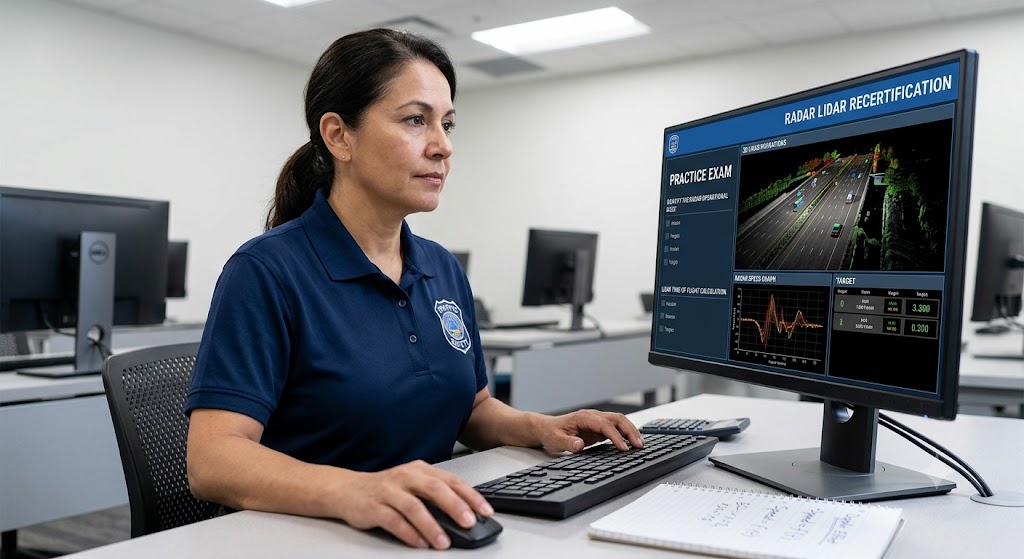
Additional Information
What the Course Entails and Exam Details
The recertification process typically involves a refresher course or self-study component followed by a comprehensive final exam. The curriculum covers the essential knowledge required for ongoing operational competence. Key topics include:
Advanced Principles of Radar: Understanding the Doppler Effect, stationary vs. moving radar operations, and cosine error.
Advanced Principles of Lidar: Reviewing time-of-flight technology, beam divergence, and specific operational techniques.
Equipment Calibration and Testing: Mandatory procedures for checking device accuracy (tuning forks, self-tests).
Case Law and Legal Admissibility: Reviewing critical legal precedents regarding speed measurement evidence in court.
Operational Procedures and Environment: Best practices for setup, tracking history, and identifying targets in challenging environments (multiple vehicles, weather).
Recent Technological Updates: Familiarization with new features or regulations relevant to current speed measurement equipment.
What to Expect in the Final Exam
The recertification exam is designed to be rigorous but fair, ensuring that only qualified operators are validated. While exact formats vary by jurisdiction and certifying body, students can generally expect:
Format: A multiple-choice, computer-based examination. It usually consists of 50 to 100 questions.
Time Limit: The exam is timed, typically providing 60 to 90 minutes to complete all sections.
Passing Score: A high passing threshold is mandatory, often set at 80% or 90%, reflecting the critical nature of accurate speed enforcement.
Rules: Proctored environment (either physical or secure remote), closed-book, with strict verification of government-issued identification required. Candidates may sometimes be permitted to use basic, non-programmable calculators.
How to Study and Exam Centers
Preparation is key to succeeding on the recertification exam, as it validates operational authority. Actionable study strategies include:
Review Official Manuals: Thoroughly study the operating manuals for the specific Radar and Lidar units you use on duty.
Complete Refresher Courses: Participate fully in any mandatory training refreshers offered by your department or state public safety academy.
Utilize Practice Exams: The most effective method for identifying knowledge gaps is taking comprehensive [Radar/Lidar Recertification Practice Exams] that simulate the real testing experience.
Focus on Weaknesses: Use practice test results to pinpoint areas where your technical understanding, procedural knowledge, or legal understanding is weakest, then double down on studying those concepts.
The recertification exam is delivered through several channels:
Departmental Portals: Many large law enforcement agencies administer the recertification process internally through secure online learning management systems.
State POST Academies: Certification is often centralized through state Peace Officer Standards and Training (POST) or equivalent public safety training centers.
Authorized Vendor Centers: Some jurisdictions partner with specific authorized vendors (e.g., equipment manufacturers or specialized training schools) or use secure testing delivery partners like Pearson VUE to offer proctored testing at numerous physical locations.
Job Opportunities from the Course
Maintaining an active Radar/Lidar certification is not optional; it is a critical required qualification for most roles involved in traffic safety and patrol operations. Successfully completing the recertification unlocks and secures ongoing employment in several key career paths:
Police Officer (Patrol/Traffic Division)
State Trooper / Highway Patrol Officer
Sheriff's Deputy
Commercial Vehicle Enforcement Officer
Traffic Safety Specialist
Accident Reconstructionist (requires further specialization, but certification is a foundation)
Frequently Asked Questions
Reviews
5.0
Based on 0 reviews
Leave a Review
No reviews yet. Be the first to review!