
Radar/Lidar Speed Detection Course Practice Test
$69.00
- Buy to unlock unlimited access to all Quiz questions and Answers in this Quiz.
- After purchase you can print a PDF of the whole quiz at any point. The PDF will contain the questions and the correct answers.
About this Exam
Welcome to your essential practice resource for the Radar/Lidar Speed Detection Course exam! This certification is a cornerstone of professional training for law enforcement officers, traffic unit personnel, and state troopers dedicated to traffic safety and the accurate measurement of vehicle speed.
The Radar and Lidar devices, when operated correctly, are highly reliable tools. This practice test is specifically designed to help you prepare for the formal examination that unlocks this critical proficiency, ensuring you can confidently and legally enforce speed limits and testify effectively in court. Whether you're a new officer or seeking to enhance your skillset, mastering these concepts is paramount.
Ready to test your knowledge?
Buy Now to Access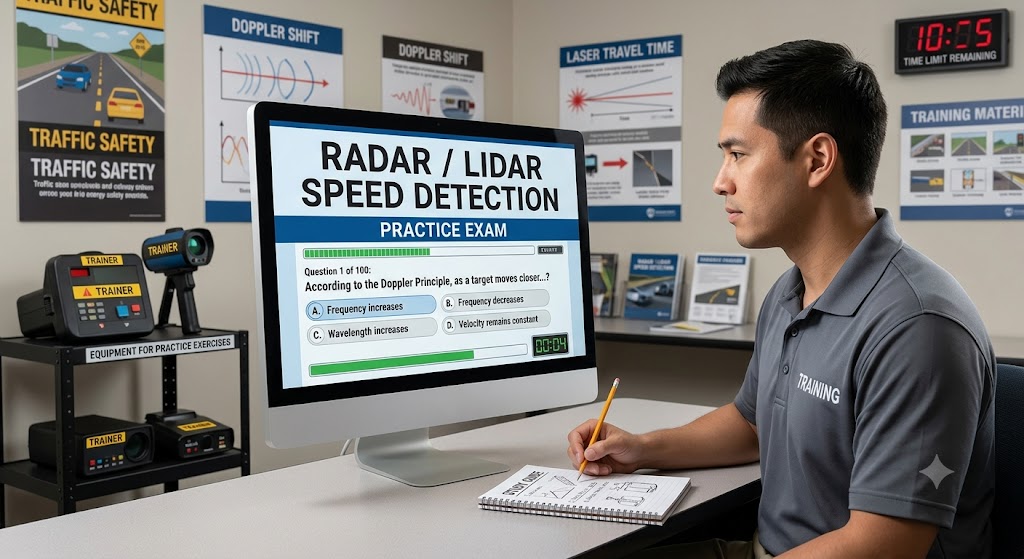
Additional Information
What the Course Entails and Exam Details
This specialized course provides in-depth training on the technology and legal aspects of speed detection. The knowledge you gain and the skills you practice include:
Doppler Radar Principles: Understanding the fundamentals of how radar devices work, including frequency shifts and target identification.
Laser Lidar Technology: Learning the principles of pulse-based measurement and target discrimination.
Equipment Operation & Calibration: Proficiency in setting up, testing, and verifying the accuracy of both radar and lidar units used by your agency.
Visual Estimation: Developing and demonstrating the ability to accurately visually estimate vehicle speeds before using technology for confirmation.
Tracking History: Master the steps to properly document and present the visual history and tracking that support a speed measurement.
Legal Standards & Case Law: Deep dives into the laws and court rulings (State and National) that govern speed enforcement and device usage.
Courtroom Testimony: Crucial practice on how to present clear, accurate, and professional testimony in court regarding your observations and measurements.
What to Expect in the Final Exam
The actual final certification exam is a comprehensive assessment of both your theoretical knowledge and your ability to apply these concepts in scenario-based situations.
Format: You can expect a predominantly multiple-choice format, designed to test your understanding of technical principles, legal requirements, equipment procedures, and scenario analysis. It will likely cover all topics included in your course.
Scenario Questions: Expect questions that require you to interpret data, apply rules, and make decisions based on specific scenarios related to speed enforcement.
Passing Score: While specific passing scores can vary slightly by department or certifying body, aim for a high level of proficiency, with typical requirements around 80% to 90% or above. Check with your specific training authority.
Time Limit: There will typically be a time limit for the written portion of the exam. This practice material is designed to help you build confidence and work efficiently.
Rules: The final exam will have strict rules, such as being a closed-book test, often administered under supervision. No unauthorized aids or electronic devices will be allowed. The integrity of this test is essential to the value of the certification. Note: Practical, hands-on testing and field proficiency are often separate components of the full certification process.
How to Study and Exam Centers
Preparation is key to succeeding in your Radar/Lidar Speed Detection Course. Here are actionable study strategies and information on where you may be able to take the exam:
Manuals and Study Guides: Thoroughly review the course materials, instructor notes, and any official handbooks provided.
Online Modules & Simulations: Utilize any online training, video demonstrations, and interactive simulations.
Hands-on Practice: Spend as much time as possible practicing setting up, testing, and operating the actual devices you will use on duty, adhering to safety protocols. Practicing visual estimation with feedback is also highly valuable.
Practice Tests: This is a fantastic step! Actively taking and reviewing practice questions helps identify your strengths and weaknesses. Focus on understanding the logic behind correct answers, not just memorizing. Repeat this process for different concepts.
Form Study Groups: Collaborating with colleagues to review scenarios and quiz each other can deepen understanding.
Where to Take the Exam
Department Training Academies: For many law enforcement officers, the primary location for course instruction and the exam is within their department's training academy or a regional public safety training facility.
Authorized Training Centers: Specialized schools or certified training providers may be authorized to deliver this training and administer the exam on behalf of state or agency bodies.
Department-Specific Facilities: Some smaller departments or specialized units may arrange for testing in dedicated in-house facilities or departmental meeting rooms, with approved instructors.
Online Portals: While hands-on elements require physical presence, some theoretical portions or practice materials might be offered via online platforms. The final formal written test is almost always in person and supervised.
Job Opportunities from the Course
A certification in Radar/Lidar Speed Detection is a valuable credential that enhances your career path and unlocks specialized roles. Specific job titles and career opportunities includes:
Police Officer
State Trooper / Highway Patrol Officer
Traffic Unit Officer / Traffic Enforcer
Special Operations Officer (where speed management is crucial)
Training Instructor (after gaining significant experience and relevant instructor certifications)
Some related private sector roles might include specialized security or traffic safety consultation, though law enforcement roles are the direct applications of this specific operational certification.
Frequently Asked Questions
Reviews
5.0
Based on 0 reviews
Leave a Review
No reviews yet. Be the first to review!