
Radar SEP Practice Test
$69.00
- Buy to unlock unlimited access to all Quiz questions and Answers in this Quiz.
- After purchase you can print a PDF of the whole quiz at any point. The PDF will contain the questions and the correct answers.
About this Exam
The Radar SEP Practice Test is an invaluable tool designed specifically for maritime professionals preparing to obtain or renew their official USCG Radar Observer Endorsement. This practice exam is the component of your study that bridges the gap between learning theory and demonstrating the mandatory competence required to serve as a deck officer or in a role responsible for navigating a vessel. A Radar Observer endorsement is not just a regulatory requirement; it is a critical safety credential, ensuring that mariners can effectively use radar to prevent collisions and navigate safely, even in restricted visibility. The practice test is ideal for aspiring deck officers, tugboat captains, pilots, and experienced mariners who must recertify, providing a simulated environment to test their skills in target tracking, threat assessment, and relative motion plotting. By identifying strengths and weaknesses through a series of practical scenarios, this practice test ensures you approach the final, high-stakes USCG assessment with confidence and proficiency.
Ready to test your knowledge?
Buy Now to Access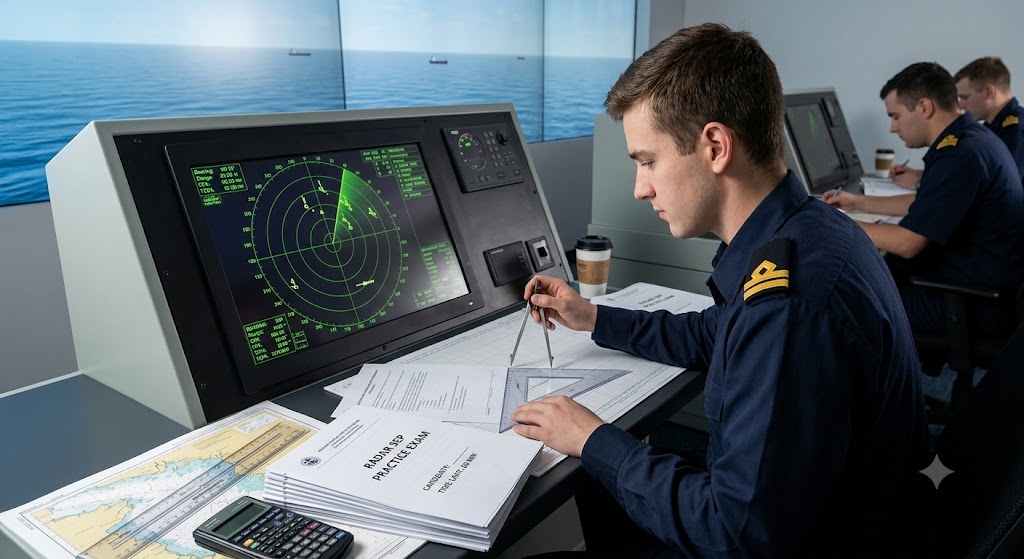
Additional Information
What the Course Entails and Exam Details
This comprehensive Radar SEP practice exam mirrors the structure and content of a standard multi-day USCG-approved Radar Observer Unlimited course. It focuses heavily on practical application, testing your ability to process information provided by the radar display and translate it into actionable navigational decisions. The core curriculum and exam modules cover three main areas:
Theory and Operations: Expect questions that test your understanding of radar fundamentals, including basic principles, common controls, display modes (e.g., Head-Up, North-Up), and crucial equipment limitations such as blind spots, sea clutter, and bearing/range resolution.
Rules of the Road (COLREGs): This section is critical. It evaluates your knowledge of specific regulations, particularly those within the International Regulations for Preventing Collisions at Sea (COLREGs) that dictate safe speed, risk of collision, and the responsibilities of vessels using radar, including navigating in restricted visibility.
Practical Radar Plotting: This is the heart of the Radar SEP test. It requires you to solve multiple-target scenarios, typically involving two moving vessels and your 'own ship'. You must demonstrate mastery of manual plotting techniques, including generating the relative motion line (RML), determining the Closest Point of Approach (CPA), Time to CPA (TCPA), and calculating the true course and true speed of all targets.
What to Expect in the Final Exam
When you move from the Radar SEP practice phase to your final USCG-approved assessment, you should expect a demanding evaluation. While specific details can vary by training provider, the standard process typically involves several components:
Multiple Written Examinations: You must pass distinct written tests. These usually include a dedicated section on Radar Theory and a high-stakes section on the application of the COLREGs (Collision Regulations). To successfully pass, you typically need to achieve a score of at least 70% in Theory and often 90% in the Rules of the Road section.
Practical Assessment: This is the most crucial part. You will be required to demonstrate your practical competency in solving relative motion problems. This often involves using a radar simulator or transfer plotting. You must successfully solve two or more scenarios, which include plotting multiple targets, calculating all key parameters (CPA, TCPA, True Course/Speed), and identifying appropriate navigational actions according to COLREGs.
Scoring and Rules: The passing score for the practical portion is typically very high, often 90% or more on each scenario, because failure to accurately solve a relative motion problem directly impacts vessel safety. The entire evaluation is typically proctored and may have strict time limits for completing the plotting exercises, emphasizing speed and accuracy under pressure. You are allowed required tools like dividers, parallel rulers, a nautical calculator, and the Rules of the Road handbook.
How to Study and Exam Centers
Preparation is paramount for success, and the Radar SEP practice exam is your best resource. Start by building a solid foundation. If your training provider offers an online simulator or workbook, use it extensively. Focus intensely on mastering the 'first triangle'—the core of every manual plotting solution. Practice solving for own ship's vectors (ER and EM) and target ship vectors, consistently calculating the relative course and speed. A good study technique is to re-solve previous scenarios until you can complete them accurately and within the time limit. Become proficient with your standard tools, including dividers, parallel rulers, triangles, and a suitable scientific calculator. Remember that while the Radar SEP Practice Test can be taken online, the final official assessment to receive your USCG endorsement must be conducted at a Coast Guard-approved maritime training center. This ensures that the practical simulator exams and written tests are properly proctored and meet the USCG’s strict standard of competence. These centers are located nationwide and include specialized maritime academies, commercial schools, and specific union training facilities.
Job Opportunities from the Course
A valid USCG Radar Observer Endorsement, once obtained, is not a standalone qualification but a critical component required to unlock many professional mariner credentials. Achieving competency through a Radar SEP Practice Exam and completing the final course opens the door to a wide array of specialized career paths on vessels that are legally required to be equipped with radar:
Merchant Mariner (Unlimited Tonnage) - Master
Merchant Mariner (Unlimited Tonnage) - Chief Mate
Merchant Mariner (Unlimited Tonnage) - Second Mate
Merchant Mariner (Unlimited Tonnage) - Third Mate
Officer in Charge of a Navigational Watch (OICNW)
Mate or Master of Towing Vessels (Tugboat Captain)
Ship Pilot
Master or Mate (Inland or River Vessels)
Charter Boat Captain (Over 200 GRT or for Towing)
Dynamic Positioning (DP) Operator
Frequently Asked Questions
Reviews
5.0
Based on 0 reviews
Leave a Review
No reviews yet. Be the first to review!