
Radiation State Card Practice Exam
$69.00
- Buy to unlock unlimited access to all Quiz questions and Answers in this Quiz.
- After purchase you can print a PDF of the whole quiz at any point. The PDF will contain the questions and the correct answers.
About this Exam
The Radiation State Card is a critical licensure document required for professionals who operate ionizing radiation-producing machines or handle radioactive materials within a specific jurisdiction. This state-mandated certification is designed to ensure that personnel—such as radiologic technologists, dental hygienists, industrial radiographers, and radiation safety officers—possess the necessary knowledge and skills to operate equipment safely, minimize exposure to patients and the public, and adhere to strict state and federal regulations. Passing this exam is often the final step in obtaining legal authorization to work in your chosen field.
Ready to test your knowledge?
Buy Now to Access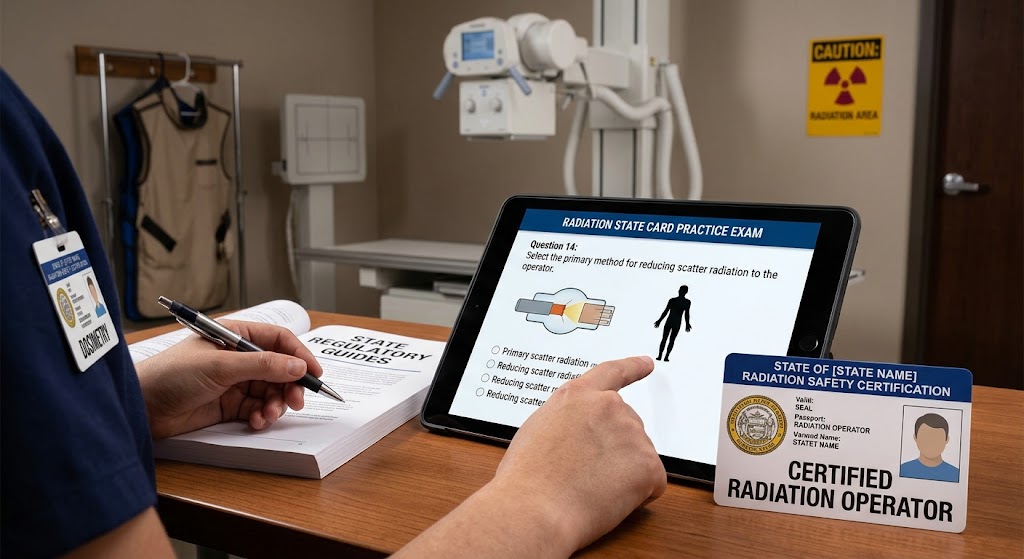
Additional Information
What the Course Entails and Exam Details
To qualify for the exam, candidates typically must complete a state-approved education program. The core syllabus of such a course covers:
Fundamentals of Radiation Physics: Understanding the nature of ionizing radiation, how it interacts with matter, and the principles of X-ray production.
Radiation Biological Effects: The risks associated with exposure, cellular damage mechanisms, and the difference between somatic and genetic effects.
Radiation Safety and Protection: Implementing ALARA (As Low As Reasonably Achievable) principles, shielding requirements, and time/distance optimization.
Regulations and Compliance: In-depth study of specific state regulatory codes, federal requirements (e.g., from the NRC or FDA), reporting procedures, and licensing guidelines.
Instrumentation and Measurement: The use and calibration of dosimeters, survey meters, and other radiation detection equipment.
What to Expect in the Final Exam
The final State Radiation Card exam is a rigorous test of competency. While individual state formats vary, you should expect the following general structure:
Format: The exam is predominantly comprised of multiple-choice questions, though some states include short answers, drag-and-drop sequencing, or calculation problems related to shielding and dose limits.
Content Weighting: The largest sections are typically dedicated to safe operating procedures, state regulations, and radiation protection principles.
Passing Score: Most states require a minimum passing score of 70% to 75%.
Time Limit: You will usually be given 2 to 3 hours to complete the exam.
Rules: Exams are typically proctored, closed-book, and require valid government identification. The use of programmable calculators is often restricted.
How to Study and Exam Centers
Preparation is the key to success. Utilize these strategies to build confidence:
Leverage Official Resources: Download and study the current state regulations and the official candidate handbook provided by your state's health department or environmental protection agency.
Complete the Practice Exam: Take full-length practice tests under timed conditions to simulate the real environment and identify your weak points.
Hands-on Review: Revisit the physical instruments you learned to use, practicing calibration checks and survey techniques.
Join Study Groups: Discuss complex concepts, especially biological effects and regulations, with peers.
Exam Centers:
You cannot take this final exam at home. You must register to take it at an authorized facility. These locations include:
State Regulatory Agencies: Many state health or environmental departments administer the exam directly in their own testing labs.
Authorized Testing Centers: States frequently contract with professional proctoring services, such as Pearson VUE or PSI, offering numerous locations statewide.
Accredited Schools: Some university-based or hospital-based programs are authorized to proctor the state exam for their graduates.
Job Opportunities from the Course
A State Radiation Card is a powerful credential that unlocks essential career paths in the medical, industrial, and research sectors. Key job opportunities include:
Radiologic Technologist (R.T.)
Industrial Radiographer (Level I, II, or III)
Dental Hygienist/Assistant (with Radiation Endorsement)
Radiation Safety Officer (RSO)
Nuclear Medicine Technologist
Limited X-Ray Machine Operator
Quality Control Technician (Non-Destructive Testing)
Computed Tomography (CT) Technologist
Frequently Asked Questions
Reviews
5.0
Based on 0 reviews
Leave a Review
No reviews yet. Be the first to review!