
Radio Detection And Ranging (RADAR) / Light Detection And Ranging (LIDAR) Practice Exam
$69.00
- Buy to unlock unlimited access to all Quiz questions and Answers in this Quiz.
- After purchase you can print a PDF of the whole quiz at any point. The PDF will contain the questions and the correct answers.
About this Exam
The RADAR/LIDAR Operator Certification is an essential credential for law enforcement professionals dedicated to traffic safety and speed enforcement. This course is specifically designed for police officers, state troopers, and other traffic law enforcement personnel who need to accurately operate speed measurement devices. The program ensures operators possess the necessary skills to effectively use Radio Detection and Ranging (RADAR) and Light Detection and Ranging (LIDAR) technologies. By successfully completing this exam, you demonstrate your competency in employing these tools within legal and technical standards, contributing to safer roadways through precise speed measurement.
Ready to test your knowledge?
Buy Now to Access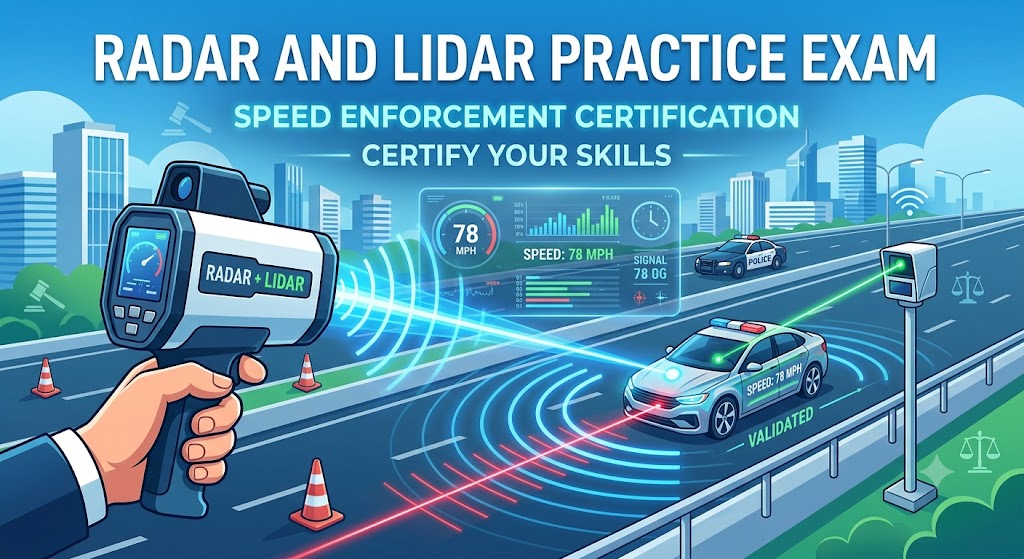
Additional Information
What the Course Entails and Exam Details
The comprehensive curriculum covers critical technical and operational aspects of both RADAR and LIDAR systems. It is structured to provide a deep understanding of scientific principles, equipment function, and practical application. Core topics included are: The history and theory of speed measurement. The Doppler principle as applied to RADAR technology. LIDAR (laser) operational theory and advantages. Equipment component identification and setup procedures. Specific unit operations for stationary and moving RADAR. LIDAR operation techniques, including target acquisition. Factors affecting accuracy and potential interference. Legal requirements, case law, and courtroom testimony. State-specific statutes and departmental policies. Hands-on practical training in various operational scenarios.
What to Expect in the Final Exam
The final certification exam typically consists of two distinct components: a written knowledge test and a practical skills evaluation.
Written Examination:
This part usually follows a multiple-choice format, assessing theoretical knowledge. You can expect to encounter questions covering all topics discussed in the course syllabus, including technical specs, legalities, and troubleshooting. Candidates must achieve a minimum passing score, often set around 80% to 90%, depending on the state or certifying agency requirements. Time limits for the written section are common, ensuring operators can make quick and accurate assessments.
Practical Evaluation:
This segment requires candidates to demonstrate proficiency in a field setting. You must successfully set up, test, and operate both RADAR and LIDAR units according to standard procedures. This evaluation may involve identifying specific targets at varying speeds and distances and correctly documenting observations. A flaw-free performance of standard operations is usually required to pass the practical component.
How to Study and Exam Centers
Preparing for this critical exam requires a structured and dedicated approach. Success hinges on mastering both technical details and practical skills.
Actionable Study Strategies:
Thorough Review of Materials:
Devote significant time to studying the provided course manual and notes. Understanding the ‘how’ and ‘why’ behind RADAR and LIDAR operation is crucial for both parts of the exam.
Take Practice Tests:
Utilize practice exams extensively. They are invaluable for familiarizing yourself with the written question format, identifying knowledge gaps, and improving time management. Consistent practice builds confidence and reinforces learning.
Focus on Legal and Technical Details:
Pay close attention to specific legal precedents and technological principles. These are often tested heavily and are essential for everyday operation.
Hands-on Practice:
Seek opportunities to practice setting up and operating the actual equipment before the final practical assessment. Repetition helps develop muscle memory and operational efficiency.
Create Study Aids:
Develop flashcards for key terms, legal cases, and operational steps. Group study sessions can also be beneficial for reviewing complex concepts.
Exam Centers:
The location and administration of the RADAR/LIDAR exam vary by jurisdiction and certifying body.
Authorized Police Academies:
Many exams are conducted within authorized police training academies as part of the initial or in-service training curriculum.
State Training Facilities:
Specific state agencies, such as the Department of Public Safety or Peace Officer Standards and Training (POST) organizations, often host certification exams at their training locations.
College or University Criminal Justice Programs:
Some institutions with certified training programs may serve as authorized testing sites.
Verification:
Always verify the specific testing requirements, locations, and schedules with your training coordinator, commanding officer, or state certifying authority well in advance of the desired exam date. Registration and prerequisite information will be available through these channels.
Job Opportunities from the Course
Earning your RADAR/LIDAR Operator Certification opens doors to several key positions within law enforcement and related fields. This credential enhances your profile for roles focused on traffic safety and operational effectiveness.
Common Job Titles:
Police Officer
State Trooper
Highway Patrol Officer
Sheriff’s Deputy
Traffic Enforcement Officer
Speed Enforcement Specialist
Traffic Safety Coordinator
Police Academy Instructor (specializing in traffic radar/lidar)
Court Liaison Officer (presenting speed evidence)
DUI/Traffic Task Force Member
Frequently Asked Questions
Reviews
5.0
Based on 0 reviews
Leave a Review
No reviews yet. Be the first to review!